A critical pressure leak during the docking maneuver of an orbital tourism module endangered the lives of several civilians. The incident, attributed to elastic deformation in the hatch's silicone seals, was caused by an extreme thermal gradient between the sunlit side (120 degrees Celsius) and the deep shadow zone (-150 degrees Celsius). This article breaks down the technical workflow used to model, simulate, and validate the failure, employing computer-aided engineering tools and optical metrology.
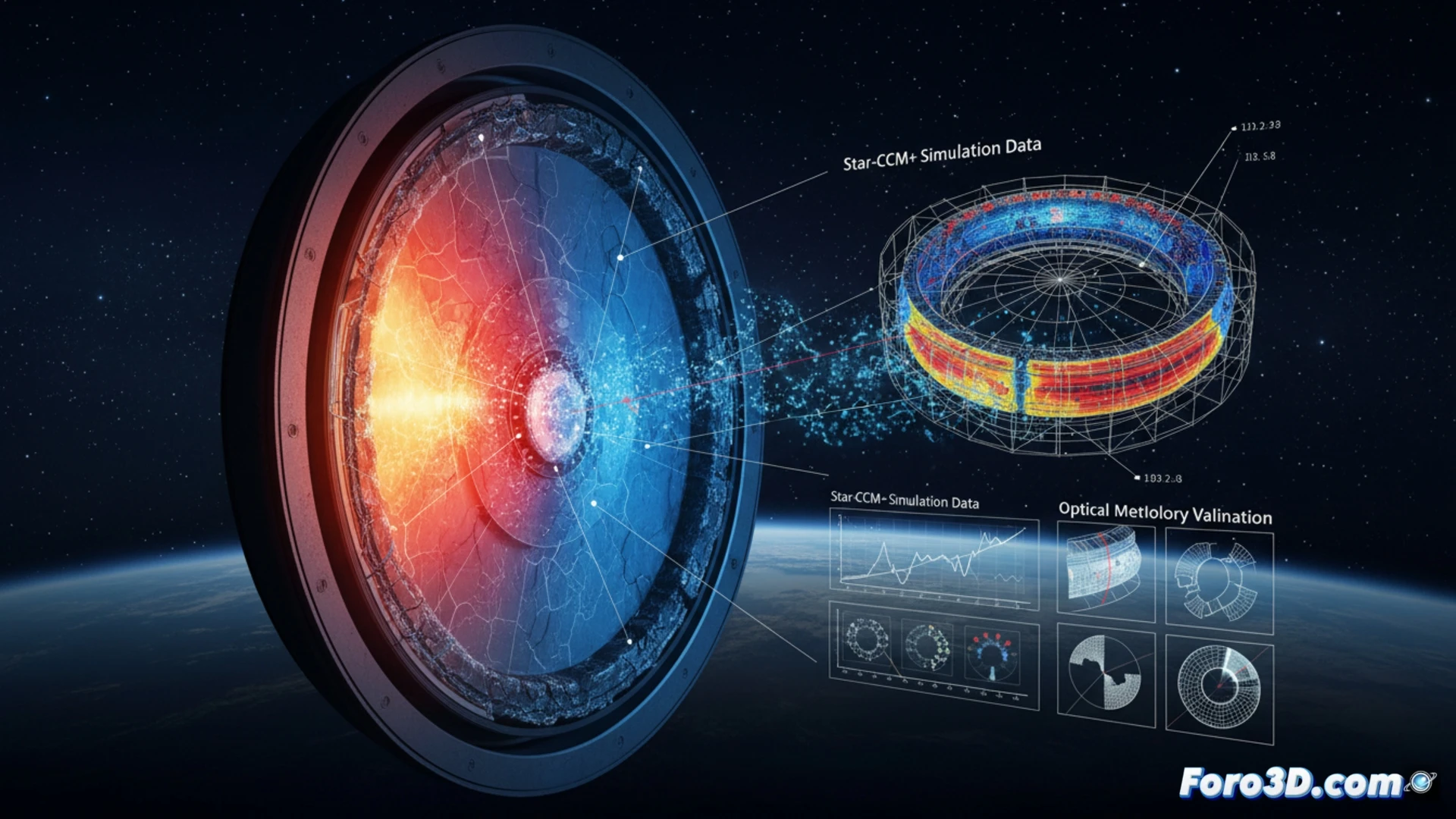
Modeling in Catia and multiphysics simulation in Star-CCM+ 🛰️
The first step involved reconstructing the silicone O-ring and its housing in Catia V5, defining a finite element mesh with nonlinear contact. Subsequently, the model was exported to Siemens Star-CCM+ to couple the radiation and conduction heat transfer simulation with the structural analysis. Surface temperature boundary conditions were applied to the external faces, recording a thermal delta of 270 Kelvin between the seal's extremes. The results showed that the differential expansion generated an elastic deformation of 0.8 millimeters in the joint's cross-section, sufficient to create a micro-channel leak. Stress-strain graphs revealed that the material operated at the upper limit of its Young's modulus, without reaching plastic yield but causing a loss of hermetic contact.
Metrological validation and lessons for orbital design 🔬
To validate the model, a seal subjected to an accelerated thermal cycle in the laboratory was scanned using a GOM Control X blue light scanner. The resulting point cloud was compared with the deformed geometry predicted by Star-CCM+, obtaining an average deviation of only 12 microns. This agreement confirmed that cyclic thermal fatigue is the primary failure mechanism. As a design recommendation, incorporating a multilayer insulator in the joint housing and switching to a silicone compound with ceramic filler to reduce the thermal expansion coefficient is suggested, ensuring leak-tightness in future crewed missions.
Is it possible to predict the exact location of the initial crack in an elastomer seal subjected to orbital thermal cycles through a finite element analysis with coupled thermo-mechanical fatigue, or does the geometric complexity of the contact prevent accurate simulation without prior physical testing?
(PS: Material fatigue is like yours after 10 hours of simulation.)