The catastrophic rupture of a methacrylate aquarium in a shopping center, which housed sharks and released millions of liters of water, has been digitally reconstructed through reverse engineering. Thanks to 3D scanning with a Leica RTC360 and finite element analysis (FEA) in Ansys Mechanical, experts identified the origin of the failure: a micro-crack generated by the use of aggressive chemicals during routine cleaning.
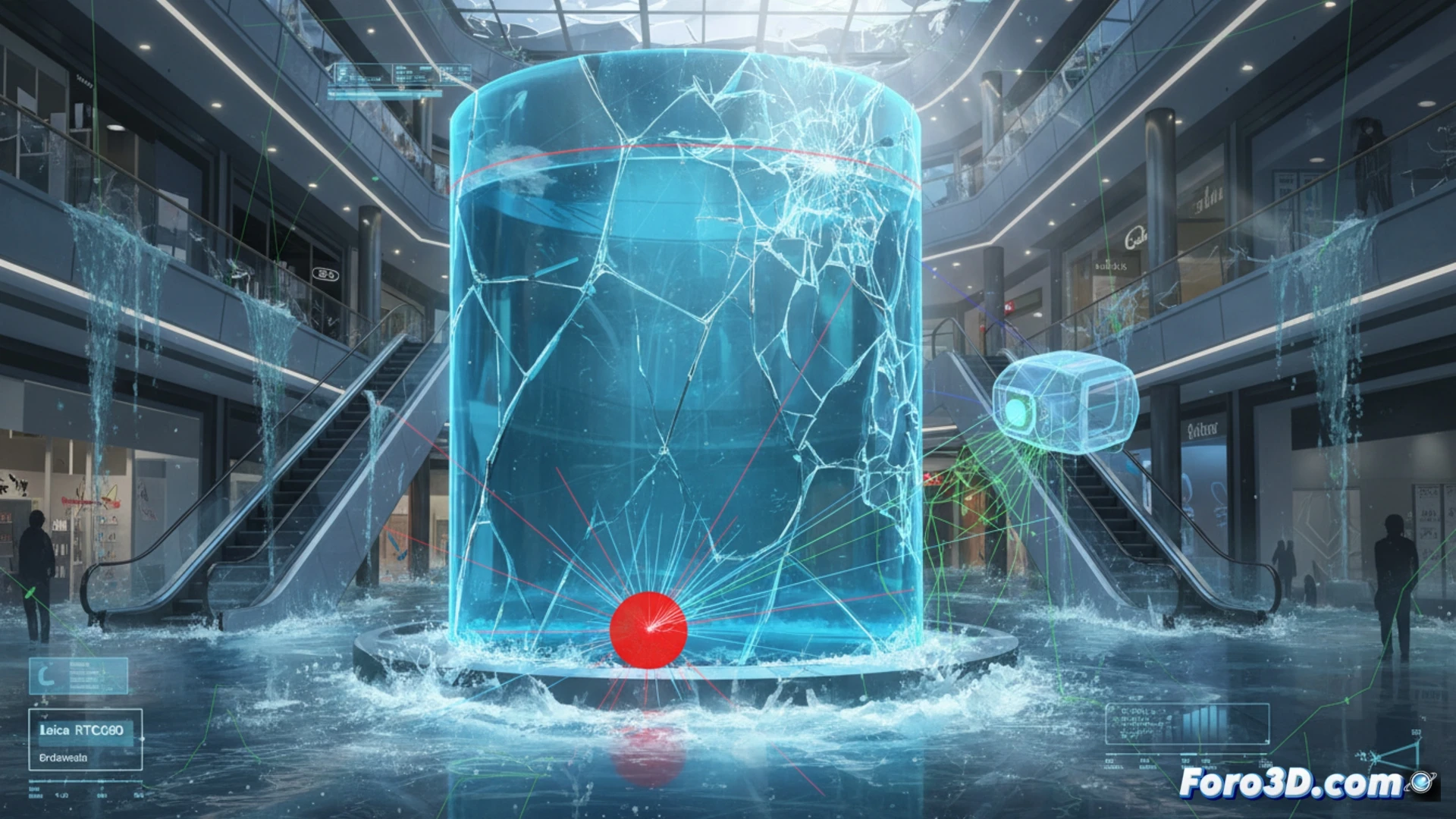
Forensic reconstruction with Leica RTC360 and Ansys FEA 🛠️
The research team scanned every fragment of the methacrylate panel and the metal support structure. The point cloud from the Leica RTC360, with millimeter precision, was imported into Ansys Mechanical to generate a finite element model. The hydrostatic simulation applied water pressure to the actual tank geometry. The FEA revealed that the surface stress in the crack area exceeded the material's yield strength by 340%, causing instantaneous propagation. The model ruled out failures in the seals or steel structure, confirming that the weakness originated from localized chemical attack.
Lessons for preventing structural disasters 📐
The visualization in Unreal Engine allowed recreating the collapse sequence from the initial crack to the hydraulic explosion, offering an educational tool for maintenance engineers. This case demonstrates that seemingly massive failures can have microscopic origins. The combination of 3D scanning, FEA simulation, and real-time rendering serves not only to determine culprits but also to redesign cleaning protocols and safety systems in large aquariums, preventing future catastrophes.
Which finite element simulation methodology allows for more accurate prediction of micro-crack propagation in methacrylate under cyclic hydrostatic loading, such as that which occurred in the collapse of the Berlin giant aquarium?
(PS: Simulating catastrophes is fun until the computer crashes and you are the catastrophe.)