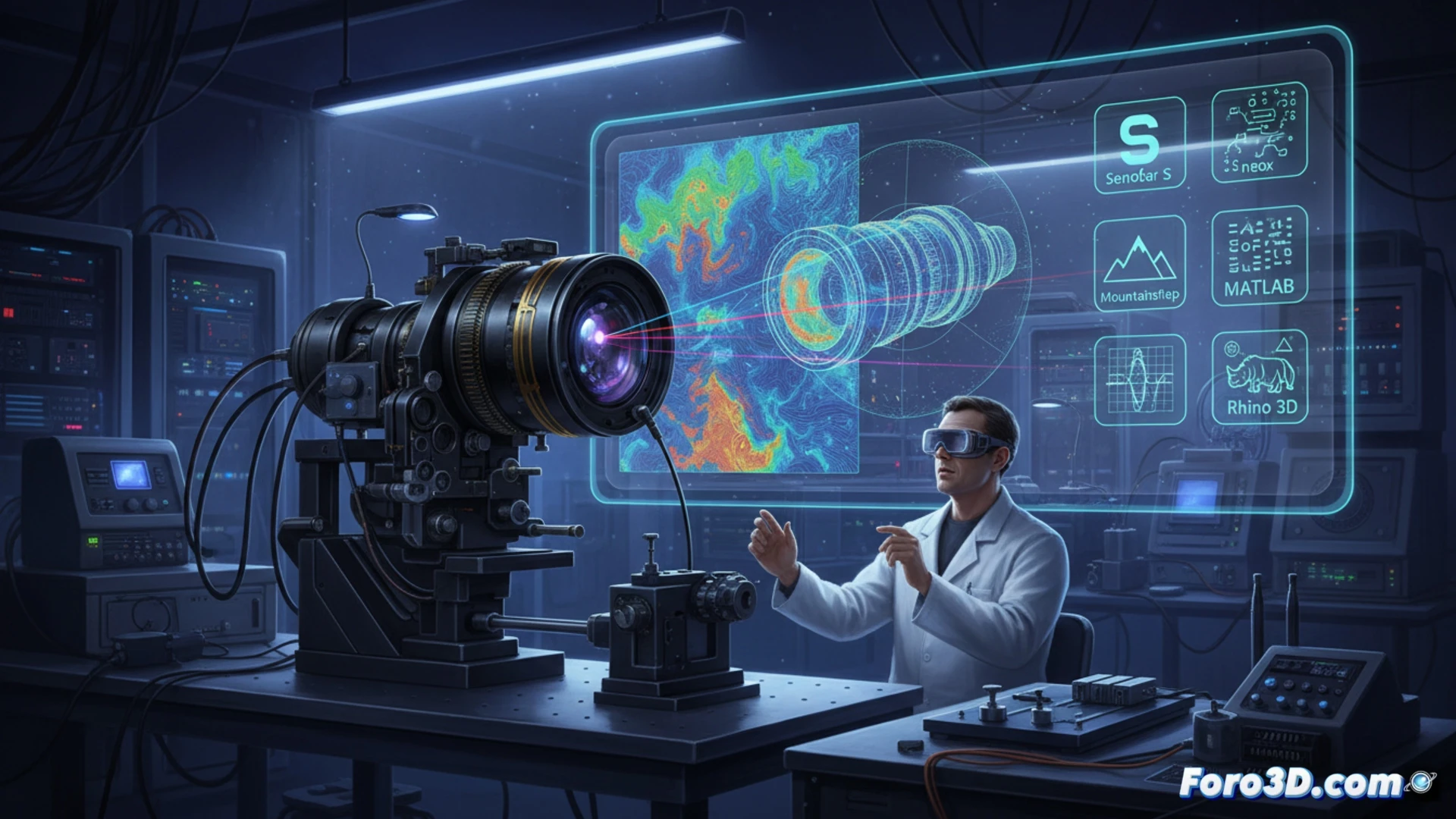
A batch of supposedly vintage cinematographic lenses from the 1970s was put up for sale for a million-dollar sum. However, a curvature and coating analysis using 3D microscopy revealed the truth: they were modern pieces artificially aged. The forensic team used the Sensofar S neox optical profilometer to capture nanometric topography, MountainsMap software to calculate roughness and wear parameters, and MATLAB to model spherical deviations. Rhino 3D allowed contrasting CAD geometries with the actual samples.
Forensic methodology: from curvature to coating 🔬
The verification process was divided into three phases. First, the optical surfaces were scanned with the Sensofar S neox, obtaining point clouds with sub-micrometric precision. Second, MountainsMap applied form filters and removed waviness to isolate the actual glass texture. Gaussian curvature maps showed polishing patterns inconsistent with the artisanal technique of the era. Third, spectral analysis of anti-reflective coatings using interferometry detected layers of synthetic materials not available in the 1970s. MATLAB processed the spectral signals, and Rhino 3D reconstructed the lens profile, demonstrating that the asphericity corresponded to a recent computational design.
Parallel with deepfake auditing 🕵️
Just as a deepfake manipulates pixels to deceive the human eye, these lenses altered matter to deceive the collector. Deepfake auditing analyzes anomalies in spatial frequency and lighting; here, MountainsMap detected irregularities in roughness frequency. The Sensofar acted as a physical metadata analyzer, revealing the real manufacturer's fingerprint. This case demonstrates that any object, digital or physical, can be authenticated through rigorous 3D analysis: curvature, coating, and topography are the new signatures of veracity in the fight against industrial and heritage fraud.
How can 3D surface analysis distinguish between the natural wear of decades of use on a vintage lens and artificial aging created with modern manufacturing techniques?
(PS: Detecting deepfakes is like playing Where's Waldo? but with suspicious pixels.)