The detection of counterfeit caviar has entered a new era thanks to 3D volumetric analysis. A recent case of food fraud has been resolved through the morphological comparison of roe, where the internal structure, captured with confocal microscopy, revealed patterns incompatible with a biological origin. This finding establishes a replicable forensic protocol for the authentication of gourmet products. 🔬
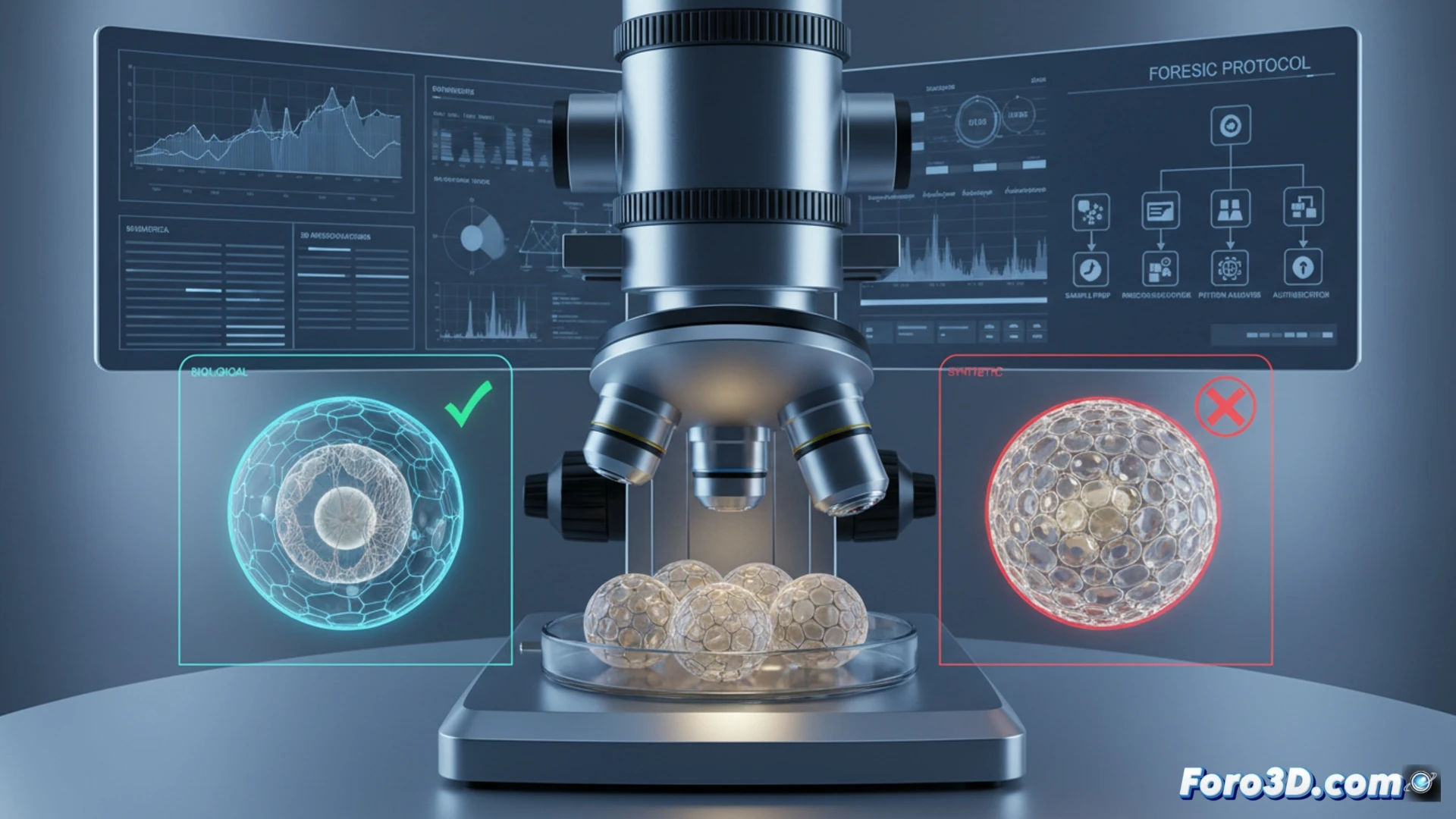
Acquisition and volumetric analysis pipeline 🧬
The workflow begins with capturing surface topographies using a Keyence VK-X 3D microscope, which generates high-resolution point clouds of each roe. This data is imported into Volume Graphics for analysis of internal porosity and sphericity. In synthetic samples, perfectly spherical internal cavities and a homogeneous density distribution were detected, a pattern impossible in biological caviar, where vitelline vesicles exhibit natural asymmetries and density gradients. Finally, MATLAB processes the extracted metrics (surface irregularity index and core-to-cortex ratio) to run an SVM classifier that separates genuine from fraudulent samples with 99.7% accuracy.
Implications for food safety 🛡️
This pipeline demonstrates that 3D morphometry is a definitive tool against fraud, surpassing traditional chemical analyses that can be circumvented with additives. The ability to document internal structure as a physical fingerprint changes the verification paradigm. For quality control laboratories, implementing this protocol means moving from suspicion to visual certainty, shielding the supply chain against increasingly sophisticated synthetic substitutes.
What specific technical challenges does the integration of a forensic 3D volumetric analysis pipeline present for distinguishing authentic roe from synthetic caviar in a recent food fraud case?
(PS: don't forget to calibrate the laser scanner before documenting the scene... or you could be modeling a ghost)