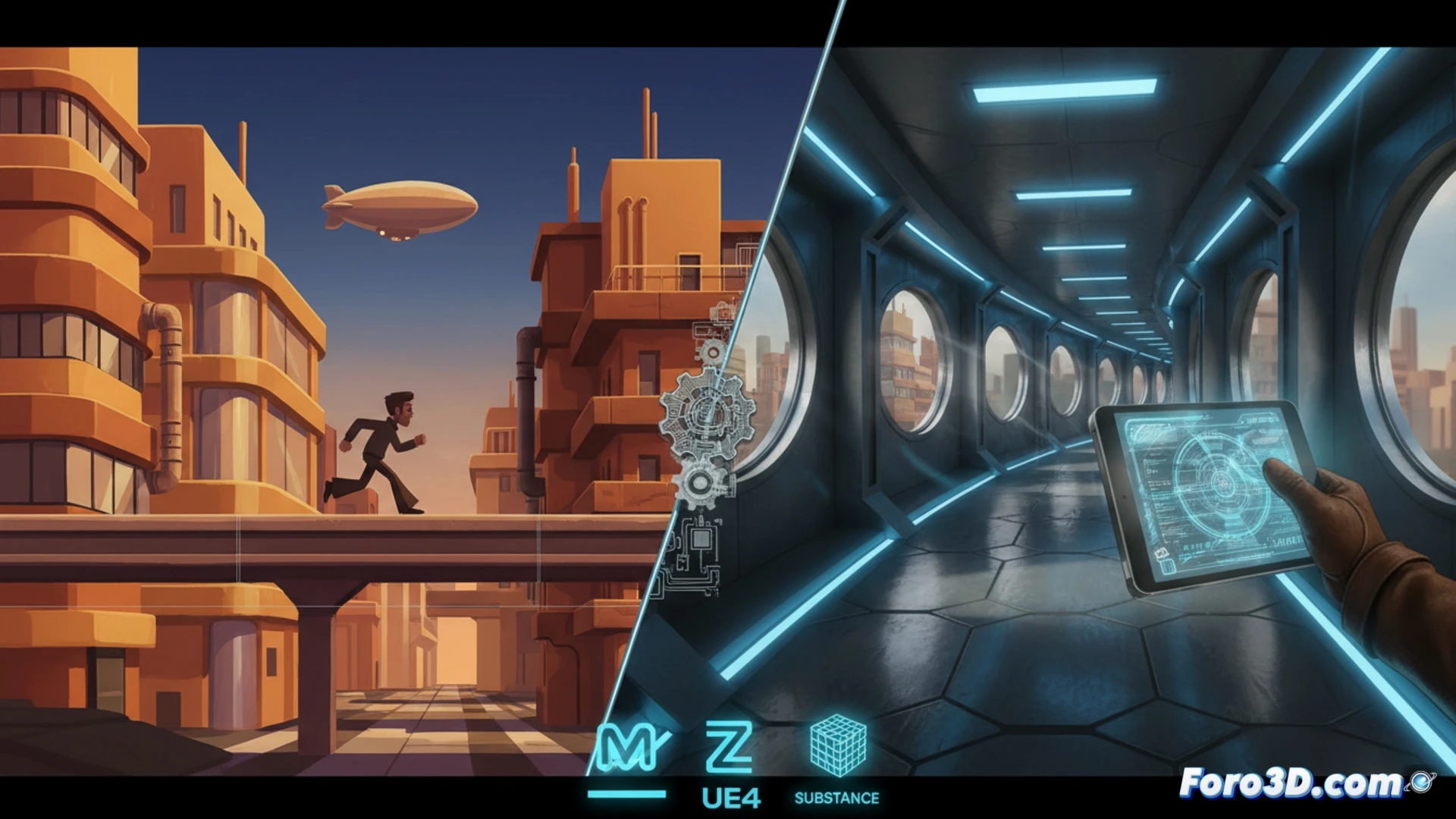
The independent studio Out of the Blue has released American Arcadia, a title that challenges visual conventions by alternating between a stylized 2.5D perspective and a photorealistic first-person view. Built on Unreal Engine 4, the game uses a pipeline combining Autodesk Maya, ZBrush, and Substance to achieve a retro-futuristic 1970s aesthetic. This technical analysis breaks down how this visual hybridization was achieved and what lessons indie developers can learn. 🎮
Production Pipeline: From ZBrush to Cinematic Lighting 🔧
The process begins in Autodesk Maya for level blocking and basic animation, while ZBrush is used to sculpt organic assets and high-density sets that are later retopologized. The key lies in Substance Painter and Designer, where smart materials are created that work both for 2.5D shots (where the camera is isometric and details are seen at scale) and for the first-person sequence, where the player gets close to objects. The biggest technical challenge in UE4 is managing LOD (Level of Detail) and shaders so that the same asset looks stylized from afar and photorealistic up close. The retro-futuristic lighting is achieved with volumetric light sources and post-processing that mimics 70s film grain, avoiding excessive bloom to maintain cohesion between both modes.
Indie Reflection: How to Unify Two Styles Without Breaking Immersion 💡
For a small studio, the risk of jumping between two graphic styles is that the player perceives a visual disconnect. American Arcadia solves this by maintaining a common color palette (oranges, acid greens, and browns) and using the same base texture set in Substance for both perspectives. The practical advice is to first design the most restrictive mode (2.5D) to establish the silhouette and gameplay readability, and then scale the details for first-person. Additionally, it is crucial to use UE4's Blueprint system for smooth camera transitions that hide the asset swap, preventing the engine from loading heavy geometry all at once.
How did Out of the Blue approach synchronizing the first-person camera with the movements of the 2.5D perspective to avoid visual mismatch and ensure a smooth transition in American Arcadia?
(PS: 90% of development time is polishing, the other 90% is fixing bugs)