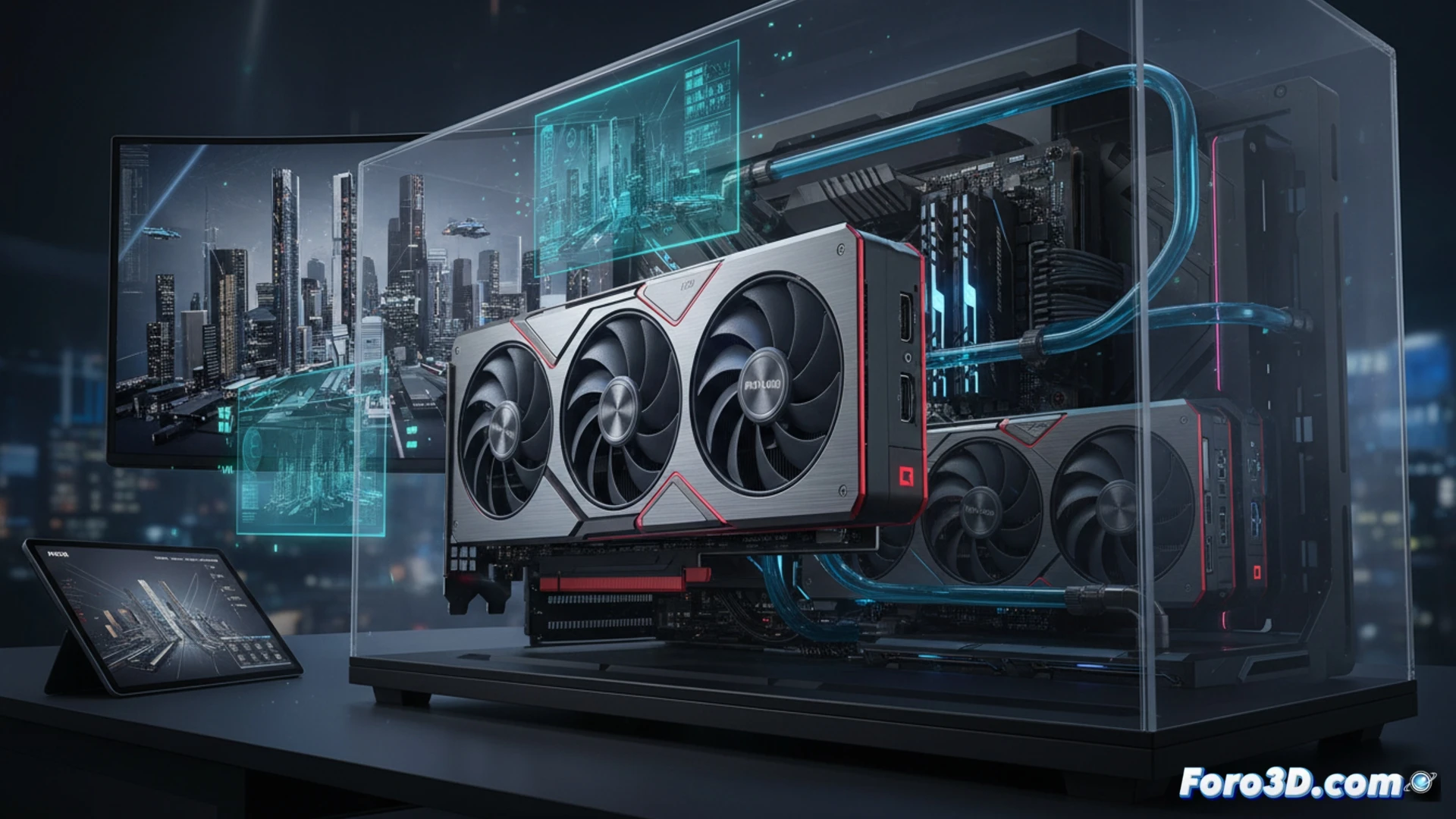
AMD has released an optimized version of its flagship professional GPU, the Radeon PRO W7900 Dual Slot, which retains 48GB of VRAM but reduces its physical footprint to just two PCIe slots. This seemingly minor design change solves the main bottleneck of workstations dedicated to massive GPU rendering: the inability to install multiple high-end graphics cards in a single chassis.
Technical Analysis: Performance and RDNA 3 Architecture 🚀
The W7900 Dual Slot retains the Navi 31 core with 96 compute units and 48GB of GDDR6 ECC memory, offering a bandwidth of 864 GB/s. Its main advantage over the original triple-slot model is the reduced form factor, allowing up to four cards to be stacked on motherboards with PCIe Gen 4.0 x16 support. In rendering benchmarks, this configuration quadruples performance in Blender Cycles (Monster test) compared to a single GPU, achieving scores of 8,500 points, surpassing an RTX 6000 Ada Generation in pure rasterization tasks. However, in engines like Redshift and V-Ray, the W7900 loses ground to NVIDIA RTX 5000 Ada in scenes with heavy AI denoising usage, due to the lack of dedicated Tensor cores.
Implications for VFX Studios and Architectural Visualization 🎨
For small architectural visualization studios working with files over 20GB in Unreal Engine or Lumion, the W7900 Dual Slot represents a more cost-effective option than a single RTX 6000 Ada. The ability to install two cards in a single system reduces the render time of a 4K frame in Cycles from 45 minutes to 12 minutes, optimizing delivery workflows. However, VFX studios relying on plugins like OctaneRender or Arnold will need to weigh the absence of AI acceleration, as in these engines NVIDIA's advantage remains significant. The final recommendation is clear: if your workflow prioritizes memory capacity and raw rasterization rendering, the W7900 Dual Slot is unbeatable. If you need intelligent denoising and technologies like DLSS, stick with the green ecosystem.
Considering that the AMD W7900 Dual Slot maintains 48GB of VRAM but in a more compact format, how does this thermal and space optimization affect sustained performance in massive renders compared to its original triple-slot version?
(PS: If your computer is smoking when you open Blender, you might need more than just a fan and faith)