Last October, a controlled road accident exposed a crack in the safety promise of smart motorcycles. The rider's airbag system did not deploy after a lateral collision at 45 km/h. The 3D reconstruction of the accident, using PC-Crash and Artec Studio, revealed that the fall detection algorithm classified the impact angle as non-critical, ignoring the actual lateral acceleration.
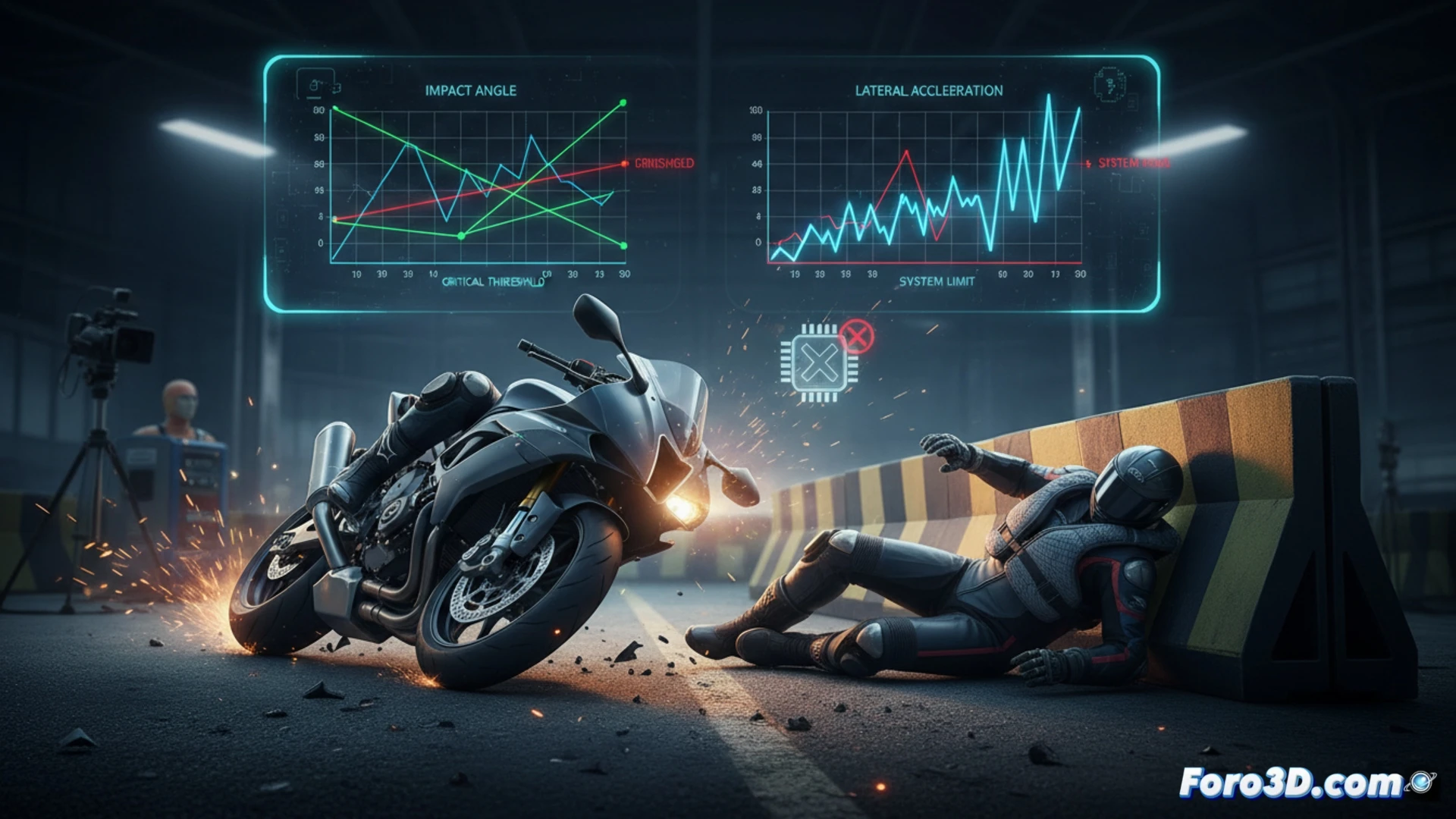
Analysis of inertial sensors and activation thresholds in MATLAB 🏍️
The data extracted from the inertial measurement unit (IMU) were processed in MATLAB to decompose the acceleration and angular velocity vectors. The simulation showed that, although the motorcycle reached a lean angle of 38 degrees on the Y-axis, the yaw rate remained within normal riding parameters. The critical error lay in the system evaluating the fall based on the magnitude of the rotation vector, instead of analyzing the instantaneous lateral acceleration and the change in the center of gravity height. In PC-Crash, the multibody recreation confirmed that the rider's torso impacted the asphalt 120 milliseconds before the algorithm reached the deployment threshold, a fatal time lag.
Lessons for redesigning ADAS systems on two wheels 🛠️
This case demonstrates that active safety systems on motorcycles cannot directly transfer algorithms from passenger cars. The kinematics of a lateral fall involve a combination of sliding and rotation that current inertial sensors, calibrated for frontal impacts or full rollovers, do not interpret correctly. The 3D simulation not only identified the flaw but also allowed proposing a new activation threshold based on the integral of lateral acceleration and the slip angle. Redesigning these algorithms is now a priority to prevent the promised technology from becoming a silent witness to the accident.
Is it possible to design a fall detection system for motorcycles that integrates inertial and pavement contact sensors, or does the solution rely exclusively on predictive algorithms based on artificial intelligence?
(PS: simulating an ECU is like programming a toaster: it seems easy until you order a croissant)