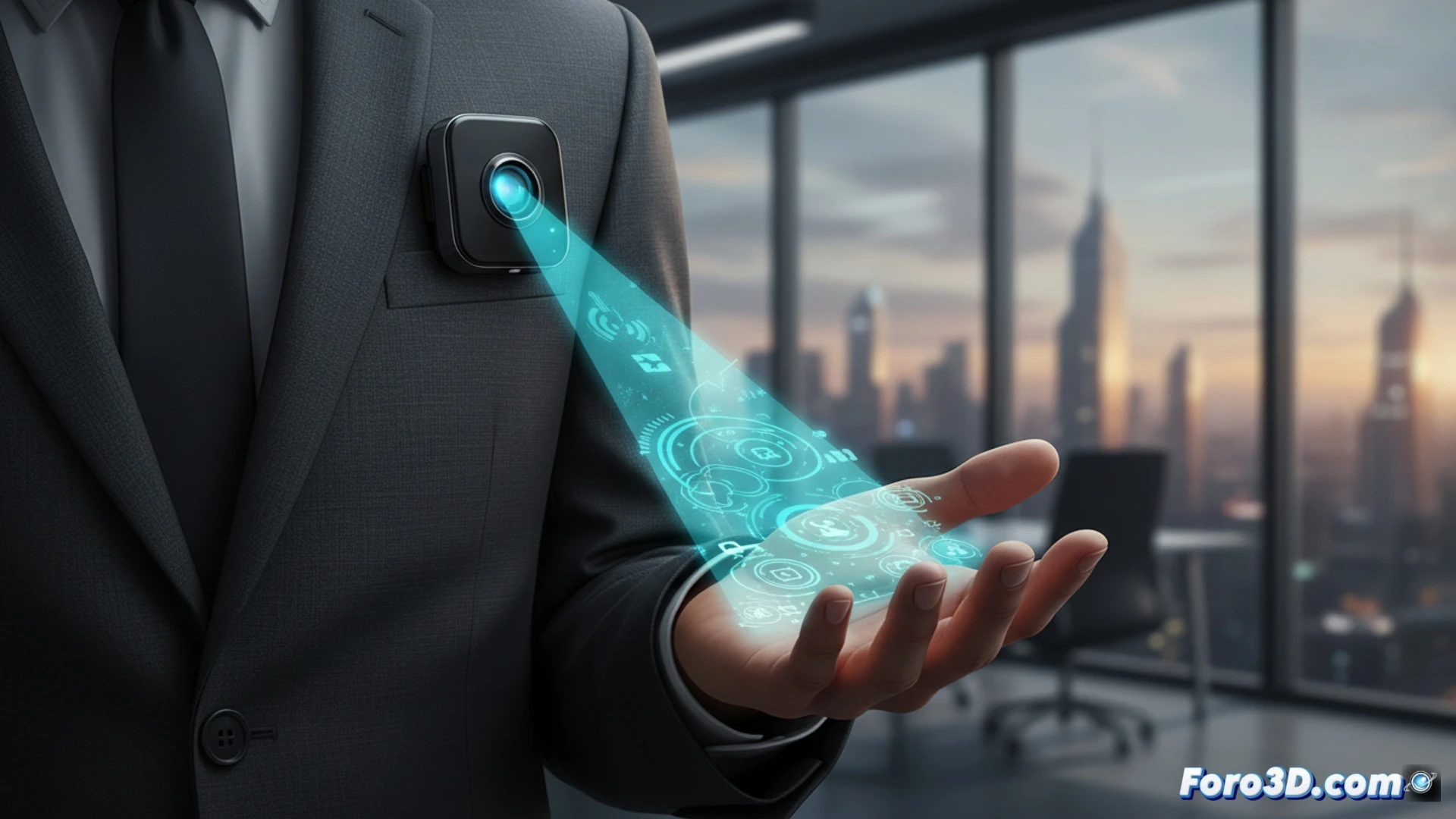
Humane, founded by former Apple employees, has launched the AI Pin, a wearable device that does away with a screen and attaches to clothing. Its operation is based on a laser projector that draws an interface on the palm of the hand, combined with an artificial intelligence assistant that processes voice and gesture commands. This approach bets on a more natural interaction, but also eliminates the visual refuge offered by smartphones, generating a radical change in usage dynamics.
Screenless architecture: voice, gestures, and laser projection 🤖
From a technical standpoint, the AI Pin integrates a system of large language models (LLMs) that performs tasks such as sending messages, making calls, or summarizing information without needing a traditional graphical interface. The device uses a camera and microphone to capture the environment, while a low-power projector displays essential data on the user's palm. However, this architecture implies high energy consumption and requires a constant cloud connection to process queries, leading to latency and dependence on external servers. Furthermore, the absence of a screen forces users to be trained in specific gestures, such as tilting their hand or tapping the device, to navigate through options.
Privacy at stake: assistant or permanent watchdog? 🕵️
The AI Pin continuously records and processes audio and video from the environment to respond to commands, posing an unprecedented privacy dilemma. Unlike a voice assistant activated by a keyword, this wearable can capture private conversations without clear visual control by the user. Digital society faces a risk: normalizing constant surveillance in exchange for convenience. While it represents an advancement in human-machine interaction, its mass adoption could erode privacy and generate excessive dependence on AI for everyday decisions.
Can a screenless device like Humane's AI Pin redefine social interaction in the digital age, or does it risk isolating us further by relying on voice commands and artificial intelligence?
(PS: tech nicknames are like children: you name them, but the community decides what to call them)