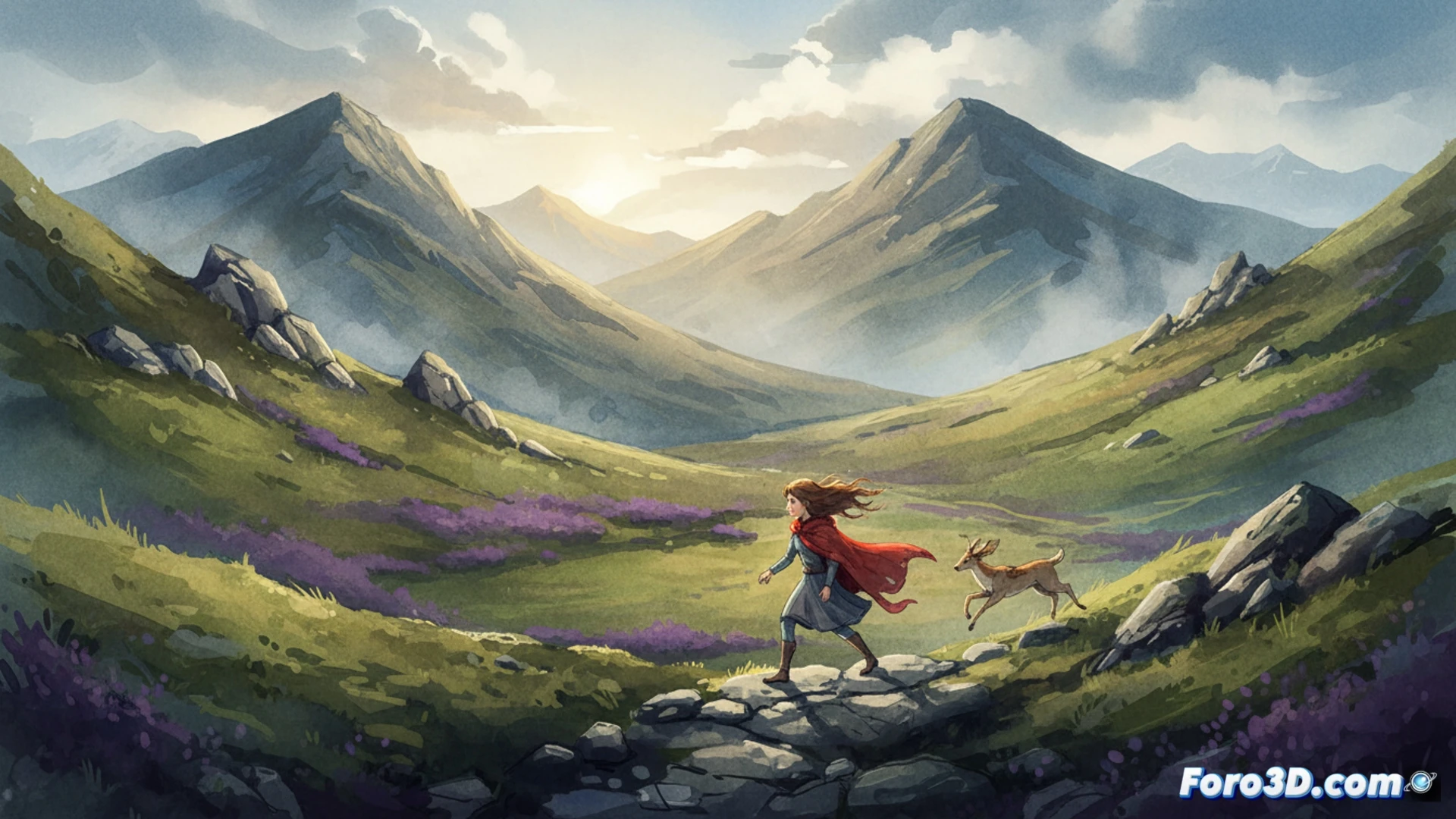
Independent studio inkle has released A Highland Song, a title that challenges visual conventions by blending 2D characters with a deep 2.5D world. Using Unity as its base engine, the game achieves a moving painting aesthetic that evokes watercolor and traditional Scottish drawing. This article breaks down the technical and artistic pipeline behind this unique visual direction.
Production Pipeline: From Photoshop to Unity 🎨
The creative process begins in Adobe Photoshop, where artists draw and paint every element of the world: from misty mountains to bushes and paths. Each illustration is separated into layers to control depth and movement. Subsequently, these layers are imported into Unity, where they are configured as sprites in a 2.5D space. The engine allows scaling and positioning these elements on Z axes to simulate relief and distance, while the animated 2D characters remain on a frontal plane. The result is a diorama effect that responds to the camera, bringing landscapes to life without the need for complex 3D models.
Lessons for Independent Developers 🧠
A Highland Song demonstrates that you don't need a huge team or cutting-edge engines to achieve a striking visual identity. The key lies in artistic coherence and exploiting the 2D composition tools that Unity offers out of the box. For any indie developer, this case is an invitation to experiment with layers, transparencies, and differential scrolling (parallax) to create worlds that feel alive and hand-painted, without losing control over performance.
How did inkle manage to integrate the digital watercolor aesthetic into Unity so that 2D characters interact fluidly with a three-dimensional world without sacrificing the visual coherence of the pictorial style?
(PS: optimizing for mobile is like trying to fit an elephant into a Mini Cooper)