Last Saturday, May 2, a Tesla Model 3 Performance was involved in a high-impact accident at the Nürburgring Nordschleife. At 1:00 PM, at the Foxhole corner, the driver lost control after hitting the outer curb while checking the mirrors to yield. The vehicle struck the left guardrail at over 110 km/h, was catapulted over the fence, and landed in the wooded area, becoming trapped against a wall. The impact caused an immediate fire in the 1850 kg NMC battery, complicating the rescue.
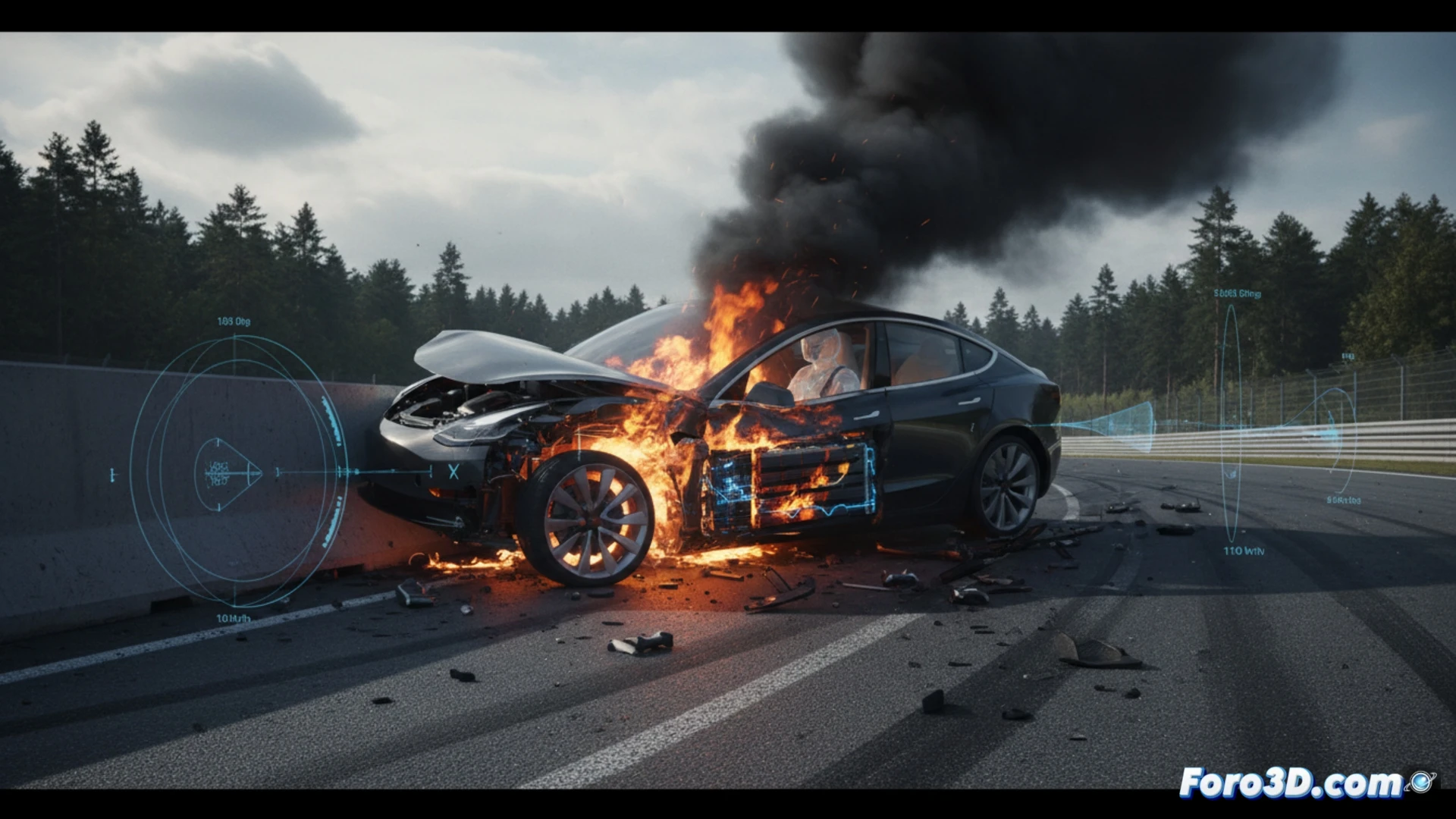
3D Reconstruction of the Trajectory and Structural Failure 🏎️
To analyze this disaster, it is vital to model the sequence in 3D: from the loss of traction on the curb to the parabolic roll over the barrier. The simulation must calculate the chassis deformation and the exact point of guardrail failure, which acted as a ramp. Subsequently, the thermal impact on the NMC cell pack must be recreated, where the release of internal oxygen accelerates combustion. The visualization allows studying how kinetic energy was transformed into mechanical and thermal damage, showing the fire propagation from the impacted module to the cabin, a critical factor for occupant evacuation.
Lessons for Circuit Safety and EV Fire Extinguishing 🔥
The 3D recreation of this accident offers key data for redesigning containment barriers on circuits, preventing a side impact from becoming a catapult. Furthermore, the simulation of the NMC battery fire reveals the ineffectiveness of traditional extinguishers, suggesting the use of thermal blankets or immersion containers. For emergency teams, visualizing the accident kinematics allows training rapid rescue protocols, minimizing the risk of delayed explosion. This case demonstrates that 3D simulation not only documents the disaster but saves future lives.
Would you export the results to GIS format?