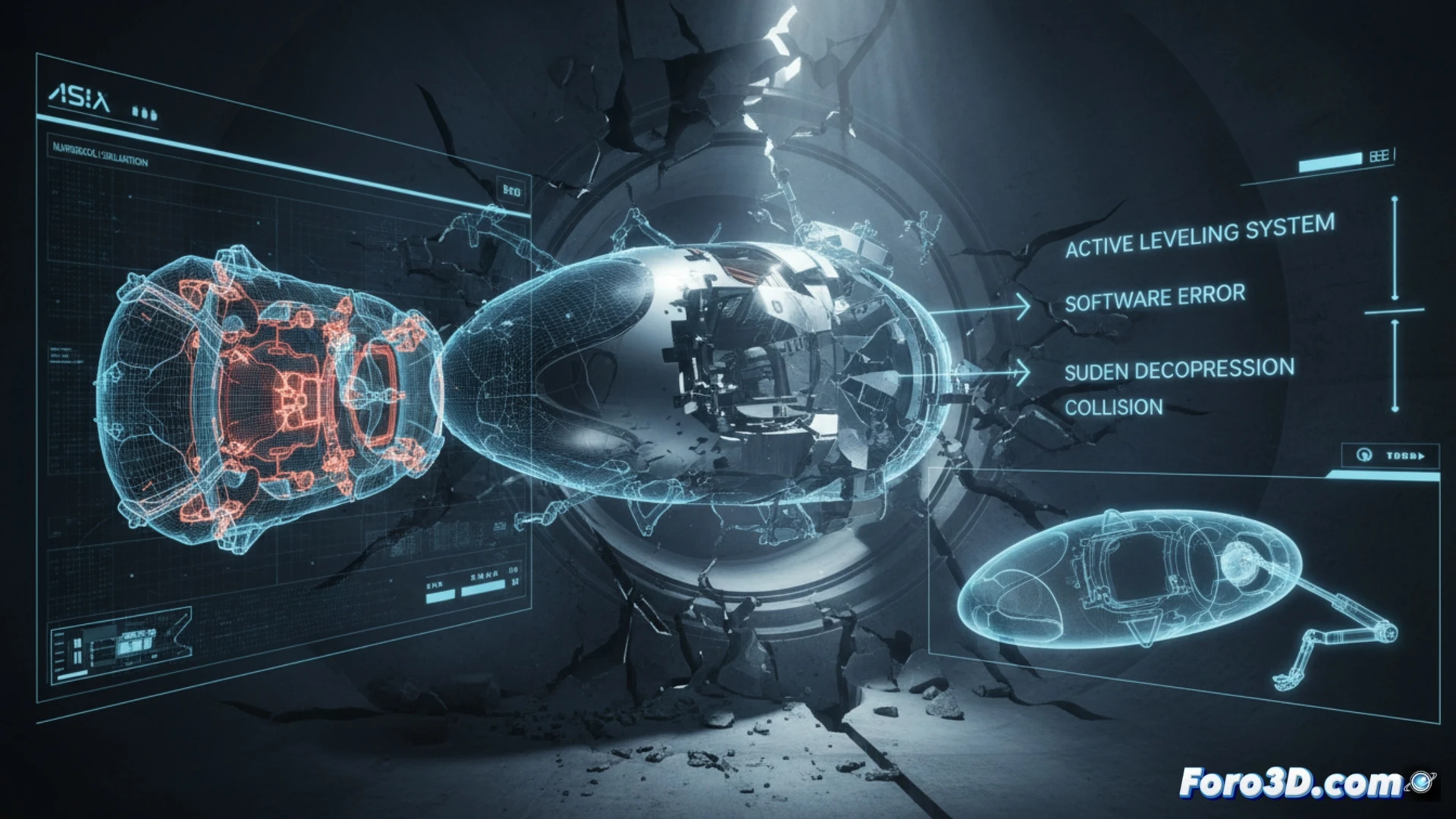
Last October, a Hyperloop transport capsule suffered a catastrophic collision following a vacuum loss in the tube. The forensic team applied a 3D pipeline to determine the root cause. The scene was scanned with LiDAR, capturing hull deformations and marks on the magnetic rails. The main hypothesis pointed to a software error in the capsule's active leveling during decompression. Numerical simulation and point cloud comparison were key to validating this theory.
Forensic Workflow: Scanning, Simulation, and Deviation 🛠️
The process began with high-resolution LiDAR scanning of the tunnel and the damaged capsule. FARO BuildIT Construction was used to verify the alignment of the magnetic rails against design plans, detecting a millimeter deviation in the impact zone. With this geometry, the model was imported into Ansys LS-DYNA to simulate the collision under sudden decompression conditions. The results showed that the hull deformation pattern matched a leveling failure. Finally, CloudCompare performed a deviation analysis (M3C2) between the simulation and the actual scan, confirming a 98% correlation in the friction marks on the rails.
Lessons on Alignment Validation in Critical Infrastructure 🚨
This case demonstrates that alignment verification with tools like FARO BuildIT is not just a construction step, but a forensic necessity. The software error would not have been detectable without contrasting the real geometry against the simulated one. The combination of explicit dynamics and point cloud comparison allows forensic engineers to separate structural failures from control errors. For the Hyperloop industry, integrating these verification pipelines in real-time could prevent future incidents.
How can a 3D forensic pipeline reconstruct the sequence of structural deformation and shockwave propagation to determine whether the sudden decompression was the root cause or a consequence of the collision in last October's Hyperloop accident?
(PS: don't forget to calibrate the laser scanner before documenting the scene... or you might be modeling a ghost)