Assetto Corsa Competizione (ACC) is not just a video game; it is a professional driving simulator that uses Unreal Engine 4 to process laser scanning (LiDAR) data from real circuits. This graphics engine, combined with 3ds Max for modeling, allows for millimeter-accurate recreation of material behavior such as wet asphalt, carbon fiber, and tire rubber under dynamic rain conditions.
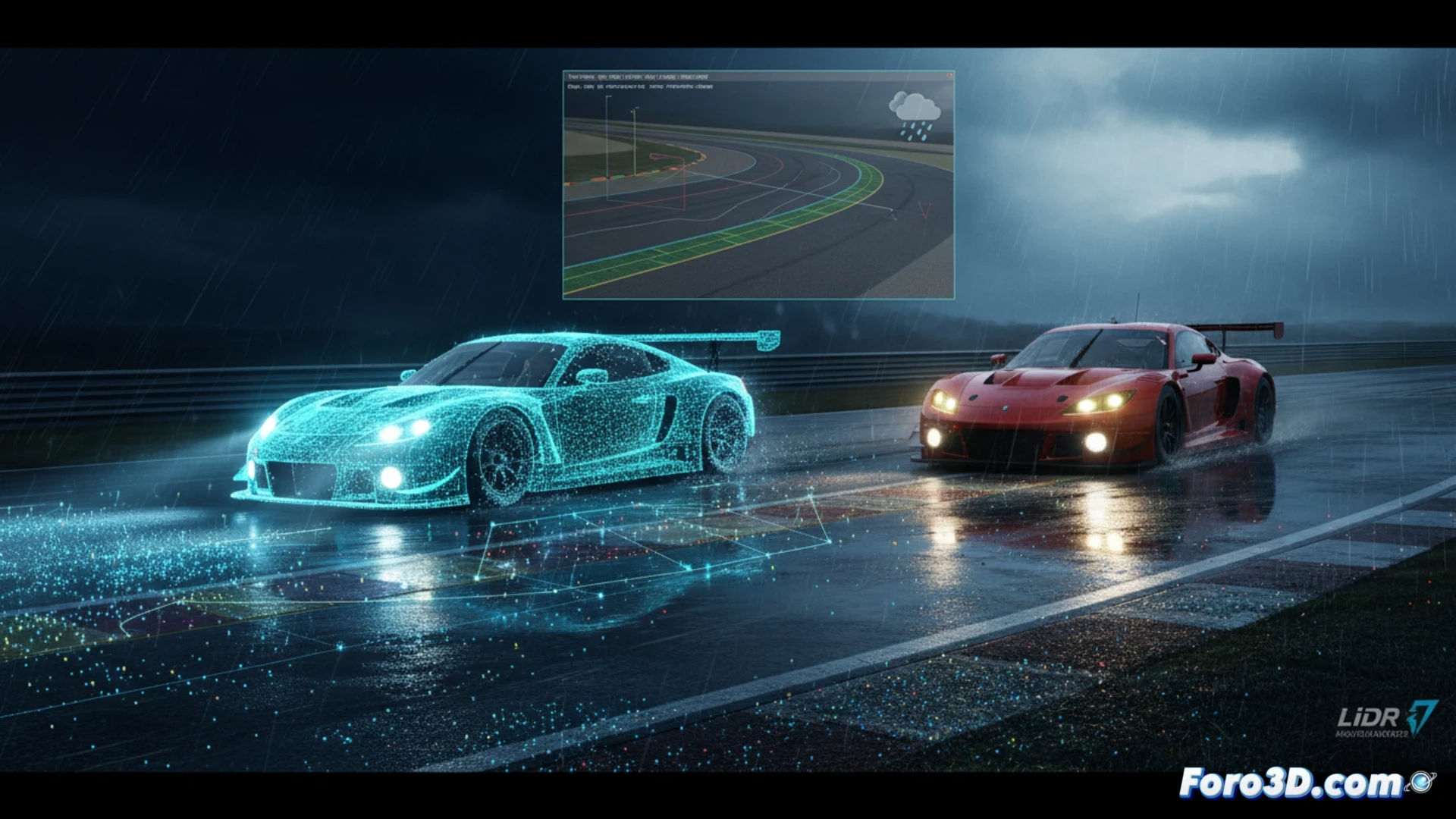
Real-time friction mapping and deformation 🏎️
The technical key of ACC lies in its implementation of physics models based on real data. LiDAR captures the micro-topography of the asphalt, which is then translated into variable friction maps. Unreal Engine 4 processes these maps along with tire tread deformation, calculating the contact patch and surface temperature in each frame. Carbon fiber modeling, meanwhile, uses anisotropy algorithms to simulate its directional stiffness and thermal dissipation capacity under aerodynamic stress, a critical factor in GT3 driver training.
Implications for ADAS development 🔧
ACC's precision has direct applications in the automotive industry. By accurately simulating grip loss on wet asphalt and carbon fiber response under extreme conditions, this software becomes a virtual test bench for ADAS systems. Engineers can validate stability control and regenerative braking algorithms in dynamic rain environments without the need for physical prototypes, reducing costs and development times in embedded systems for high-performance vehicles.
How does the implementation of material physics in Unreal Engine 4 affect LiDAR accuracy in Assetto Corsa Competizione for simulating rain conditions and variable reflectivity on the car body.
(PS: car electronics are like family: there's always a fuse that blows)