The high-definition display market exceeds $270 billion, with 4K dominating televisions and streaming. However, in the PC gaming and 3D workstation ecosystem, the reality is different: more than half of Steam users still use 1080p, while 1440p is growing as the sweet spot. For a modeling or simulation professional, choosing the right resolution is not just a visual matter, but a critical factor that determines hardware viability and workflow fluidity.
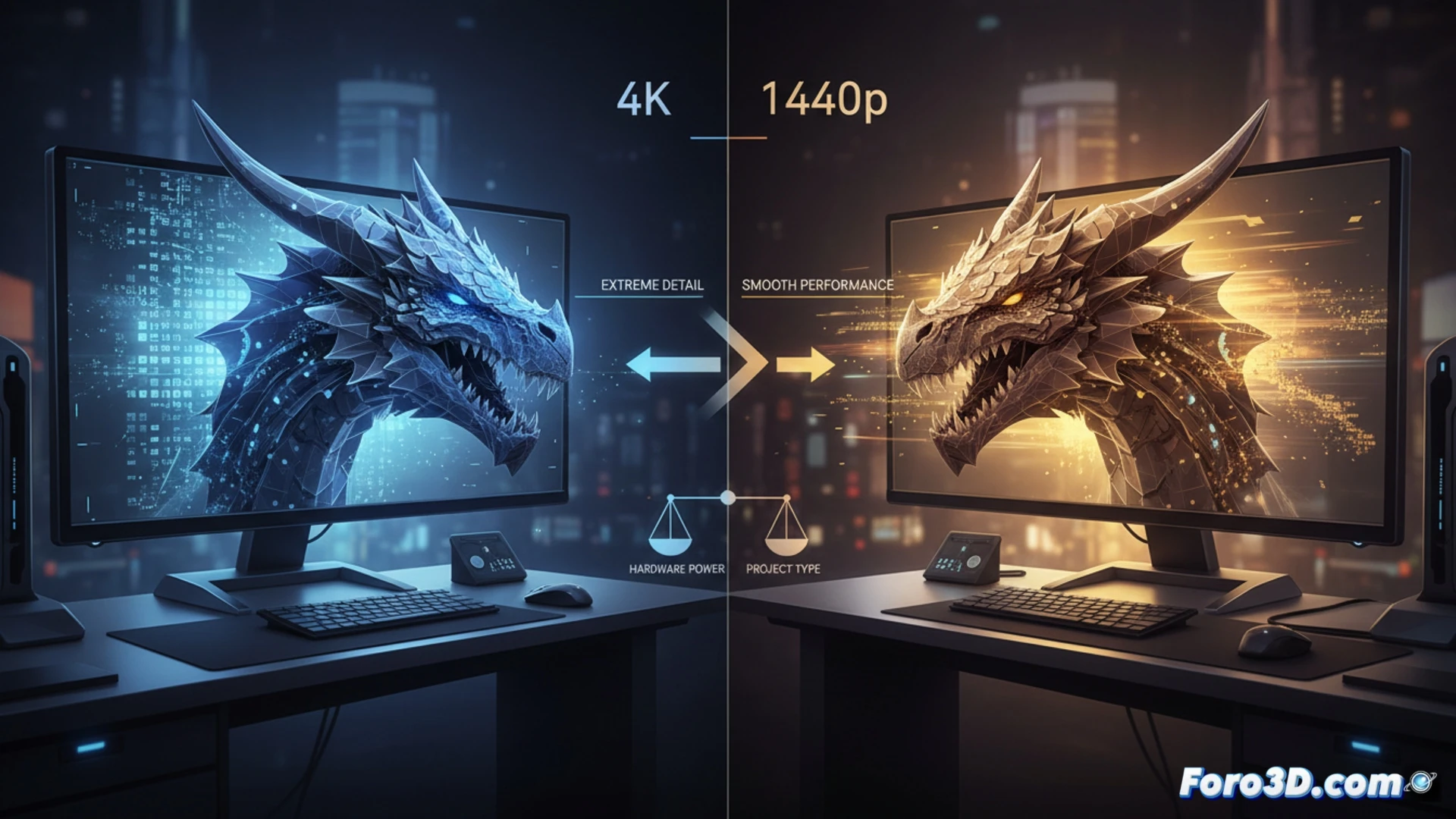
Impact of resolution on GPU, VRAM, and render times 🖥️
Working in 4K means quadrupling the number of pixels compared to 1080p, which requires a GPU with at least 12 GB of VRAM to maintain textures and meshes without swapping. In GPU-based render workflows (such as Cycles or V-Ray), 4K can triple computation times per frame. Conversely, 1440p reduces the video memory load to around 8 GB, allowing mid-range cards like an RTX 4070 to handle dense scenes with global illumination without sacrificing real-time preview. For physical simulations or particles, keeping the viewport at 1440p avoids frame rate drops that interrupt the review of complex animations—a luxury that 4K rarely grants without high-end hardware.
The false standard: why 4K is not necessary for 3D productivity 🎯
Although 4K is the benchmark in audiovisual consumption, in the professional 3D field its adoption is limited to top-tier equipment or final project reviews. For day-to-day modeling and simulation, 1440p offers sufficient pixel density to appreciate fine details without the computational cost of 4K. The key is to prioritize viewport fluidity and the ability to iterate quickly on a design: in that context, 1440p establishes itself as the sweet spot where visual quality, performance, and hardware price converge.
For a 3D modeler working with high-resolution textures and real-time lighting simulation, does the pixel scale savings of a 1440p display still offer a practical benefit over the sharpness of 4K, considering that current graphics hardware can render both resolutions smoothly?
(PS: RAM is never enough, like coffee on a Monday morning)