George Washington's correspondence is a textual map of the American Revolution, detailing logistical crises, moral dilemmas, and the loneliness of command. Traditionally analyzed as texts, these letters enclose spatial, temporal, and relational data that demand a modern interpretation. This is where 3D modeling and data visualization offer an analytical leap, transforming words into visual and interactive structures that reveal hidden patterns of foundational leadership.
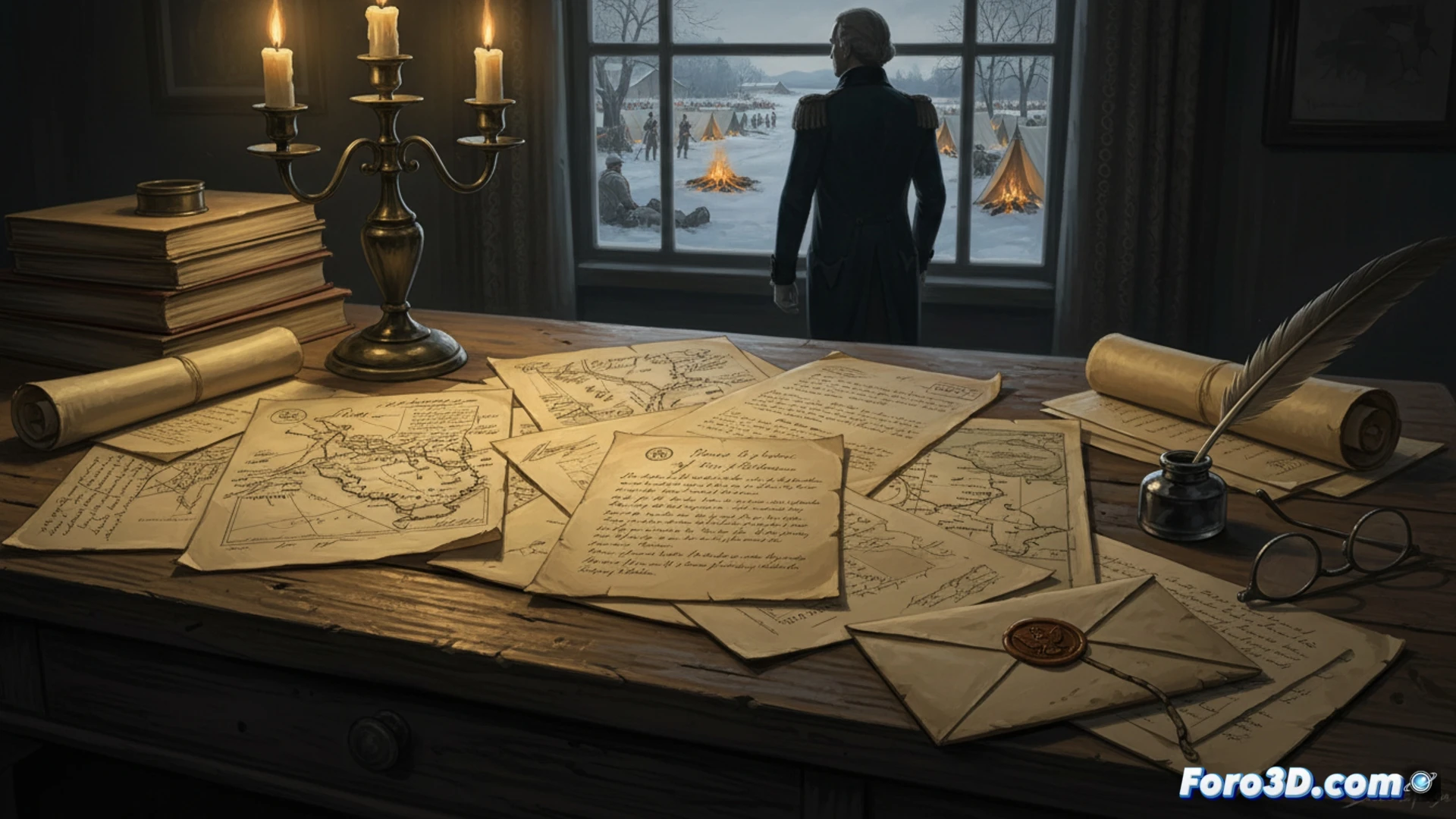
From text to terrain: visualization techniques for historical analysis 🗺️
Imagine a georeferenced 3D map where the temporal progression of the letters is overlaid on the topography of the Thirteen Colonies. Each letter becomes a node connected to places, recipients, and military units. We could visualize the supply network as a real-time flow model, or recreate the winter scene at Valley Forge in 3D to contextualize descriptions of hardship. Tools like 3D GIS, game engines, and network software enable the construction of this analytical environment, where cross-referencing spatial and relational information layers offers insights impossible to obtain through linear reading.
Immersive leadership: beyond the historical archive 🧠
This approach does not seek merely to illustrate, but to delve into the psychology of command. A 3D simulation of the dispersion of his troops against the British concentration makes the pressure of his decisions tangible. Visualizing his network of correspondents reveals alternative power centers and informational isolation. By giving volumetric form to the data from his letters, we transform historical narrative into a spatial experience that invites a more intuitive and profound understanding of the mechanisms of leadership under extreme pressure.
How can 3D modeling and data visualization transform the analysis of a leader's historical correspondence, such as George Washington's, to reveal patterns of strategic communication and political narrative construction?
(P.S.: press conferences are like STL files: sometimes they open, sometimes they don't, and you never know why)