A scientific team has experimentally confirmed a hidden critical point of water at around -63°C and extreme pressures. This finding, published in Science, explains anomalous properties such as its maximum density at 4°C. The challenge was to avoid instantaneous freezing, achieved using amorphous ice and ultrashort laser pulses to observe the phenomenon in nanoseconds. This discovery validates a decades-old theoretical prediction.
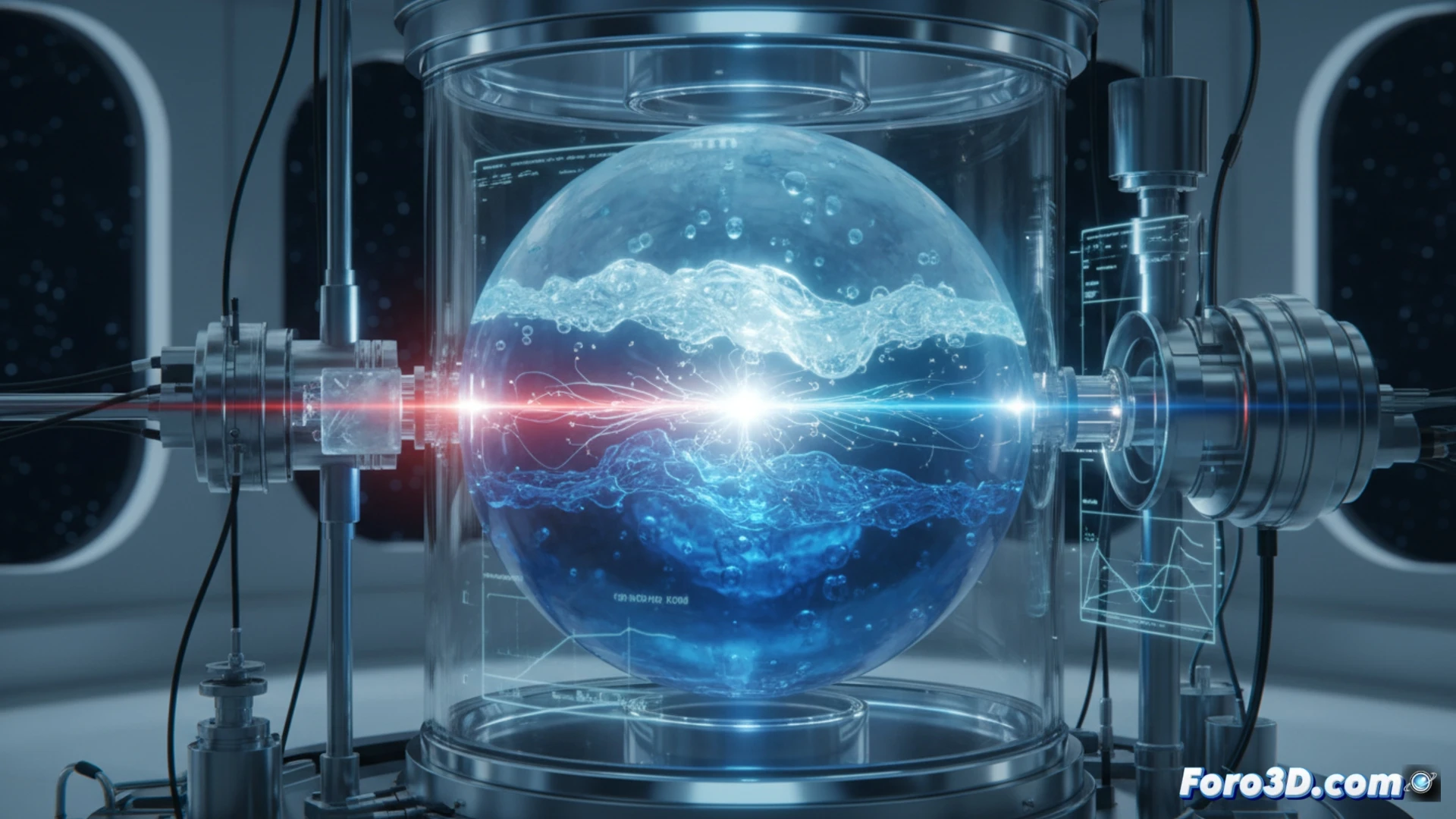
3D Modeling of the Two Liquid Phases and the Critical Point 🔬
The key to the finding is that supercooled water can exist in two distinct liquid phases: one of high density (HD) and another of low density (LD). In a 3D phase diagram, with axes of temperature, pressure, and density, these phases would be represented as two separate regions or surfaces. At normal temperatures and pressures, we only see one. But as we venture into the 3D space toward extreme cold and high-pressure conditions, the two regions become accessible. The newly discovered critical point is the exact coordinate in that 3D diagram where the boundary between both phases disappears and they unify. Visualizing this transition in a dynamic 3D model is crucial for understanding how water's density fluctuates at the molecular level, giving rise to its unique properties.
3D Visualization as a Discovery Tool 🧩
This case underscores how scientific 3D visualization transcends mere illustration. Modeling the complex phase diagram of water in three dimensions not only communicates the finding but was essential for conceptualizing and predicting the phenomenon. In materials science, transforming abstract data into interactive spatial structures allows intuiting matter's behavior under conditions impossible to observe directly, guiding experimental design and revealing hidden relationships between fundamental physical properties.
How does the discovery of a second critical point at -63°C change the understanding of water's phase transitions and what implications does it have for materials science?
(P.S.: Visualizing materials at the molecular level is like looking at a sandstorm with a magnifying glass.)