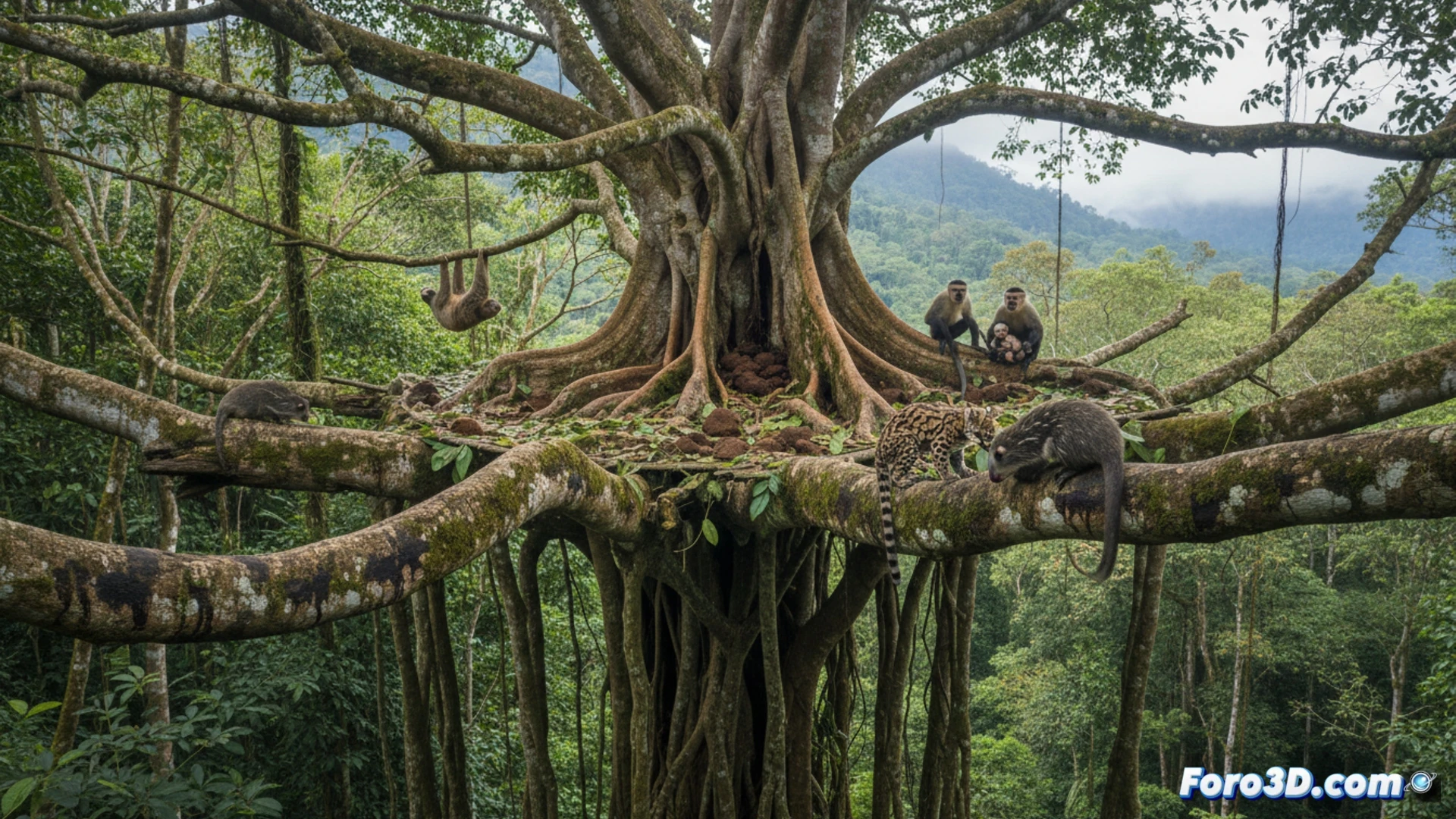
High in the Costa Rican jungle, a strangler fig, Ficus tuerckheimii, functions as an unexpected social hub. Camera traps revealed that 17 species, from sloths to felines, share its natural platforms as communal latrines. This finding, a rare documented arboreal behavior, opens a window to the complex chemical and spatial communication in the canopy. 3D scientific visualization stands as the ideal tool to unravel and communicate this hidden ecological dynamic. 🌳
3D Modeling to Break Down a Complex Ecosystem 🧩
Understanding this phenomenon requires going beyond photographs and videos. An accurate 3D model of the Ficus tree, with its unique platform architecture, would be the core. On it, species usage and time data could be mapped, creating a dynamic activity heatmap. Procedural animations would show each animal's visitation patterns, while specific shaders would visualize chemical marking zones. This digital reconstruction would allow researchers to analyze spatiotemporal interactions, test hypotheses about competition or coexistence, and understand why this tree is a disproportionately connected node in the jungle.
From Data to Narrative: Immersive Disclosure 🎥
The greatest potential lies in disclosure. An interactive 3D environment, accessible in a browser or as a VR experience, would transport the user to that canopy platform. They could observe visitation sequences, activate information layers, and perceive the real scale of the system. This visual narrative transforms raw data into an understandable and impactful story, crucial for raising awareness about the intricate and fragile ecology of tree canopies, a world yet to be fully explored.
How can advanced 3D scientific visualization techniques be used to model and analyze the spatial and temporal dynamics of a forest canopy functioning as a communal latrine for multiple species?
(P.S.: fluid physics to simulate the ocean is like the sea: unpredictable and you always run out of RAM)