The movie Project Hail Mary presents an apocalyptic scenario where space microorganisms, the astrophages, reduce solar luminosity. Two science journalists analyze its plausibility: a 10% drop in solar energy would cool the Earth drastically, but it would not exactly replicate a glaciation, caused by orbital cycles. This is where scientific visualization becomes crucial to disentangle fiction from real science and communicate complex climatic and astronomical concepts in an accessible way.
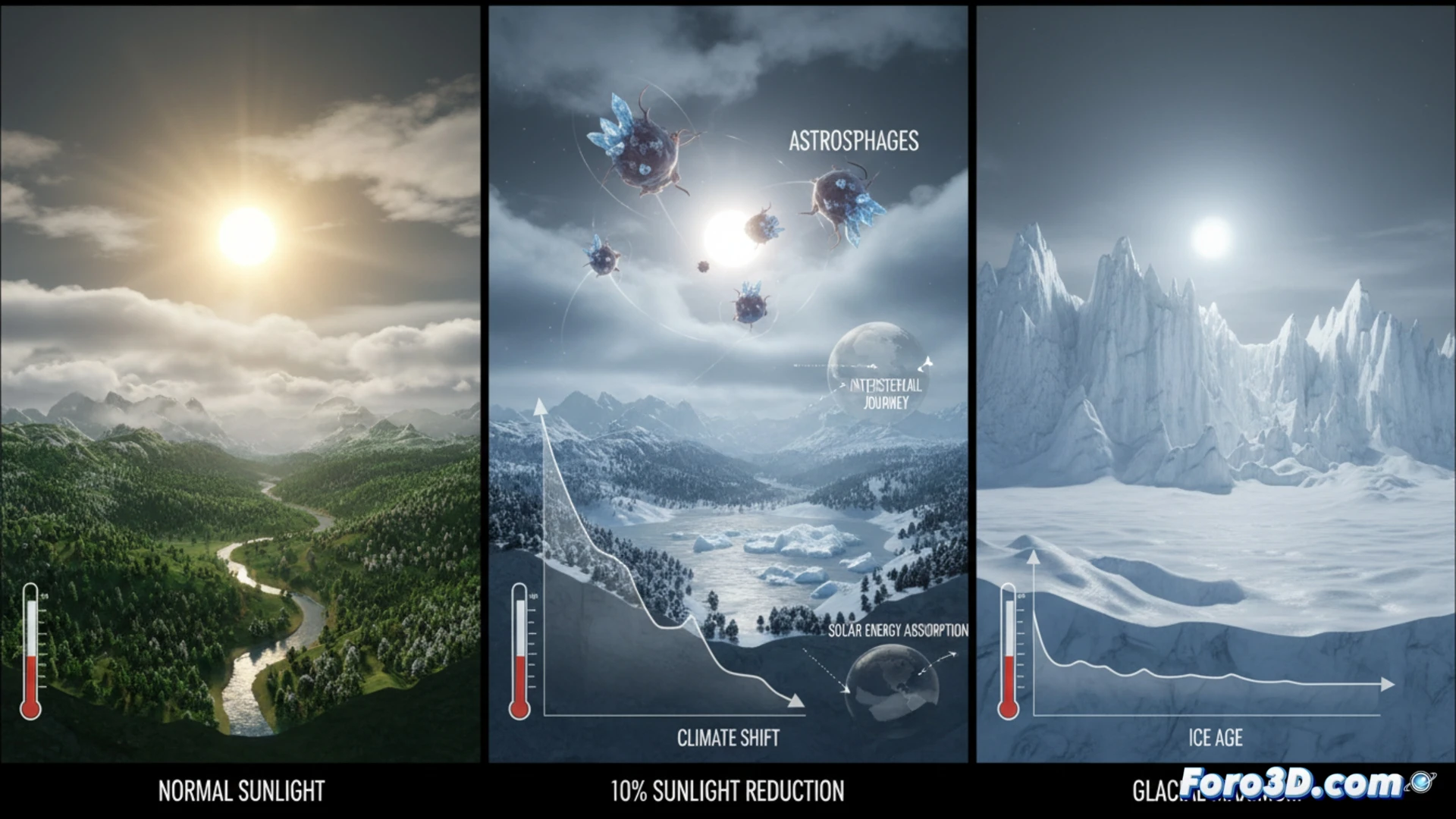
3D Modeling to Simulate Stellar and Climatic Catastrophes 🔬
3D visualization and simulation tools are ideal for exploring this premise. First, the astrophage hypothesis could be modeled, showing a representation of these organisms absorbing photons in the solar corona. Then, through visual climate simulations, the current solar irradiance would be compared with a 10% less scenario, illustrating changes in global temperature and the cryosphere. Finally, interactive models would be created that contrast this fictional mechanism with the true causes of glaciations, linked to Milankovitch cycles, using animations to show changes in Earth's orbit and tilt.
Visualization as a Bridge Between Narrative and Rigor 🌉
This case exemplifies the power of scientific visualization as a science communication tool. By taking an engaging fiction narrative, we can use 3D models and simulations to break down the underlying science, separating creative liberties from physical principles. Thus, not only is the plausibility of a story evaluated, but education is provided on orbital mechanics, climatology, and solar physics, transforming entertainment into a profound opportunity for learning and understanding our planet and its star.
How can precise and engaging scientific visualizations of extreme astrophysical phenomena, such as stellar attenuation by space organisms, be created using accessible 3D software?
(P.S.: fluid physics for simulating the ocean is like the sea: unpredictable and you always run out of RAM)