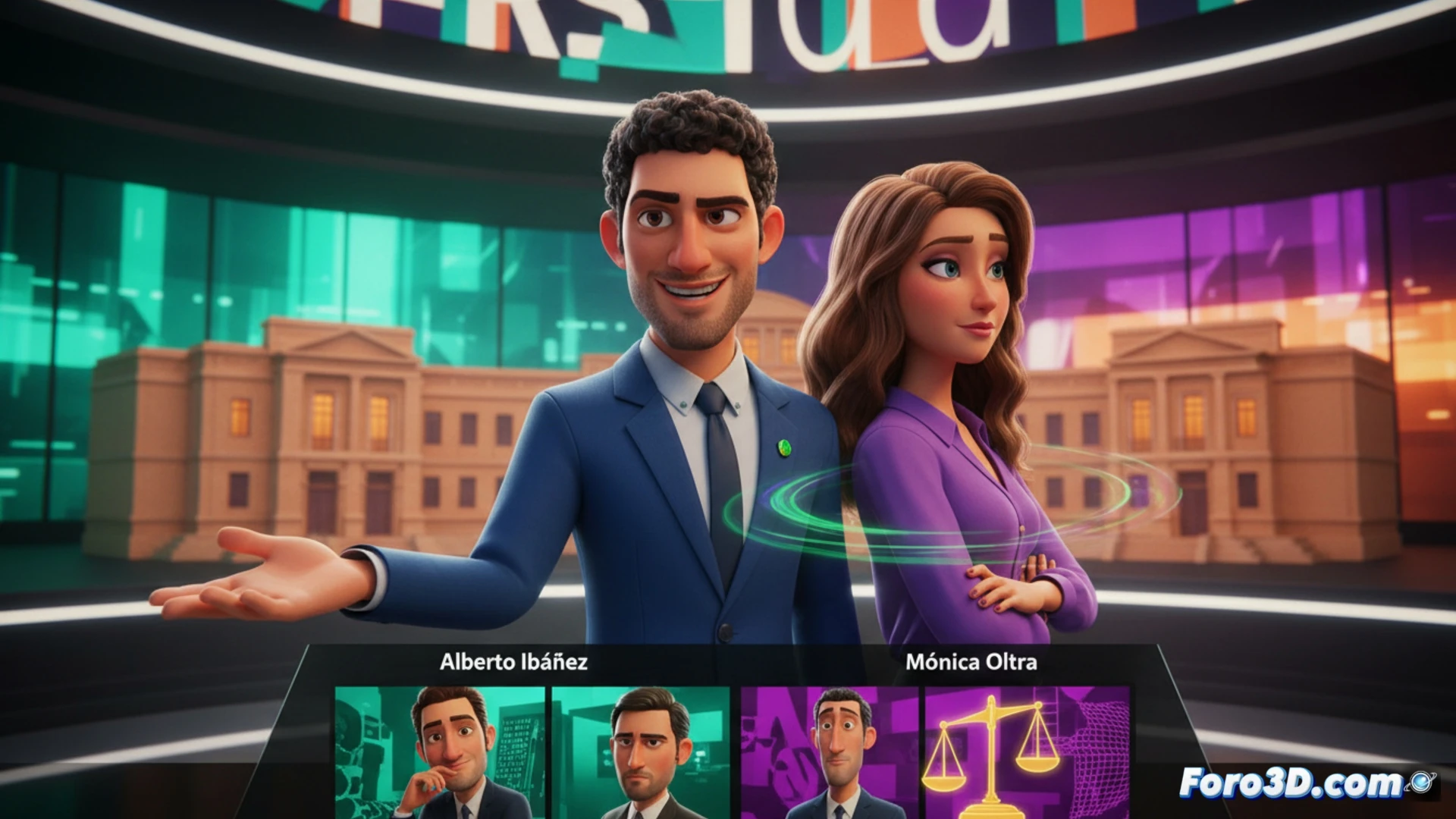
The recent statement by deputy Alberto Ibáñez, projecting the return of Mónica Oltra with a relevant position, transcends mere political commentary. It constitutes a strategic communication act to reinstall a narrative: that of an indispensable leadership and a victim of lawfare. This case is ideal for analyzing how political trajectories are constructed and reconstructed publicly, and how visual analysis technology can break down these discourses for a more objective and in-depth understanding.
3D Tools to Deconstruct Political Narratives 🧩
Imagine an interactive 3D model that visualizes this news. A temporal axis would show Oltra's career, with key nodes like her resignation in 2022. Another axis would connect political and media actors, tracing relationships and statements around her figure. A sentiment analysis module, applied to speeches and news, could visualize the polarization of the case with colors. We could even recreate a virtual television set to train communicative coherence, analyzing gestures and tone in statements like those of Ibáñez. This visualization would allow contrasting the lawfare accusation with the existing information flow.
Beyond the Model: Visual Verification of Discourse 🔍
The proposal is not just graphical. The core is in verification. A computer vision system could automatically compare statements from different spokespersons about the same fact, detecting contradictions or consensuses. By mapping the evolution of terms like lawfare in media and networks, we would visualize their strategic adoption. The ultimate goal is to transform the opacity of political debate into comprehensible data and spatial relationships, fostering critical analysis less susceptible to pure narrative manipulation.
How can the narrative of a political return and the lawfare accusation in the communication of figures like Mónica Oltra be analyzed visually?
(PD: deepfakes are like polygons: the closer you look, the more imperfections you find)