Congress has given final approval to the Criminal Code reform to toughen penalties for multiple recidivism. This regulation, whose parliamentary journey has been complex, culminates a process with cross votes, amendments added in the Senate, and a government veto. To unravel this political tangle, we propose an interactive 3D model that visualizes the law's journey, showing voting blocs, pacts, and points of conflict, offering a unique tool for civic understanding.
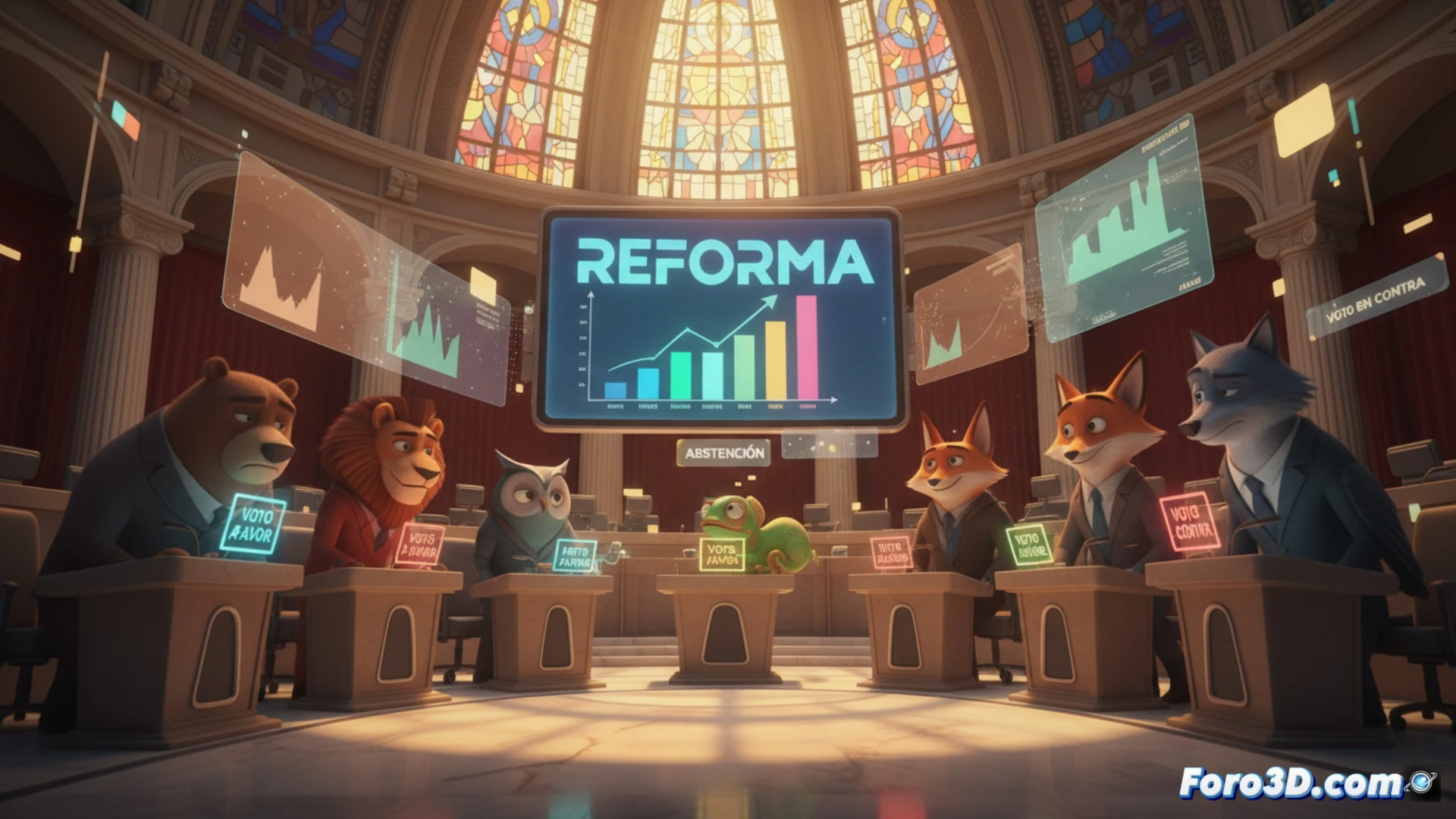
Modeling the process: chambers, votes, and veto in an interactive space 🗳️
The 3D model would recreate the Congress and Senate chambers. Each seat would be represented with a color according to the final vote: green for PSOE, PP, Vox, Junts, PNV, CC, and UPN; red for Sumar, Bildu, Podemos, BNG, and Compromís; and yellow for the abstention of ERC. The law would be an object that travels between chambers. Upon passing through the Senate, two geometric blocks representing the controversial amendments on immigration and tax havens would be attached to it. Its trajectory would be interrupted by a wall, the Government veto, which prevents those blocks from reaching Congress. By interacting, political blocs could be isolated and specific alliances in each phase could be viewed.
The democratization of legislative complexity 🧩
This visualization exercise goes beyond the technical anecdote. It transforms an abstract process, full of technicalities and political twists, into a spatial and clear narrative. By making a law's journey tangible, with its pacts and obstacles, it empowers citizens to understand how the norms that govern coexistence are built. 3D technology thus becomes an essential bridge for informed digital participation, translating institutional complexity into a universal visual language.
How could interactive 3D models and data visualization transform citizen participation in tracking and understanding complex legislative processes like the Criminal Code reform?
(PD: at Foro3D we believe in democracy... and that the render always finishes before the elections)