The recent discovery of a superluminous supernova with a strange chirp signal has revolutionized astrophysics. This event, detected in December 2024, presents a brightness fluctuation whose frequency increases over time, a phenomenon never observed before. The main hypothesis points to a magnetar, a hyper-magnetized neutron star, at the core of the explosion. This is where scientific visualization and computational simulation become indispensable to decipher what telescopes cannot see directly.
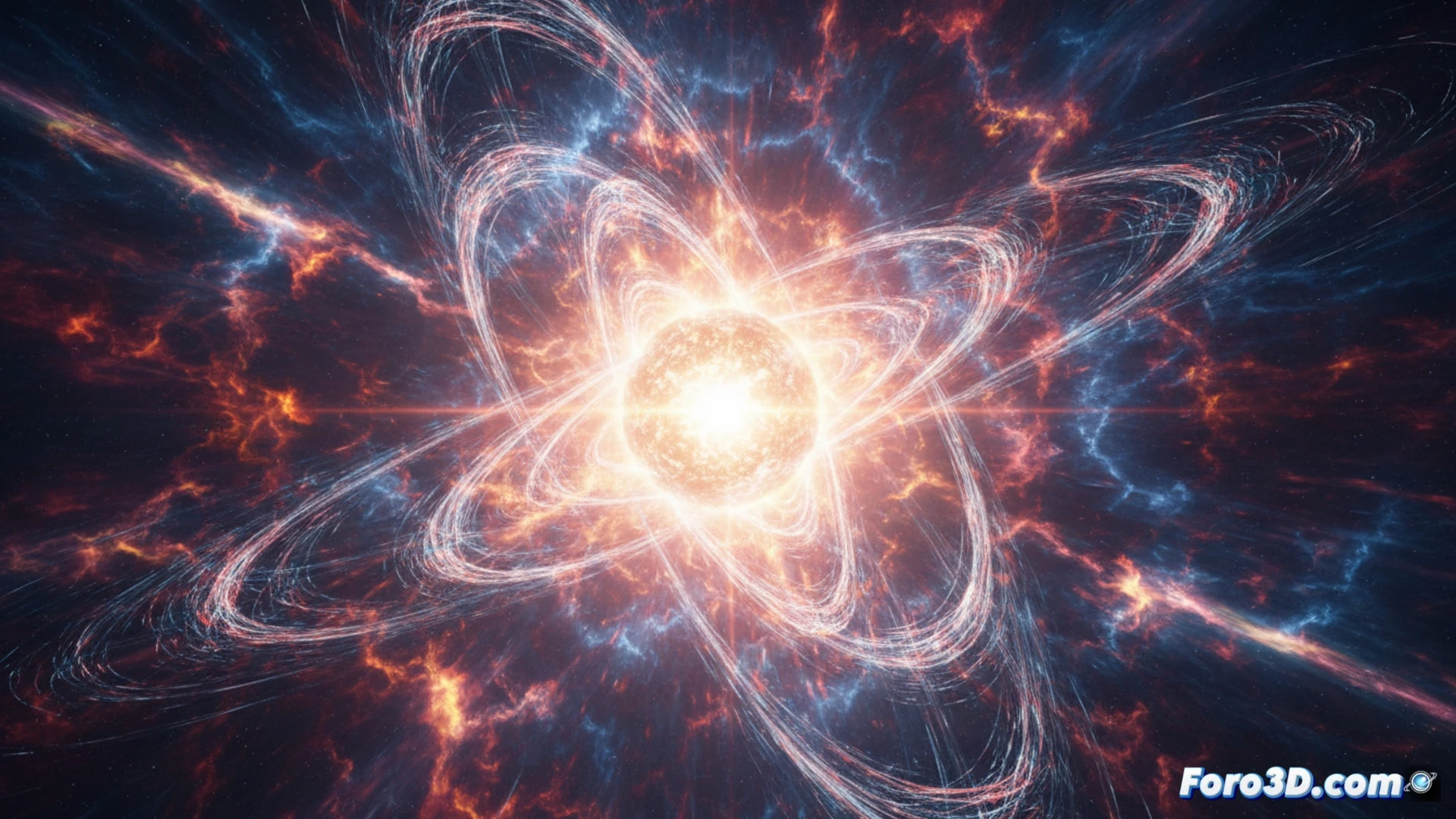
3D Simulations: from raw data to theoretical validation 🔬
The confirmation that a magnetar could drive such an explosion does not come solely from observation, but from complex 3D numerical simulations. Researchers model the extreme physics of stellar collapse, the formation of the compact object, and the dynamics of a possible disk of material around it. Visualizing this data in 3D allows analyzing how oscillations of that disk, due to gravitational effects, would modulate light emission, creating exactly the observed chirp pattern. These visualizations are not just illustrations; they are diagnostic tools that validate or discard physical models, transforming millions of data points into an understandable narrative about titanic forces.
Beyond the image: visualization as a driver of discovery 💡
This case exemplifies the crucial role of visualization in modern science. It is not about generating spectacular images, but about creating an interactive space to explore hypotheses. By modeling in 3D the behavior of the magnetar and its environment, astronomers can pose new questions: What other phenomena could generate similar signals? Visualization guides the search for new cases, becoming a bridge between abstract theory, computational simulation, and future observation, essential for confirming the role of magnetars in the most energetic events in the cosmos.
How can the structure and dynamics of a magnetar's magnetic field be modeled and visualized in 3D to explain the gravitational wave emission detected in a superluminous supernova?
(P.S.: if your manta ray animation doesn't excite, you can always add music from a Channel 2 documentary)