A recent study on tropical giant mantises has revealed a surprising asymmetry between sexes: adult females strike with nearly three times the force of males. This data, 196 versus 70 millinewtons, is not explained solely by their size. This is where 3D scientific visualization becomes crucial. We can go beyond the numbers, creating interactive anatomical models and animations that unveil the biomechanical secrets behind this perfect predator, transforming complex data into a comprehensible and visually impactful experience.
3D Modeling to Unravel Biomechanics 🦾
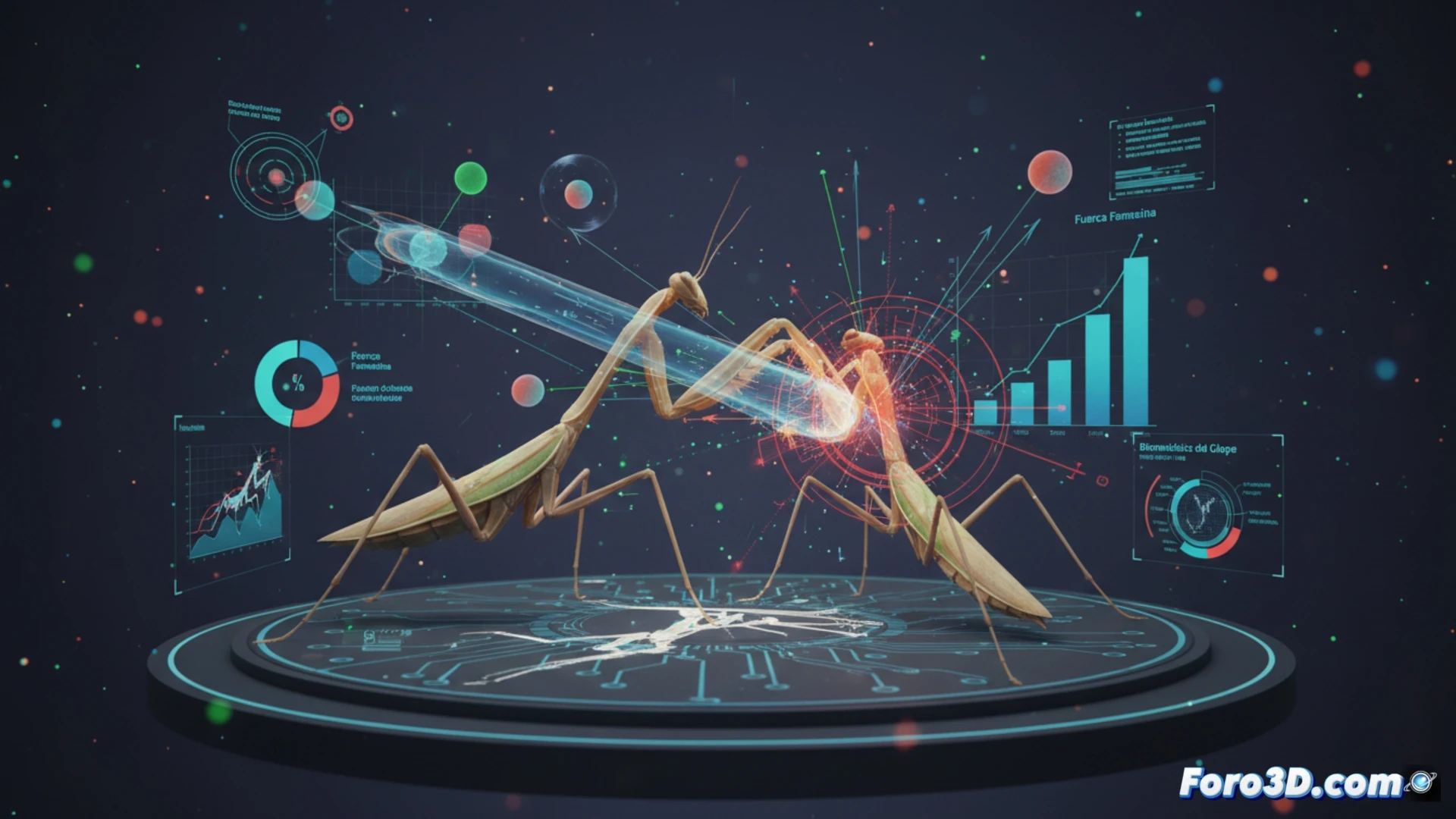
The research suggests that force increases disproportionately with muscle size, especially in females. To explore this phenomenon, 3D visualization proposes several approaches. First, detailed and sectionable anatomical models of the raptorial legs of both sexes, allowing comparison of muscle insertion, spine geometry, and exoskeletal structure. Second, physical simulation animations that show the kinematics of the strike and energy transfer. Third, 3D graphs representing the non-linear relationship between muscle volume and impact force, making tangible the hypothesis of yet-to-be-discovered biomechanical amplification mechanisms.
From Data to Understanding: The Power of Representation 🧠
This case demonstrates how scientific visualization is an essential bridge between pure research and effective outreach. An interactive 3D model of a mantis, with its real weight of less than 3.5 grams scaled to view, and an animation that visually compares the power of both strikes, communicates more intuitively than a data table. By making abstract concepts like relative force or biomechanical efficiency tangible, 3D tools not only illustrate findings but also generate new questions and hypotheses for science.
How can 3D scientific visualization unveil the biomechanical mechanisms behind the asymmetric lethal strike of female giant mantises?
(P.S.: if your manta ray animation doesn't excite, you can always add Channel 2 documentary music)