The recent CERN announcement about the discovery of a heavy baryon with two charm quarks is not just a triumph of experimental physics. It is, above all, a victory for advanced scientific visualization. In an environment where particles are ephemeral and never observed directly, it is the three-dimensional reconstructions of collisions and decays that allow scientists to see the signature of a new particle. Without these tools, the sea of data from the LHC would be indecipherable.
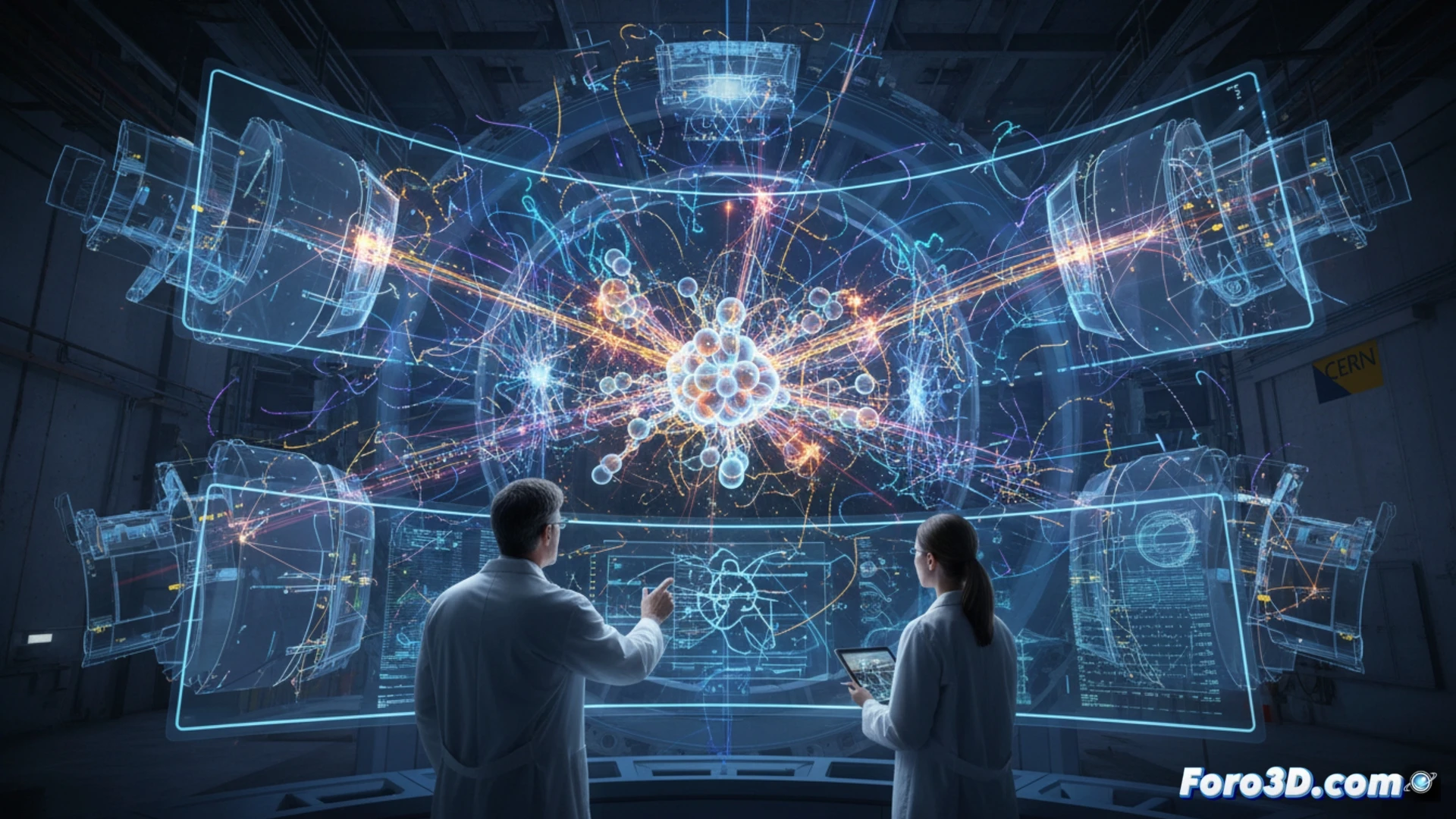
From petabytes to particles: 3D reconstruction in the LHCb detector 🔍
The identification of this particle, with a statistical certainty of 7 sigma, began with the detection of its decay products in the LHCb experiment. Each collision generates a cascade of secondary particles whose trajectories are recorded by layers of detectors. Reconstruction algorithms trace these trajectories in 3D, calculating origin points and energies. Scientific visualizers assemble these tracks, recreating the complete event in a virtual space. This allows filtering billions of collisions to find the few events where the heavy baryon was produced and decayed, confirming its mass and properties through the visualized geometry and kinematics.
Modeling for understanding: beyond discovery 🧩
Once confirmed, visualization plays a crucial pedagogical role. How to represent a particle four times more massive than a proton? 3D models of its internal structure, although simplified, offer a tangible analogy. These representations, along with visualizations of real events, are essential bridges. They transform abstract data into comprehensible narratives, closing the gap between the complex world of particle physics and the human need to see to believe, and understand.
How did 3D scientific visualization techniques enable the interpretation and communication of the complex data that led to the identification of the double charm quark baryon? 🎯
(PD: fluid physics to simulate the ocean is like the sea: unpredictable and you always run out of RAM)