NASA advances with its ACS3 solar sail technology, a propulsion system that harnesses light pressure. To understand this complex concept, 3D visualization is indispensable. At Foro3D, we explore how modeling and simulation can break down this engineering, transforming technical data into clear representations that illustrate from sail deployment to its interaction with solar photons, making the abstract tangible.
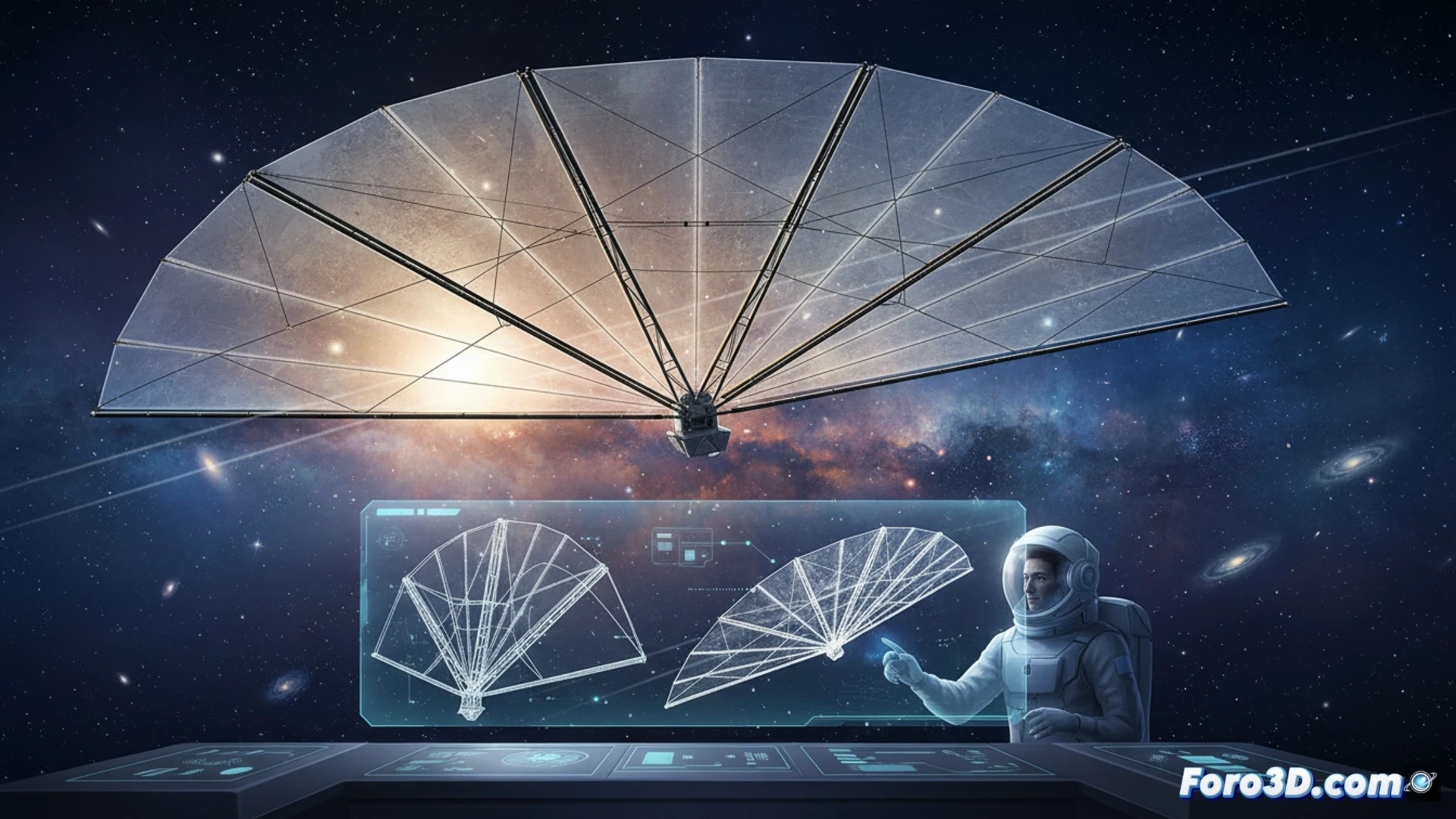
From concept to mesh: modeling the ACS3 structure and physical simulation 🛰️
The first challenge is modeling the sail: an ultralight structure of advanced composite with deployable booms. 3D modeling allows recreating its geometry, tension, and mechanisms with precision. Then, through simulations, we can visualize the key physical principle: how photons, represented as particles in a simulation engine, exert pressure on the surface. This allows calculating and animating the spacecraft's gradual acceleration, showing trajectories in the vacuum that would be impossible to illustrate with traditional methods.
Render for outreach: communicating complex science 🎨
The final render is where science becomes communication. A good rendering can show the contrast between the ultra-thin sail and the immensity of space, the direction of the light force, and the system's scale. These images and animations are not only tools for engineers but also powerful educational resources to explain to the public how we will travel between the stars without a drop of conventional fuel.
How can 3D modeling and scientific visualization be used to simulate and optimize the deployment and dynamics of solar sails in the space environment?
(P.S.: modeling manta rays is easy, the hard part is making them not look like plastic bags floating)