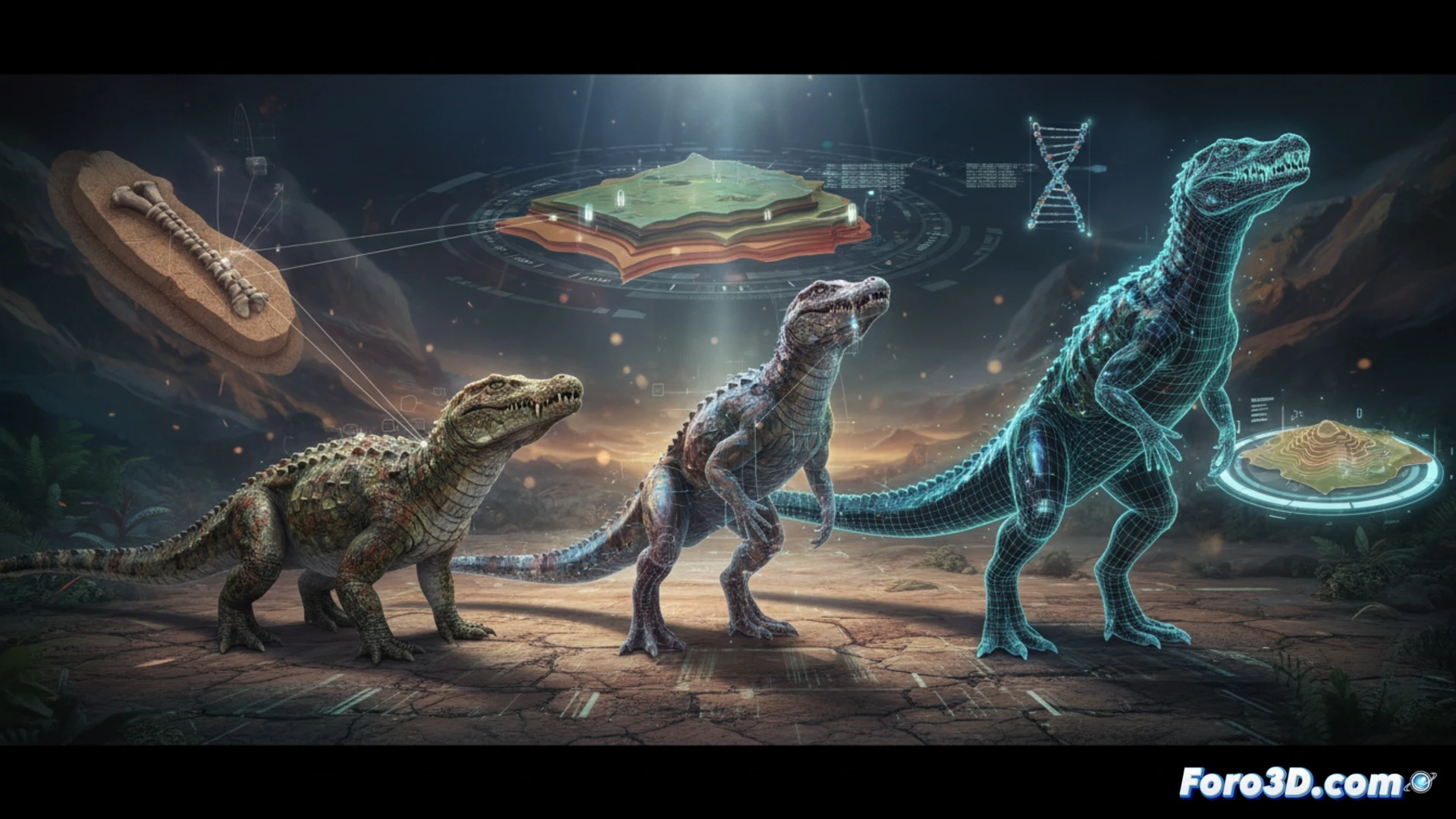
The recent discovery of Sonselasuchus, a Triassic reptile that transitioned from walking on four legs in its youth to standing on two in adulthood, poses a fascinating visualization challenge. Understanding this radical transformation solely from fossils is complex. This is where 3D scientific visualization becomes indispensable, allowing digital reconstruction of its anatomy, simulation of its growth, and animation of its postural change, transforming bone data into a dynamic and comprehensible narrative about evolution.
3D Modeling to Unravel Ontogenetic Development 🦴
To study a case like that of Sonselasuchus, the first step would be to 3D scan the bones of juvenile and adult individuals. With this data, the complete skeleton is modeled, inferring musculature and ranges of motion. The key lies in animation and comparative analysis: a 4D model (3D + time) can visualize the differential growth rate of the limbs, showing how the hind ones progressively lengthen and strengthen. Biomechanical stress analysis tools on the adult 3D model can verify its capacity to support bipedal weight, while an environmental reconstruction of the Arizona Triassic places the animal in its context, offering a holistic view impossible with traditional methods.
Beyond Illustration: 3D as a Research Tool 🔬
These reconstructions go beyond mere illustrations. They are interactive and testable visual hypotheses. An accurate 3D model allows other researchers to measure joint angles, calculate centers of gravity, and test alternative scenarios. For the public and outreach, this approach makes an abstract concept tangible, clearly showing the incredible diversity of forms experienced by crocodile relatives, rivaling dinosaurs long before their dominance. 3D visualization bridges the gap between raw data and deep understanding.
How can the complex biomechanical and body mass changes during the ontogenetic transition from quadruped to biped in extinct species like Sonselasuchus be recreated and validated in 3D?
(P.S.: at Foro3D we know that even manta rays have better social bonds than our polygons)