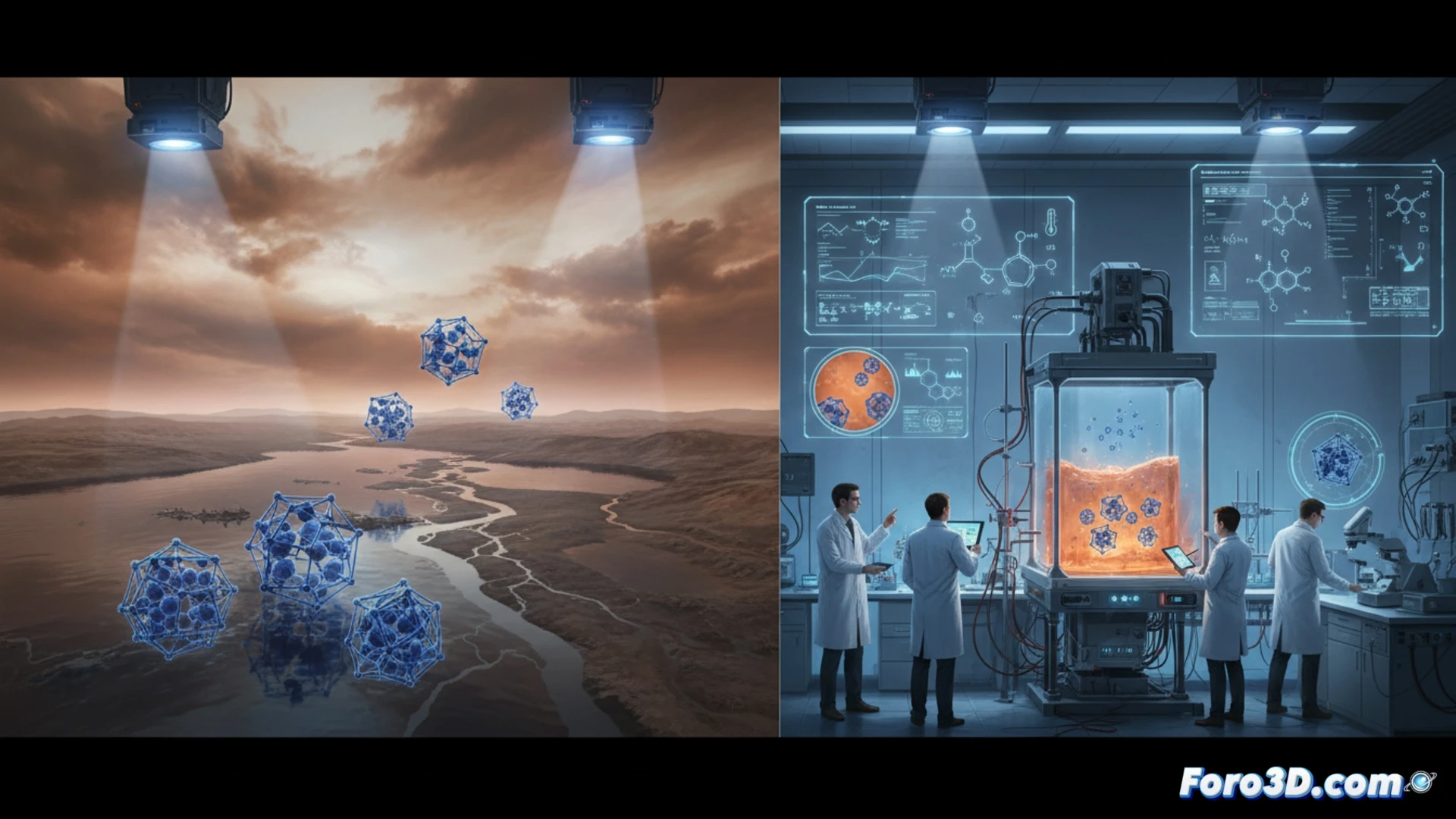
The search for life beyond Earth often begins not in a telescope, but in 3D modeling software. NASA's recent research on vinyl cyanide on Titan is a perfect example. Before recreating the frigid conditions of its lakes in the laboratory, scientists digitally visualized how these molecules could self-assemble into exotic cell membranes, called azotosomes. This scientific visualization process is fundamental for transforming an astrobiological hypothesis into a tangible and testable experiment.
From 3D model to crystal: the crucial role of visualization in astrobiology 🔬
3D visualization acts as an indispensable bridge between theory and practice in studies like this. First, complex organic molecules, such as vinyl cyanide, are modeled to understand their geometry and bonding potential. Then, extreme environments are simulated and rendered, such as methane lakes at -180°C, and the hypothetical structures that could form there. These visual representations not only guide experimental design, determining concentrations and conditions, but also allow digital predictions to be contrasted with real results. In this case, the visualization predicted protective spheres, but the laboratory showed only crystals, a crucial negative finding that redefines biochemical possibilities on Titan.
Beyond the membrane: the future of visualizing unknown biochemistries 🪐
This experiment underscores that scientific visualization must evolve to explore the radically different. With a terrestrial membrane analog ruled out, the challenge now is to model and represent forms of life that do not depend on known structures. 3D visualization will continue to be key for proposing and communicating new biochemical paradigms, imagining complex systems in exotic liquids. Its true power lies in making visible, and therefore investigable, possibilities that we cannot yet fully conceive, keeping alive the fascinating question of life on worlds like Titan.
How are 3D simulation tools and scientific visualization used to model and explore possible methane-based ecosystems on the moon Titan? 👨🚀
(P.S.: the fluid physics to simulate the ocean is like the sea: unpredictable and you always run out of RAM)