Benjamin Franklin's letters during the American Revolution are a labyrinth of diplomacy. Negotiating with France and Spain required precise and strategic communication. Today, we can go beyond the text. Through 3D and data visualization technologies, we can transform this historical correspondence into interactive and dynamic maps, revealing the power networks and the flow of information that forged a nation.
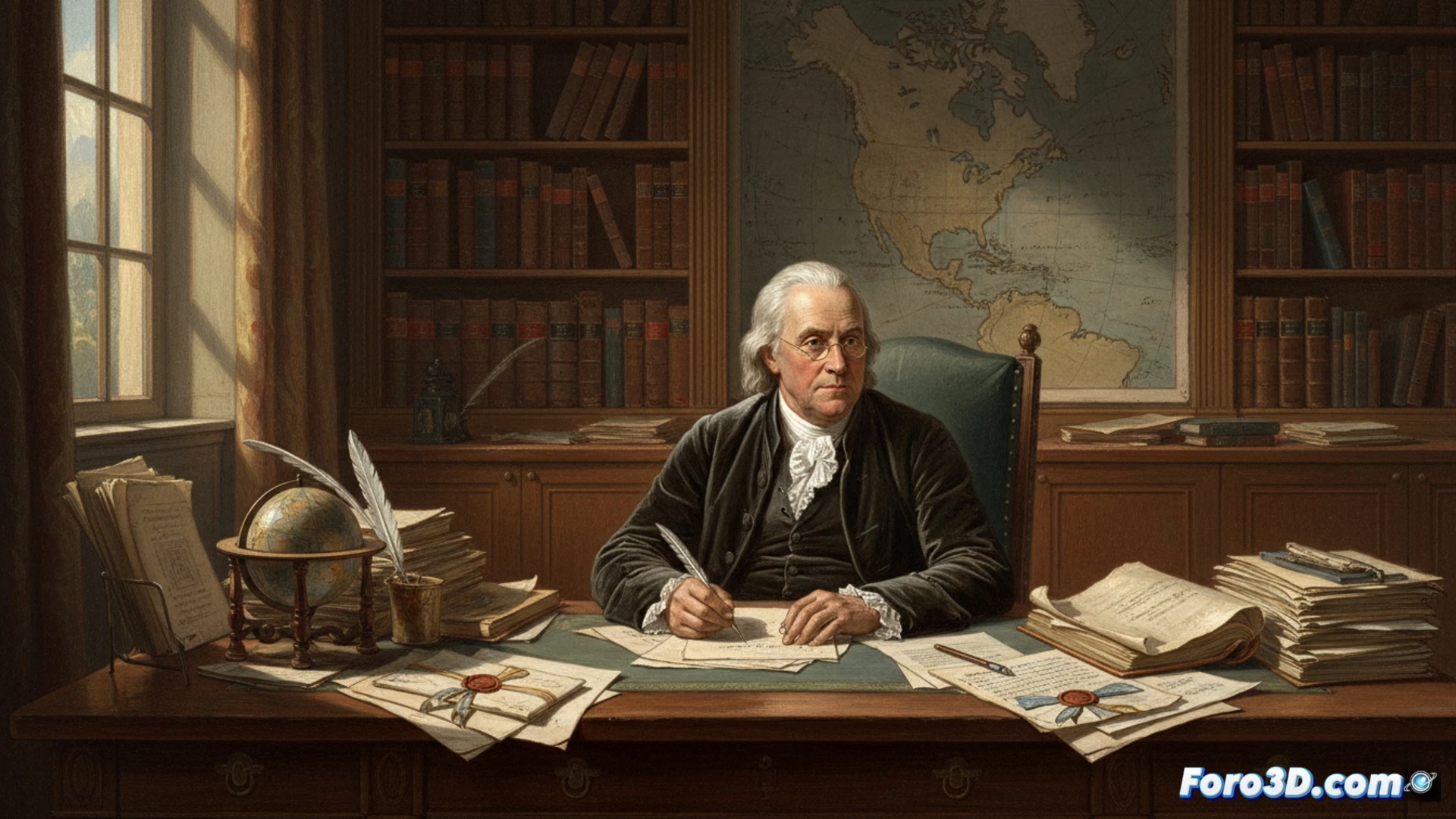
Technical Reconstruction of Networks and Chronologies 🗺️
The technical proposal involves a dual approach. First, a 3D nodal network model where each character (Franklin, Vergennes, congressmen) is a point connected by lines representing letters. The thickness and color of the line would indicate tone or urgency. Second, a 4D spatial timeline that shows, on an interactive globe, the physical journey of each missive and how negotiating positions (e.g., loans, treaties) evolved in parallel. Tools like Blender for modeling and engines like Unity for interactivity would allow simulating this diplomatic ecosystem.
From Archive to Analytical Experience 🔍
This approach transcends digitization. It's not just about reading letters, but experiencing negotiation as a complex system. Visualizing the density of communications during a crisis, or the delay between sending and response, offers intuitive insights. It transforms historical analysis into a spatial experience, where geopolitical distance and strategic proximity become tangible, allowing a deeper understanding of the mechanisms that define high-level political communication.
How can 3D visualization techniques and network analysis be used to unravel the hidden diplomatic strategies in Benjamin Franklin's correspondence during the American Revolution?
(P.S.: deepfakes are like polygons: the closer you look, the more imperfections you find)