The recent 2026 Abel Prize awarded to Gerd Faltings reminds us of a monumental triumph of the human mind: the proof of the Mordell conjecture. This problem, which challenged mathematicians for six decades, states something profound about equations with apparently infinite possibilities. For us, the artists and technicians of visualization, this achievement is an invitation. The key to the proof lies in a visual concept: surfaces with multiple holes. This is where our mastery of 3D geometry can build a bridge between pure abstraction and intuitive understanding.
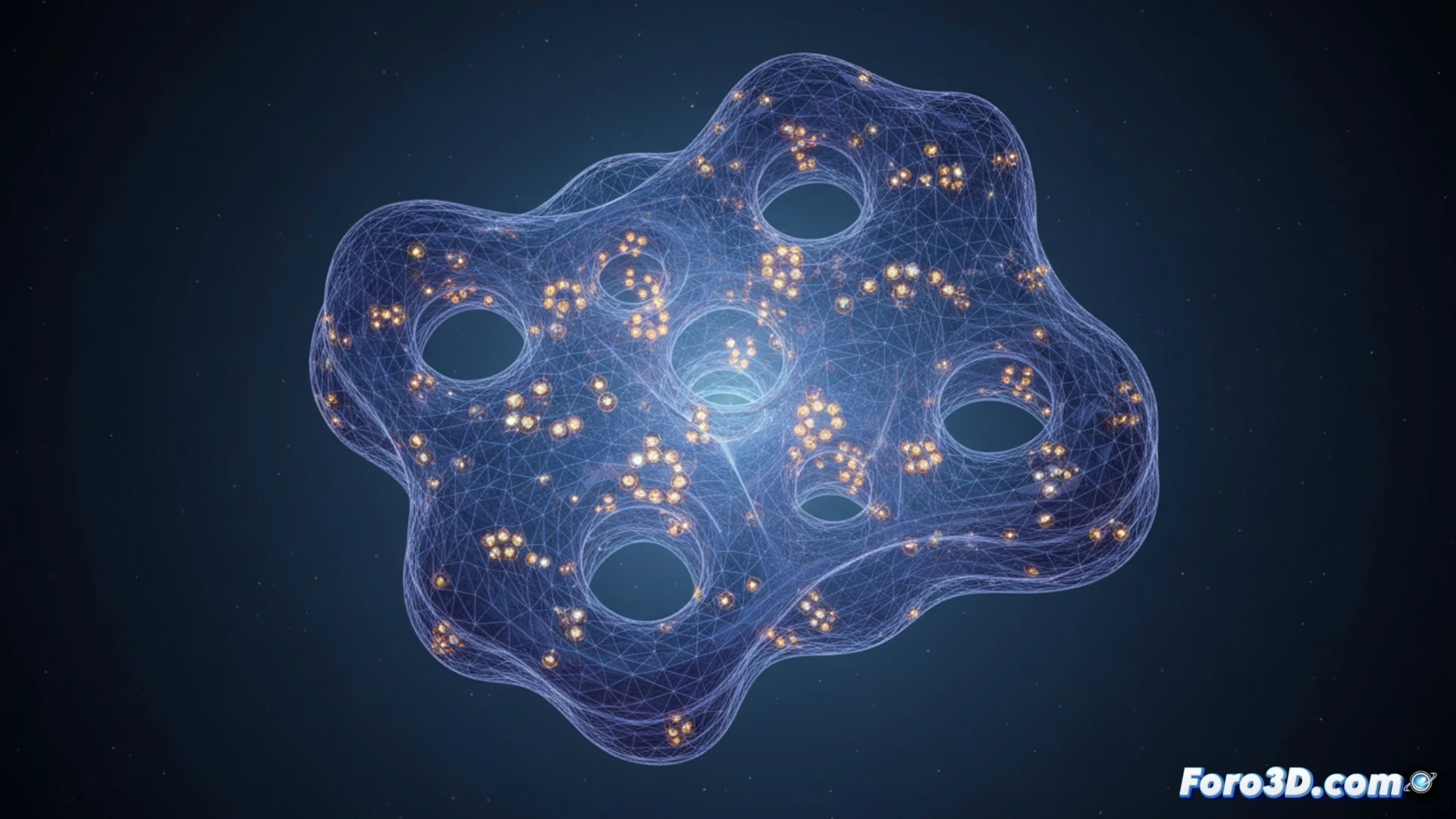
From Genus to Geometry: Modeling Finiteness in 3D 🌀
The conjecture applies to algebraic curves defined by complex polynomial equations. Their crucial property is the genus, a number that essentially counts their topological holes. A sphere (genus 0) or a torus (genus 1) can have infinite rational solutions. But Faltings proved that if the genus is 2 or higher, the rational solutions are finite. Our opportunity lies in visualizing these high-genus surfaces. Using software like Blender or Houdini, we can generate and manipulate models of these complex shapes, showing how connectivity and intrinsic topology (the abundance of holes) drastically restrict the possible paths where simple solutions might exist. An interactive model that allows varying equation parameters and observing how the surface's genus deforms would be a powerful pedagogical tool.
Abstract Beauty as a Rendering Challenge ✨
Faltings' work transcends immediate practical application; it is an exploration of the deep structure of mathematics. For the Foro3D community, this type of milestone represents the supreme challenge of scientific visualization: rendering the elegance of an idea. How to illuminate a multidimensional surface? How to animate the transition between genera? This theorem not only celebrates a genius but proposes a project to us: use our tools to make the abstract tangible, giving visual form to the proof that, sometimes, complexity imposes its own finite limits.
How can the computational visualization of algebraic curves and their rational points help intuitively understand the density and finitude described by Faltings' Theorem (Mordell Theorem)?
(P.S.: if your manta ray animation doesn't excite, you can always add music from a Channel 2 documentary)