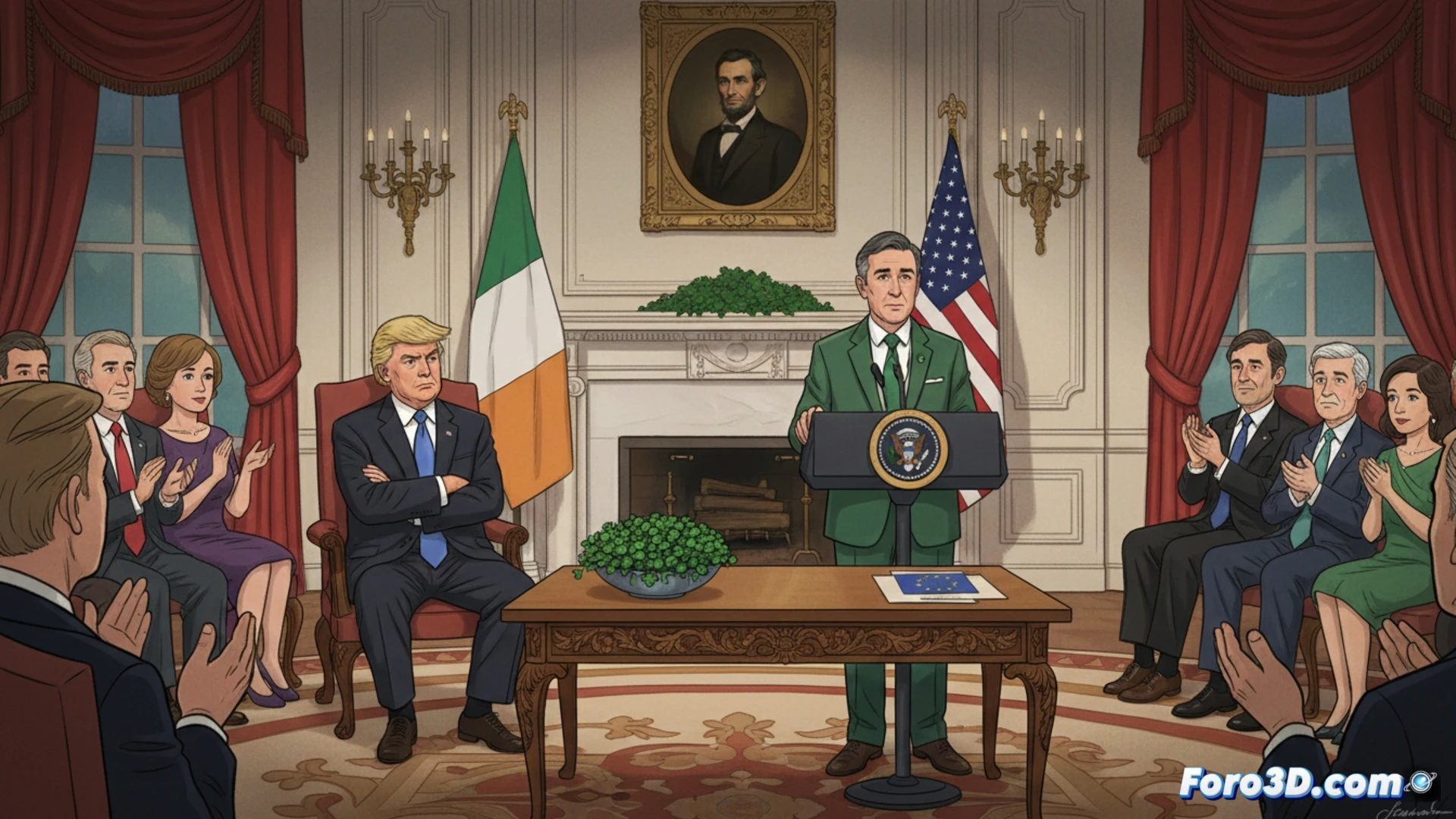
In the traditional St. Patrick's Day gathering at the White House, Irish Prime Minister Micheál Martin's speech was a masterclass in political communication. In the face of Donald Trump's criticisms of Europe, Martin diplomatically defended European unity and the bond with the United Kingdom. This clash of narratives is an ideal case for advanced visual analysis, where 3D technology and computer vision can break down the layers of a political message beyond the words.
Technical Tools for Deconstructing a Diplomatic Encounter 🛠️
Imagine an interactive 3D model of the East Room, mapping the proxemics between the leaders and their entourages to analyze power dynamics and alliances. Facial and gestural expression analysis systems could quantify the contrast between Trump's rhetoric and Martin's restrained firmness. Additionally, through network graphs and diffusion models, it would be possible to visualize how different discourse frames, the Irish bridge versus America First, competed in media ecosystems, tracking their real-time impact.
Visualization as the Language of Political Analysis 📊
This case demonstrates that modern diplomacy is also fought in the realm of perception. Visualization technologies are not just representation tools, but tools for deep understanding. By transforming discursive, spatial, and media data into interactive models, we turn political complexity into an analyzable object, offering a new perspective to understand how messages of power are constructed, confronted, and transmitted on the global stage.
How can 3D modeling and dynamic infographics deconstruct and analyze the non-verbal and contextual elements of a diplomatic speech, such as that of the Taoiseach at the White House, to reveal political communication strategies?
(P.S.: analyzing political microexpressions is like looking for inverted normals: everyone sees them, no one fixes them)