Orchids have perfected the art of deception to survive, with pollination mechanisms as complex as they are fascinating. Strategies such as sexual deception, false traps, or the emission of carrion smells are difficult to appreciate in a simple photograph. This is where 3D scientific visualization becomes a key tool, allowing these biological processes to be broken down and animated for research and education in a completely new way.
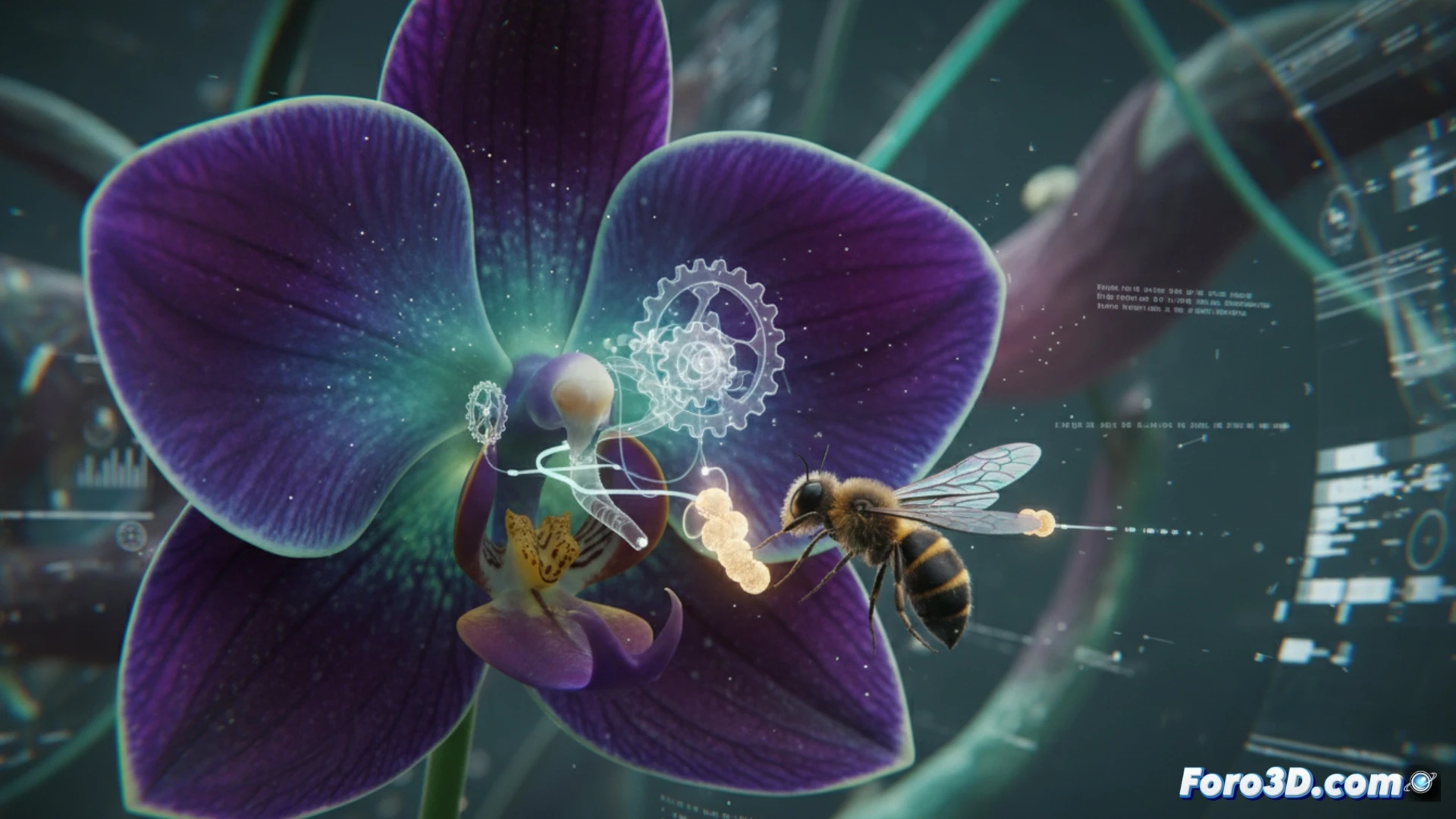
3D Modeling of Deceptive Pollination Mechanisms 🦟
3D technology allows these tactics to be recreated with anatomical precision. For the sexual deception of Lepanthes, an interactive model could show the floral structure that mimics the female mosquito, with animations of the copulation attempt and pollen transfer. In the case of Phragmipedium, a dynamic simulation would visualize the insect's fall into the pouch and its forced escape route through the stigmas. Data layers can even be integrated to represent the dispersion of odoriferous compounds in species like Bulbophyllum, giving volume to an invisible process.
Beyond Illustration: An Educational Bridge 🌉
These models go beyond mere illustration to become immersive learning environments. A student could virtually explore an orchid, layer by layer, understanding the exact relationship between form and function in its deception. This visualization not only explains but also generates awe for evolutionary complexity, making tangible the urgency to conserve these threatened species and their intricate survival strategies.
How can the complex deception mechanisms and floral structures of orchids be modeled and animated in 3D to effectively visualize and communicate their pollination strategies? 🌸
(P.S.: At Foro3D, we know that even manta rays have better social bonds than our polygons)