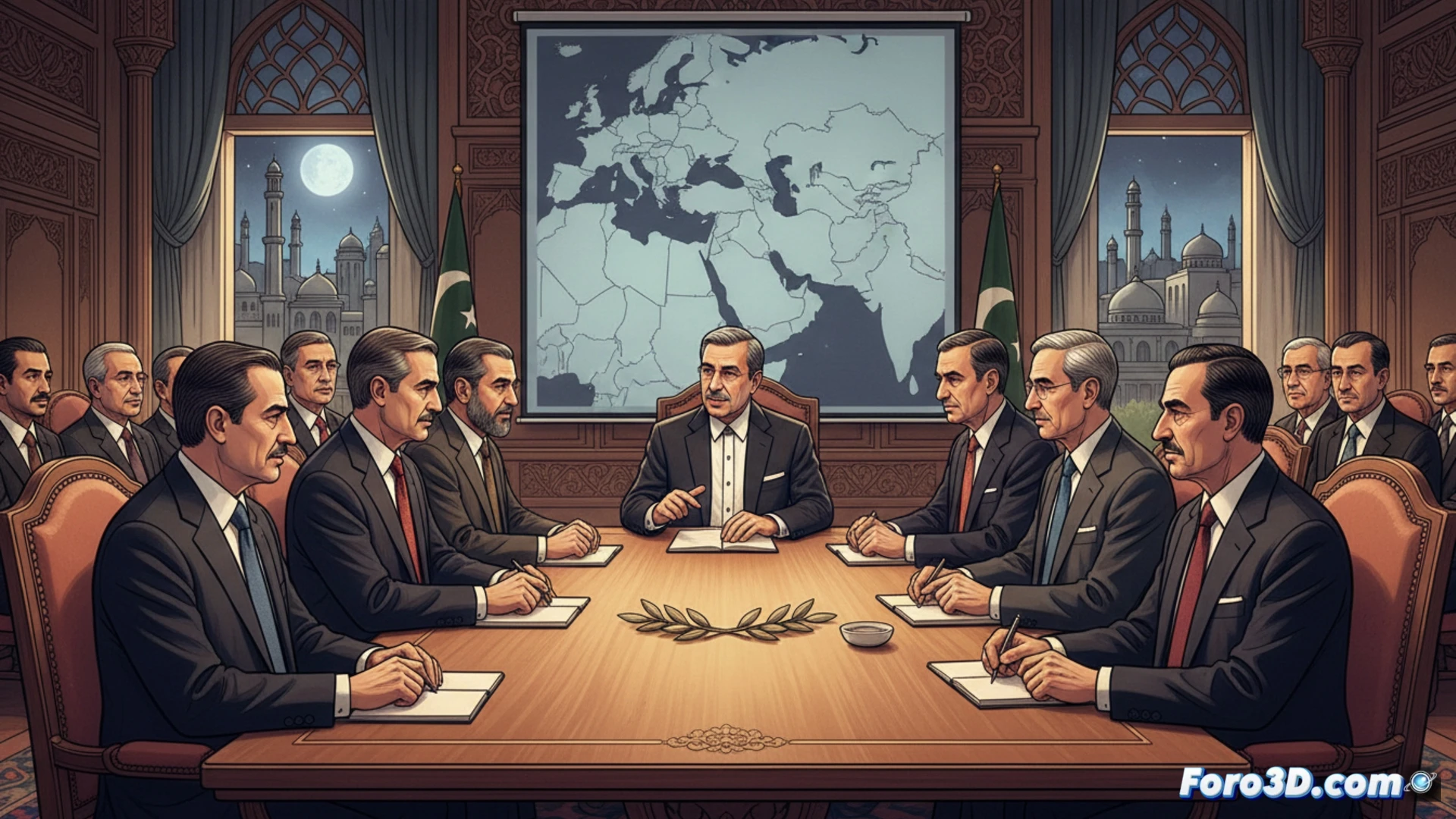
Pakistan emerges as a key mediator in the conversations between the United States and Iran, seeking to end an active war conflict since February. With the backing of powers like China and the UN, this diplomatic initiative opens a critical window for peace. At Foro3D, we analyze how three-dimensional visualization technology can transcend its traditional scope to become an indispensable tool in complex negotiation processes, offering clarity where there are only political maps and statements.
3D Tools for Diplomacy and Conflict Understanding 🗺️
Geospatial 3D cartography enables millimeter-precision mapping of force deployments, critical bases, and disputed air and maritime spaces in the region. Beyond simple location, dynamic 3D simulation is essential for modeling de-escalation scenarios, virtually testing the impact of troop withdrawals or the establishment of security corridors before implementing them. Additionally, the 3D reconstruction of civil and energy infrastructures, such as refineries or nuclear plants, can quantify the potential damage from an escalation and serve as a basis for protection agreements. These interactive representations offer negotiators and the public a tangible understanding of the complexity of the theater of operations.
Beyond Modeling: Visualization as a Common Language 🤝
The true power of these tools lies not only in their technical precision, but in their ability to create a common visual language. At a table with actors from such opposing narratives, an objective 3D model can clear ambiguities, focus the debate on concrete spatial facts, and facilitate transparency. By visualizing agreement proposals, the space for misinterpretation is reduced. Thus, 3D technology becomes a digital bridge, supporting the work of mediators like Pakistan by transforming abstract concepts of diplomacy and security into manipulable and understandable visual realities for all.
How can the 3D modeling of strategic corridors and military deployments in the Persian Gulf, visualized in real time during negotiations, facilitate de-escalation and build trust between the US and Iran?
(PS: at Foro3D we document war damages with the same millimeter precision as our meshes)