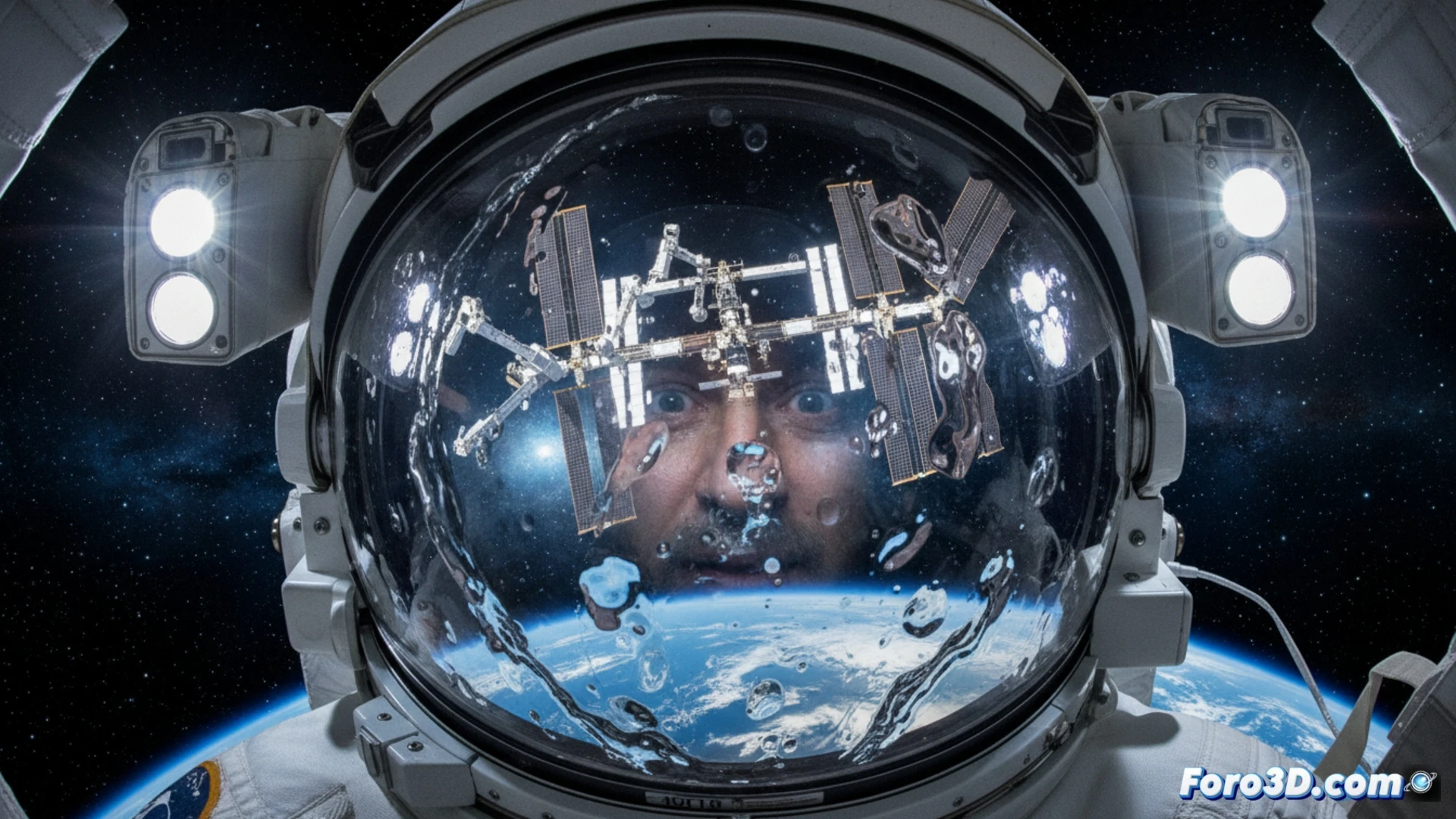
In 2013, during a spacewalk, astronaut Luca Parmitano faced a critical situation when his helmet began to fill with water. With his vision and hearing nullified, and the liquid blocking his nose, his only priority was to return to the safety of the International Space Station. This account is not just a survival anecdote, but a perfect scientific case study for 3D visualization and simulation technologies, which allow us to break down and understand every physical and human aspect of the emergency.
Modeling and simulation of fluids in microgravity 🌀
Recreating this incident with fidelity requires precise modeling of the spacesuit helmet, considering its reduced volume and internal geometry. The key lies in simulating water behavior in microgravity, where capillarity and surface tension dominate over gravity. Fluid dynamics software can visualize how water adheres and spreads across the helmet surfaces, accumulating in critical areas like the visor and nasal zone. This simulation not only illustrates the sequence of events but also allows analysis of failure points, reaction times, and the effectiveness of emergency procedures, transforming the account into an invaluable tool for astronaut training.
Beyond training: an educational tool 🧑🚀
The 3D visualization of this event transcends the realm of operational training. By digitally reconstructing the astronaut's perspective, immersed in the void with his field of vision progressively blocked, we can communicate to the public the physical reality and extreme risks of space exploration. These recreations make fluid science in weightless environments tangible and humanize the technology, serving as a powerful bridge between the complexity of space engineering and public understanding.
What technique would you use to represent years of social bonds in an animation?