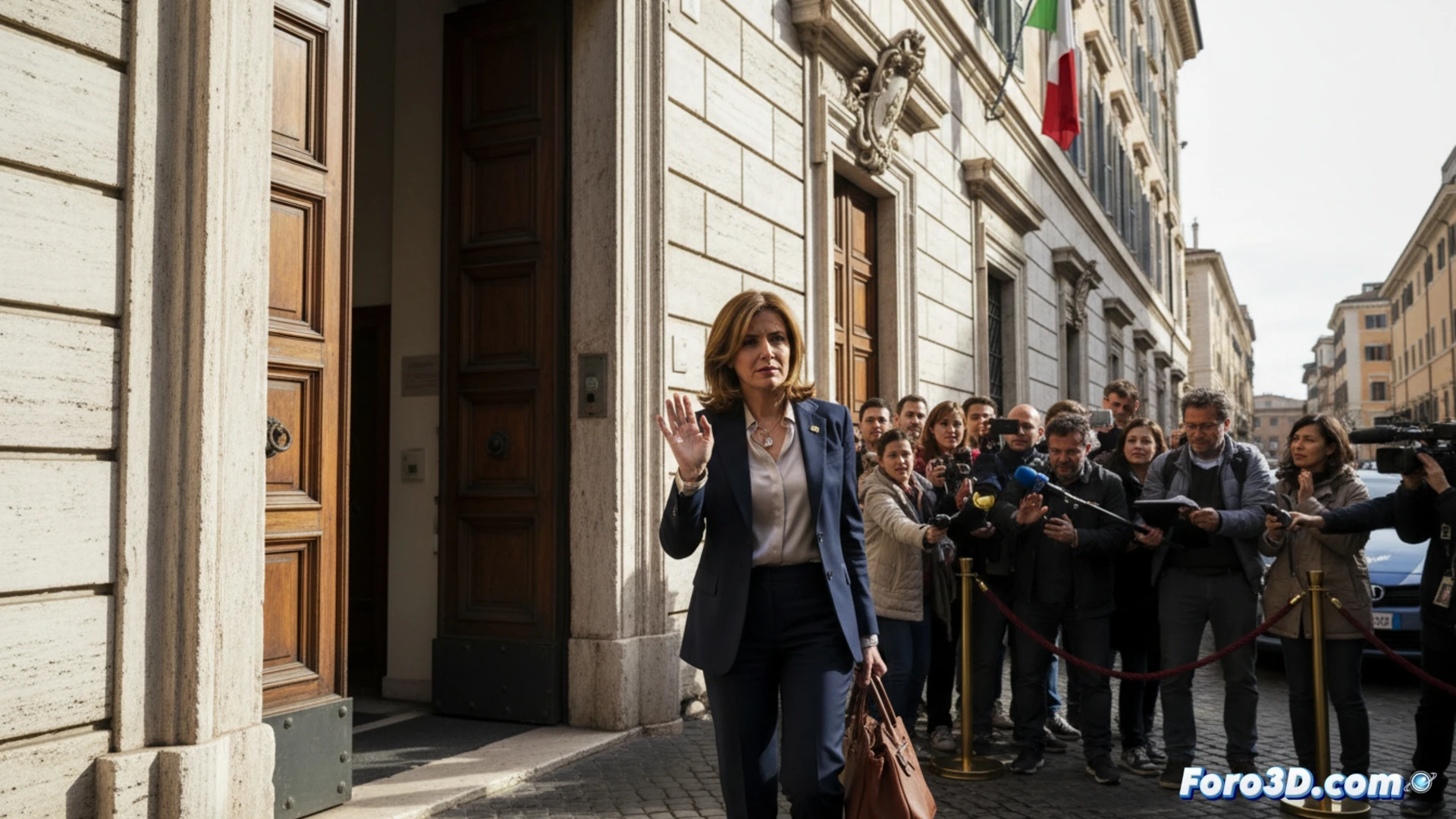
Italian Minister Daniela Santanchè's resistance to resigning, despite her prime minister's request and the judicial investigations, transcends the political realm to become a case study in communication under pressure. Her arrival at the office, reserved and without statements, contrasts with the political and media storm surrounding her. This scenario is ideal for applying a technical analysis of her nonverbal communication and modeling in 3D the complex network of institutional, judicial, and political forces that define this crisis.
3D Deconstruction of Body Language and the Pressure Network 🔍
Through photogrammetric analysis of her arrival, we can quantify microexpressions, body angles, and proxemics, revealing stress or avoidance levels not perceptible to the naked eye. Parallely, an interactive 3D network model allows visualizing this crisis. The nodes would represent key actors: Santanchè, Meloni, the Milan prosecutor's office, opposition parties. The connectors, color-coded and thickness-coded, would show the nature of each link: political pressure, hierarchical dependence, judicial conflict. This dynamic model would illustrate how judicial pressure transfers as political tension within the coalition and how the no-confidence motion acts as a formal counterweight.
When the Silent Image Speaks More than Words 🤐
Santanchè's strategy, public silence, is in itself a powerful message analyzable visually. In a 3D model of the public sphere, her profile would appear as an isolated node, while information flows and accusations converge on it from justice and the opposition. This communicative void, far from being passive, becomes a shield that forces other actors to move their pieces on the visible board. Visual analysis confirms that, in political crises, what is not said and how one acts physically builds a narrative as decisive as official speeches.
How does visual analysis deconstruct Daniela Santanchè's nonverbal communication strategy to project resilience and defiance in the face of political and media pressures?
(PD: press conferences are like STL files: sometimes they open, sometimes they don't, and you never know why)