Aston Martin faces the start of the season with a serious technical problem. Its AMR26 suffers from severe vibrations originating in the power unit, which are transmitted to the chassis and limit its drivers. Fernando Alonso cannot exceed 25 consecutive laps without the risk of nerve damage in his hands. After a complex preseason, the team has achieved a provisional solution tested on the bench, reducing the vibrations and giving a glimmer of hope for the Australian GP.
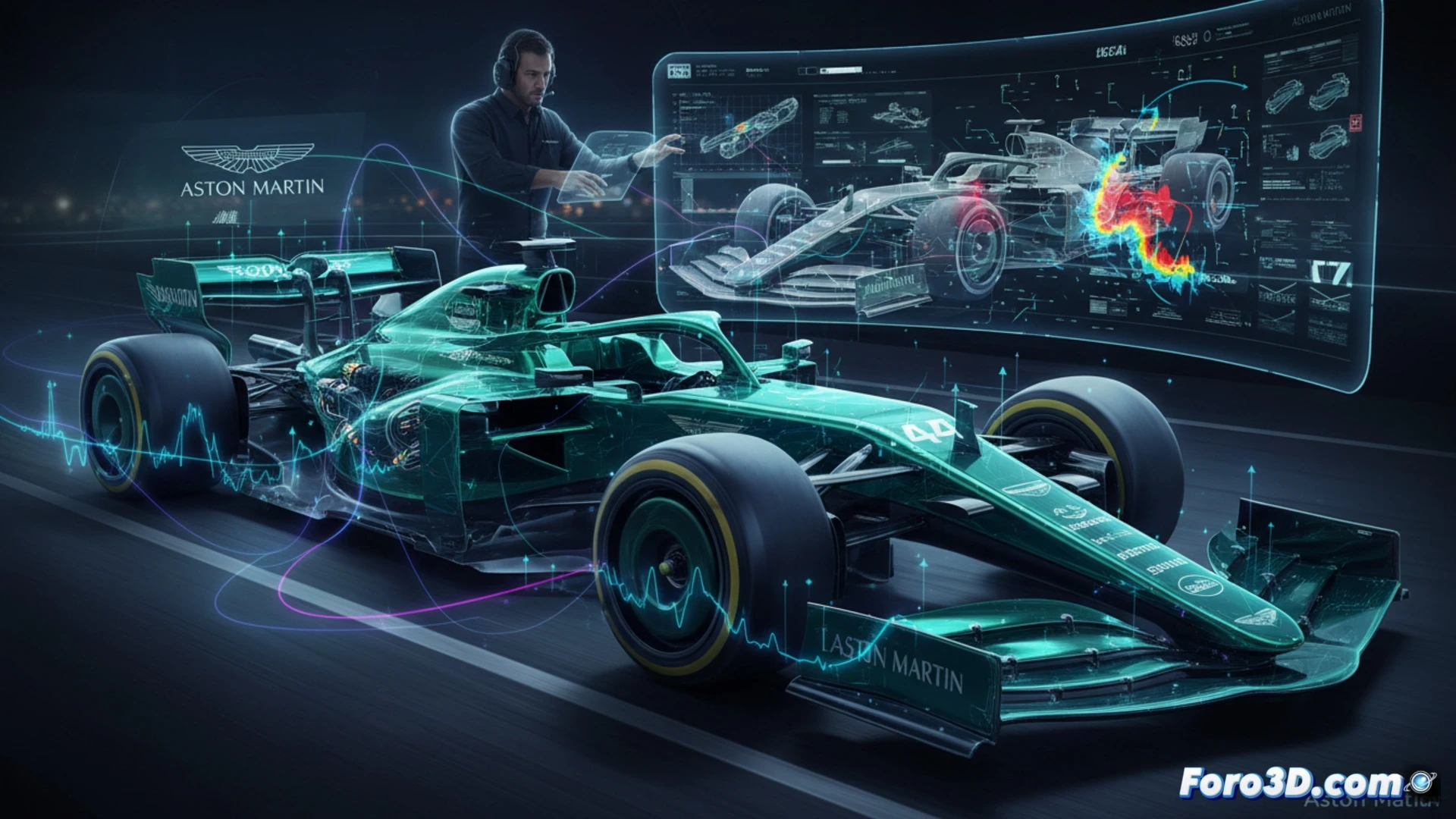
Virtual diagnosis and bench solutions: the technical process 🛠️
The key to addressing a problem like this lies in digital recreation. Using 3D modeling and simulation tools, engineers can generate a digital twin of the single-seater. This model allows isolating and analyzing the critical interaction between the power unit, the battery, and the chassis structure. Fluid dynamics simulations and finite element analysis identify resonances and stress points. Before any physical modification, solutions are tested virtually and then on test benches that replicate track conditions, validating their effectiveness in damping vibrations without compromising performance.
More than performance: simulation for driver safety 🧑🚒
This case underscores that 3D simulation in F1 goes beyond the pursuit of speed. It is a vital tool for the driver's safety and physical integrity. Visualizing and quantifying how forces and vibrations travel through the chassis to the steering wheel allows evaluating long-term risks, such as the vibration injuries suffered by Alonso. The technology not only optimizes a car but also protects the athlete, demonstrating that 3D innovation is fundamental on all fronts of elite competition.
What software would you use to visualize possession and pressure statistics?