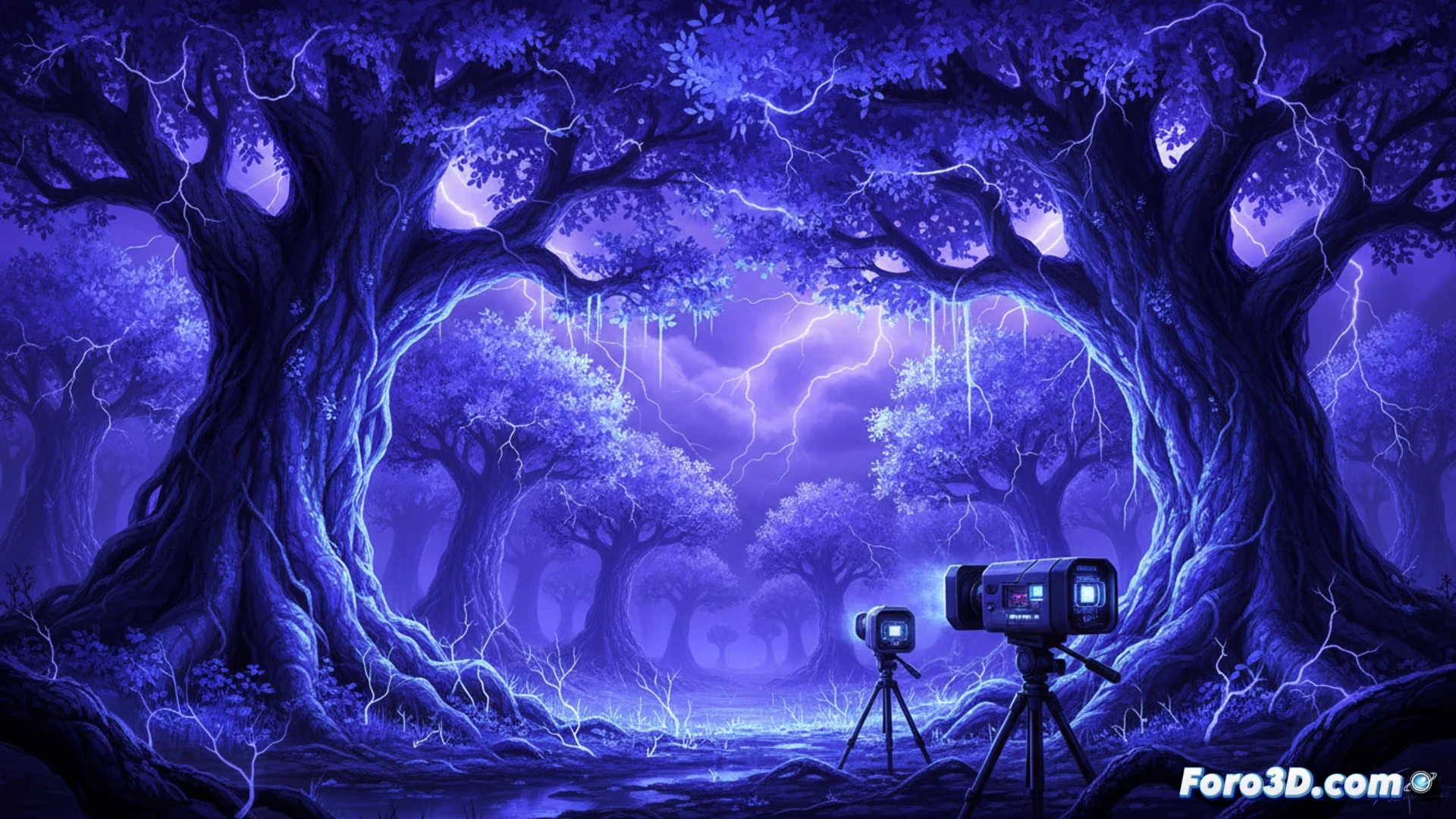
During storms, the tips of trees can emit a faint bluish and ultraviolet glow, a phenomenon called corona or corona effect discharge. Inspired by this curiosity, a team from Penn State University decided to investigate it. First, they replicated the event in the laboratory by applying high voltage to branches, and then they took a specialized ultraviolet camera to Florida. Their perseverance paid off: they recorded these coronas in real trees for the first time during thunderstorms, confirming their active role in charge exchange with the atmosphere.
Scientific visualization as a discovery tool 🔬
This finding, published in Geophysical Research Letters, is a triumph of scientific visualization. The process followed a robust method: validation in a controlled environment (laboratory simulation) and verification in the real world with specialized instrumentation. The UV camera acted as an extended eye, capturing wavelengths invisible to us and transforming abstract data into incontrovertible visual evidence. This methodology is analogous to using 3D renderings and computer simulations to predict and analyze complex physical phenomena before observing them, closing the cycle between theory, simulation, and empirical observation.
Beyond the visible: simulate to understand 💡
The case illustrates the power of visualization techniques to unveil nature's secrets. Just as UV cameras made the electric discharge visible, 3D graphics and computational simulations allow us to model everything from fluid flows to structural stresses, exploring inaccessible or dangerous scenarios. This approach not only advances science but also offers powerful visual narratives to communicate complex discoveries to the public, democratizing knowledge and inspiring new questions.
How can scientific visualization techniques be used to simulate and analyze the ultraviolet light emission from trees during thunderstorms?
(P.S.: if your manta ray animation doesn't excite, you can always add Channel 2 documentary music)