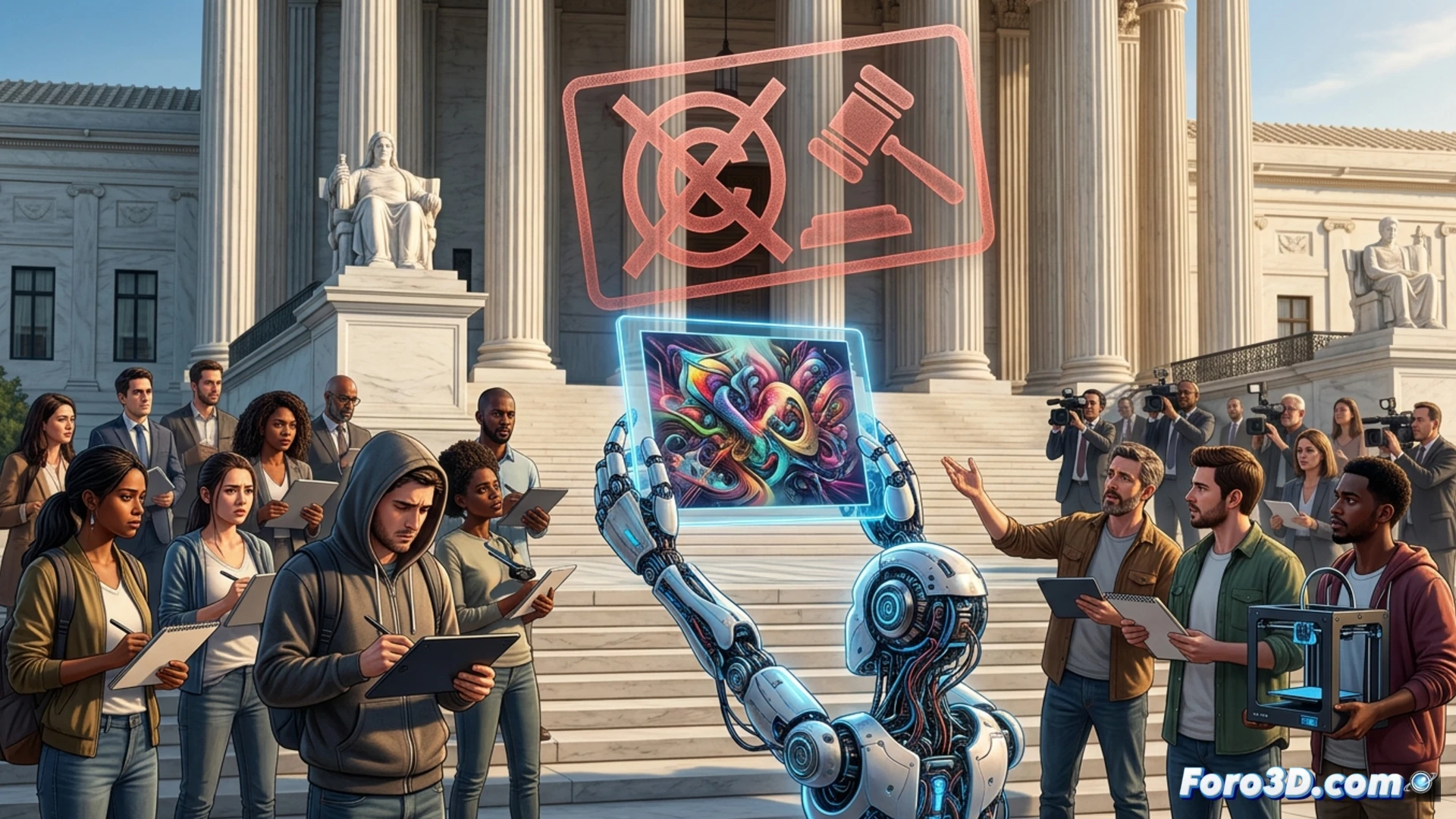
The United States Supreme Court has confirmed that works generated exclusively by artificial intelligence cannot be protected by copyright. The decision, which closes the case of scientist Stephen Thaler and his AI-generated image, establishes a crucial precedent: no human author, no copyright. This directly impacts digital creators and 3D artists who use these tools, leaving their purely generative works without the automatic protection of traditional copyright.
The principle of human authorship and its technical application ⚖️
The ruling is based on the fundamental principle that copyright protects expressions of human creativity. The Copyright Office argued that a work produced through a simple text prompt lacks the creative touch and intention of a human author. For 3D creators, this means that a model generated 100% by AI from a textual description is not registrable. However, the debate becomes complicated with hybrid works. The legal strategy now must focus on meticulously documenting the human creative process: the selection, editing, modification, and composition of elements generated by AI. A base 3D model created by AI but significantly modified, textured, and assembled by an artist could, in theory, protect the portion of human authorship.
Practical strategies for creators in the post-decision era 🛡️
Artists and studios must adapt their workflows. Documenting every stage of the process with screenshots, file versions, and descriptions of human intervention is essential. Considering contractual licenses instead of relying solely on copyright can offer protection. Additionally, exploring figures such as trade secrets for internal AI tools or trademark registration for distinctive styles derived from AI processes becomes relevant. The decision does not close the door to all protection, but rather demands greater precision in claiming human creative authorship over the final result.
How does the U.S. Supreme Court's decision on the copyright of works generated by AI affect the legal protection of digital creations that combine significant human contribution with artificial intelligence tools?
(P.S.: AI can generate art, but not copyrights... like us, who generate polygons but not money)