TSMC's international expansion strategy is advancing steadily. Its future factories in Arizona, USA, already have their production capacity fully committed by giants like Apple, Nvidia, AMD, and Qualcomm. This move, driven by relocalization policies and geopolitical security, ensures demand even though only one plant is currently operational. With a total investment that will reach 165 billion dollars in the country, this project redefines the global map of semiconductor manufacturing.
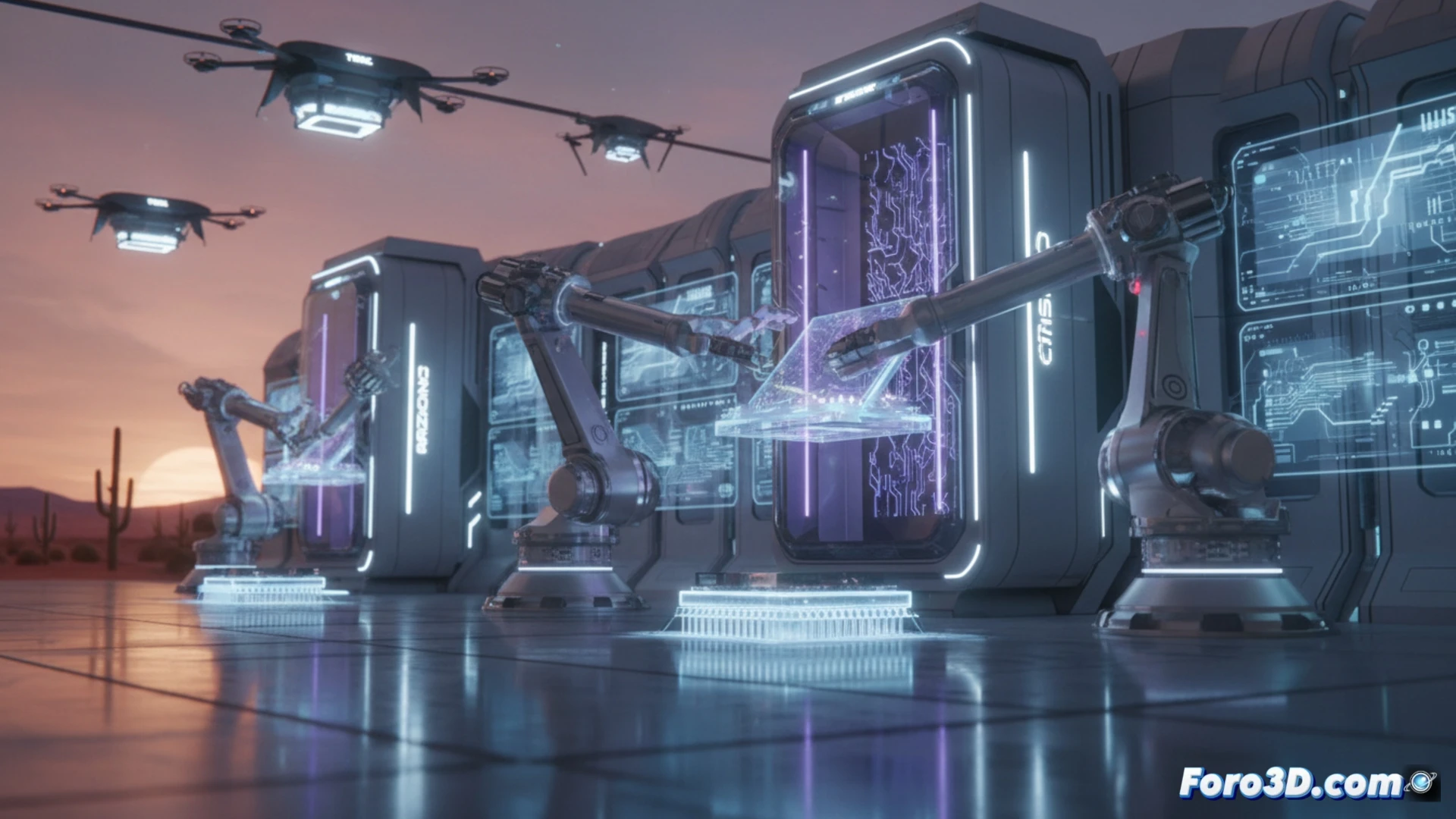
3D Visualization of Factories and Sub-2 Nanometer Processes 🏭
The complexity of these megaplants and the advanced nodes they will house, such as sub-2 nm production planned for 2030, requires 3D visualization tools for their understanding and design. Interactive 3D models of the facilities would allow analyzing material flows, clean room cleaning, and the layout of expensive EUV lithography machines. Additionally, 3D simulations of manufacturing processes are key for technical disclosure, showing layer by layer how transistors are built at atomic scales and how they are integrated into 3D-IC architectures. These tools are indispensable for planning the global distribution of capacity, where by 2028 20% of TSMC's production will be outside Taiwan.
3D Modeling as a Strategic Industrial Tool 🧠
TSMC's news underscores that competition in semiconductors is no longer just technological, but also in infrastructure and supply chain resilience. In this scenario, 3D modeling and simulation emerge as strategic assets. They enable optimizing the construction of billion-dollar factories, training specialized personnel in virtual environments, and effectively communicating the complexity of this industry. For the Foro3D community, this case opens a field of study to create visualizations that explain the engineering behind chip geopolitics.
How will 3D-IC integration and advanced packaging influence TSMC's capacity and specialization strategy in its new Arizona factories?
(P.S.: integrated circuits are like exams: the more you look at them, the more lines you see)