Donald Trump's recent threat to withdraw the United States from NATO is not just a political statement. It is a geopolitical earthquake with the potential to redefine global security and military supply chains. The trigger, the lack of automatic support in the conflict with Iran and the veto of bases in Spain and Italy, exposes deep cracks. At Foro3D, we analyze this scenario through spatial modeling to visualize the strategic consequences of a NATO without its main pillar.
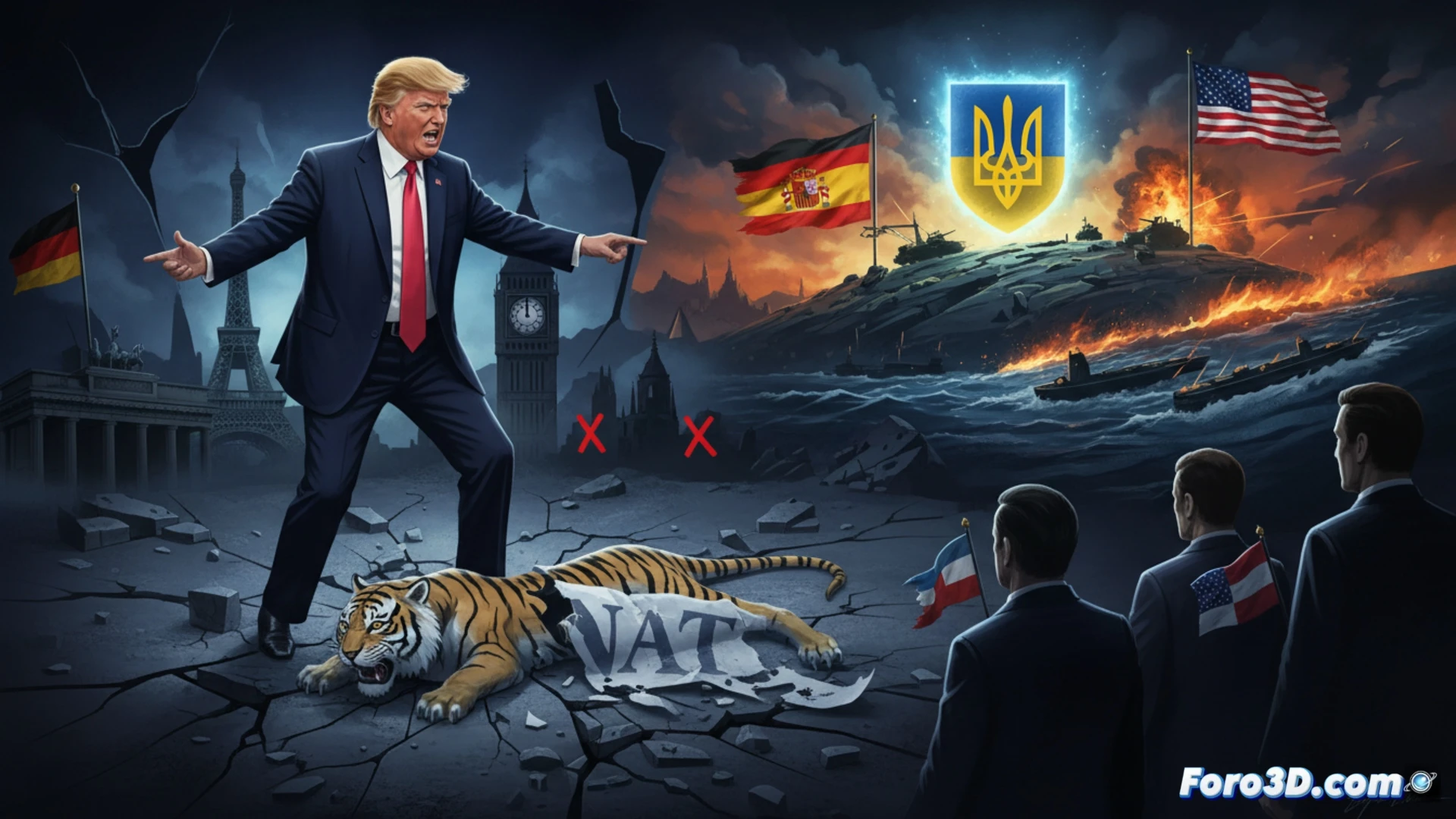
3D Visualization: Critical Routes and Key Bases at Stake 🗺️
An interactive 3D model allows mapping the current defense architecture. It highlights vital maritime routes, such as the Strait of Hormuz, the focus of the crisis with Iran, and the logistical flow to Ukraine. The geolocation of key bases, such as Rota in Spain or Naples in Italy, shows power nodes that Washington could lose. By simulating the U.S. withdrawal, the model reveals coverage gaps, new influence corridors for powers like Russia or China, and stress points in European military material supply chains, now deprived of the U.S. logistical umbrella.
NATO as a System: Collapse or Reconfiguration? ⚙️
Beyond the map, the crisis questions the collective security system. The 3D visualization of dependencies shows Europe exposed on its eastern and Mediterranean flanks. The model invites reflection: would the alliance fragment into regional blocs? What new bilateral agreements would fill the void? The dynamic cartography not only illustrates the risk but becomes an essential tool for planning resilience in a world where alliances are no longer permanent.
What visual metrics would you use to show geopolitical dependence on chips?