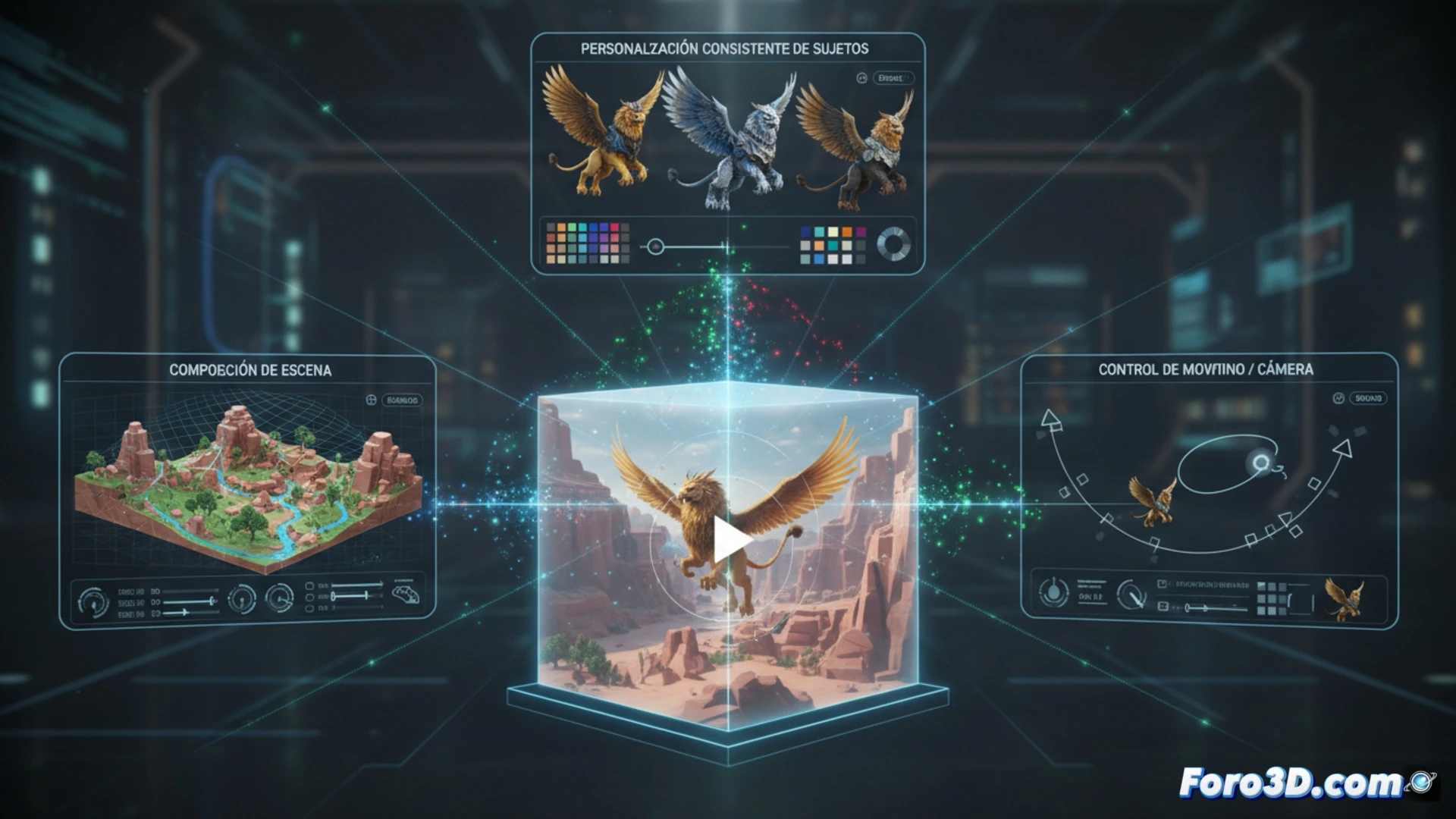
AI video generation has reached impressive visual quality, but precise and unified control remained a distant dream for creators. Until now. We present Tri-Prompting, a revolutionary unified framework that finally integrates three key dimensions: scene composition, consistent subject personalization, and motion/camera control. This breakthrough solves the biggest headaches, such as character identity loss across different shots or 3D inconsistency, opening the door to fully customizable and controllable video content creation.
Unified Architecture and Dual Motion Control 🎬
Tri-Prompting surpasses the fragmented approach of previous methods with a two-stage training architecture and paradigm. Its technical core is a dual-conditioned motion module: for backgrounds and scenes, it uses 3D tracking points, while for foreground subjects it employs reduced RGB cues. This ensures independent and precise control. Additionally, it introduces scale scheduling for ControlNet during inference, a crucial adjustment that balances fidelity to the instructed control with final visual realism, avoiding overstrained or artificial results.
A New Paradigm for the Digital Artist 🧑🎨
More than a technical model, Tri-Prompting is a paradigm shift. It enables previously impossible workflows, such as inserting a consistent 3D character into any filmed scene or manipulating the pose and movement of an existing subject in a still image. For 3D and video artists and content creators, this means moving from mere prompt suggestors to having real director control over the visual narrative, camera, and characters, marking the beginning of a true era of AI-assisted cinematic authorship.
How can the Tri-Prompting technique be implemented to maintain character and scene coherence throughout AI-generated video sequences in 3D art projects?
(P.S.: Generative art is like having a child who paints by itself. And you don't even have to buy it paints.)