CERN has achieved an unprecedented breakthrough: transporting antiprotons in a van. This delicate eight-kilometer journey was made possible thanks to a portable magnetic trap that prevented annihilation upon contact with ordinary matter. This success of the BASE-STEP project is not just a technical achievement; it is the key to performing extremely precise measurements in other laboratories, far from CERN's interferences. Scientific visualization becomes crucial to understanding the magnitude of this experiment.
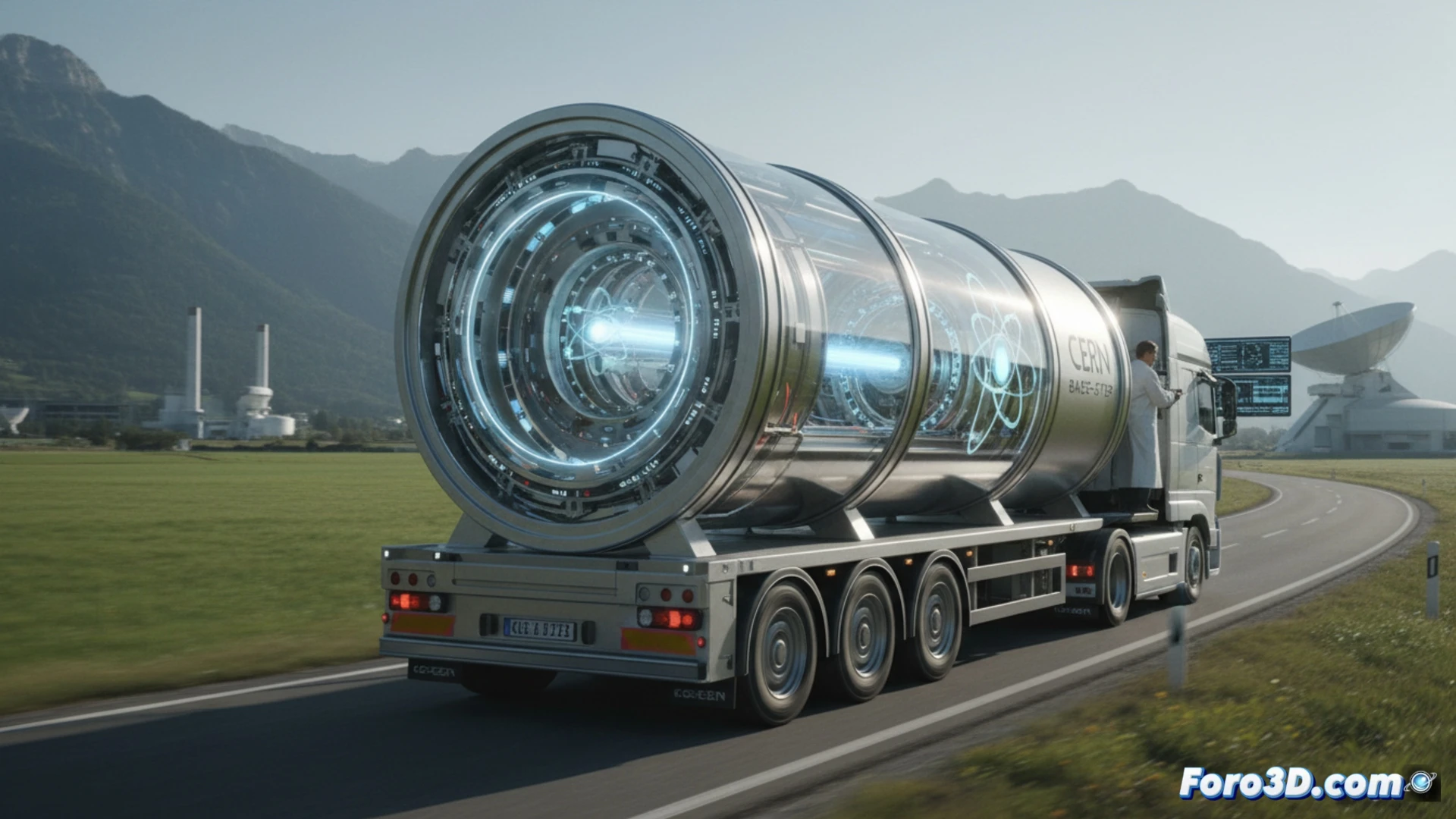
Visualizing the invisible: 3D modeling of the magnetic trap and annihilation 🔬
Understanding this achievement requires visualizing what cannot be seen directly. This is where 3D modeling and simulation are indispensable tools. An interactive infographic could show a cross-section of the Penning trap used in the transport, illustrating how electromagnetic fields confine the antiprotons in an ultra-high vacuum. Another key animation would simulate the annihilation process, showing how the collision between a matter particle and an antimatter particle turns into a burst of energy (photons), a phenomenon that the trap must avoid at all costs. These visualizations make cutting-edge research tangible.
The future of research, rendered in real time 🚀
The successful transport opens a new experimental era. The next big goal is to precisely measure how antimatter responds to gravity. Visualizing these future experiments through advanced 3D simulations allows scientists to design configurations and predict outcomes. Rendering in real time the trajectories of antiprotons in free fall, for example, would be a powerful tool for outreach and planning. Thus, scientific visualization not only explains the discovery but also paves the way to solving the cosmic mystery of the absence of antimatter.
What technique would you use to represent years of social bonds in an animation?