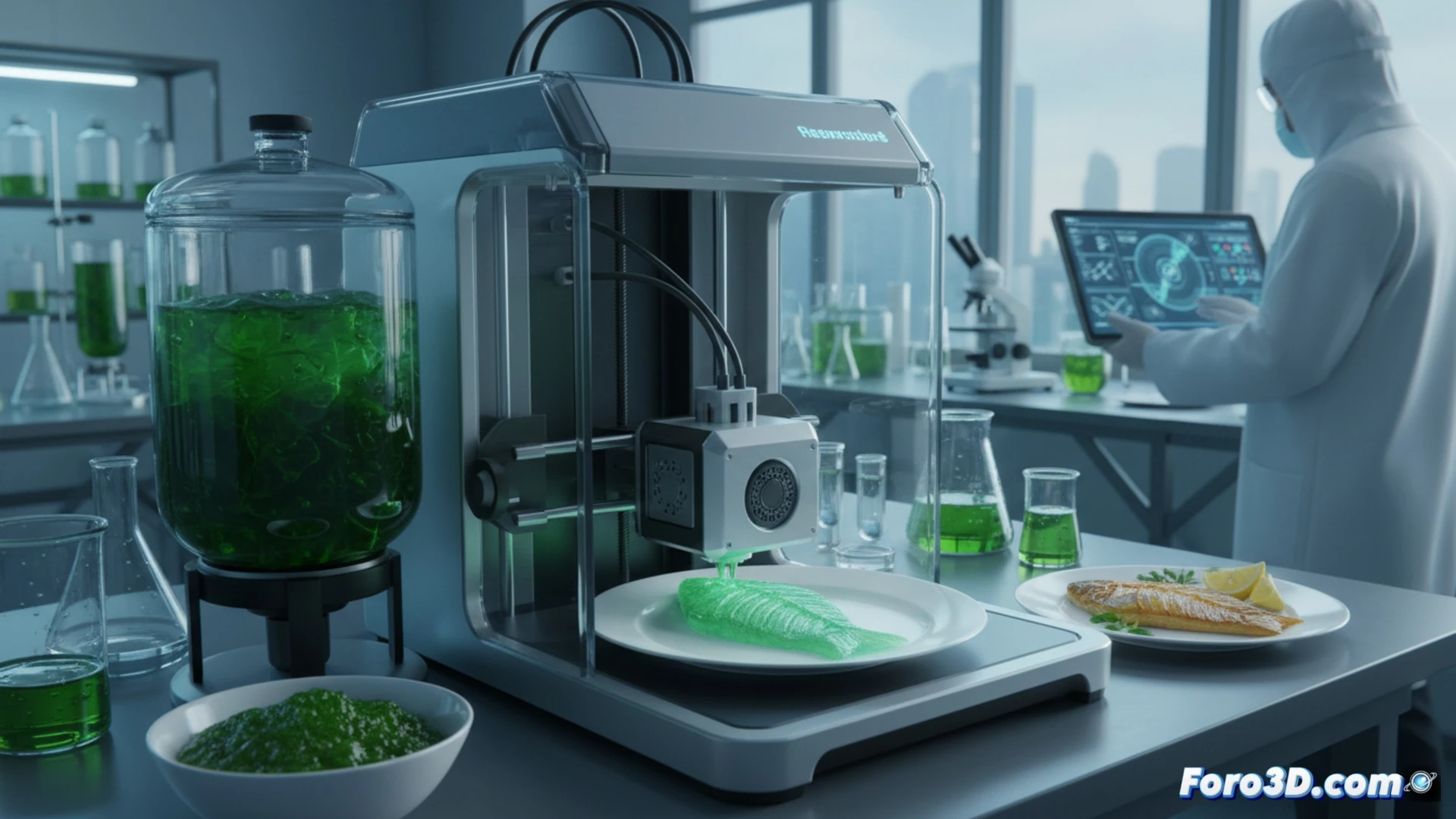
The search for sustainable alternatives to seafood takes 3D food printing to a new level. A research team from South Korea has created an edible ink based on the microalga *Auxenochlorella protothecoides*, designed to replicate the texture of fish. This approach proposes a single-ingredient protein analog, addressing the environmental impacts of the growing consumption of marine products.
Rheology and concentration: keys to stable extrusion 🧪
The success of printing depends on a precise formulation. Only the ink with 36% microalga biomass achieved stable extrusion and dimensional precision. Rheological analyses showed pseudoplastic behavior, necessary for it to flow when extruded and maintain shape afterward. The structure is predominantly elastic. Concentration is critical: too little biomass causes filament deformation, and too much causes nozzle clogs.
Nozzle steak or algae clogs? The delicate art of 3D fishing 🎣
It seems that the 3D chef must also be a fine watchmaker. The processing margin is so narrow that one more or less percentage point in the algae soup can ruin the banquet. One imagines the dilemma: do you prefer a steak that spreads like mush or a clog that requires disassembling the printer? At least, if the print fails, you can always eat the ink straight from the syringe. An emergency appetizer.