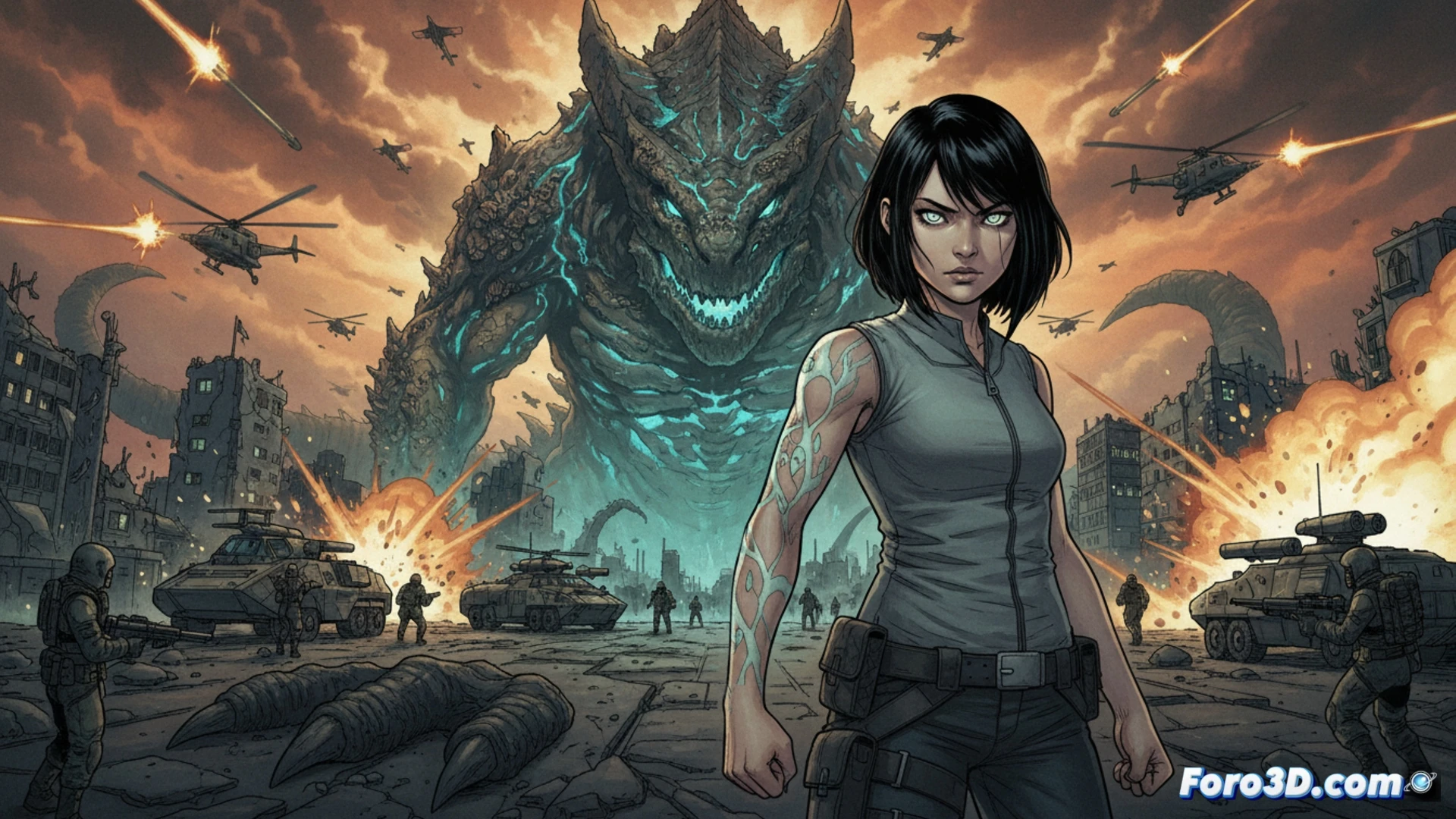
Dark Horse announces for October 2026 a graphic novel that transcends the mere spectacle of giant monsters. The Weapon Is Hungry, by Zac Thompson and Arjuna Susini, introduces Kana, a young woman who discovers that her biological father is a kaiju. This premise serves as a powerful narrative engine to explore the nature versus nurture debate, using the colossus metaphor to discuss inheritance, identity, and control over one's own destiny in the face of seemingly inescapable legacies.
The Visual Metaphor of the Kaiju in Narrative Construction 🎨
The kaiju here is not just a destructive force, but a visual manifestation of trauma and an overwhelming genetic inheritance. Susini's visual narrative will have the task of externalizing Kana's internal conflict, where her struggle for identity is reflected in the physical conflict between the kaiju father and the military forces. The creative team, with Thompson on writing, promises a psychological exploration where the graphic art must convey both the epic scale of the creatures and the intimacy of the human drama. This approach places the work in the trend of high-concept graphic novels, which function as dense narrative blueprints, ideal for possible animated or cinematic adaptations where the visual and thematic elements are inseparable.
Graphic Narratives as a Breeding Ground for Visual Ideas 💡
Projects like The Weapon Is Hungry reaffirm the role of the graphic novel as an essential laboratory for cinema and visual narrative. The freedom of the medium allows for the development of complex metaphors, such as the family kaiju, with a depth and rhythm that are difficult to achieve in other formats. The work not only tells a story, but builds a visual universe loaded with meaning, demonstrating how comics remain a vital space for the pre-production of ideas that can later resonate on larger screens.
How can the graphic novel The Weapon Is Hungry use the kaiju metaphor to explore the identity crisis in a way that conventional action cinema rarely allows?
(P.S.: Previz in cinema is like the storyboard, but with more chances of the director changing their mind.)