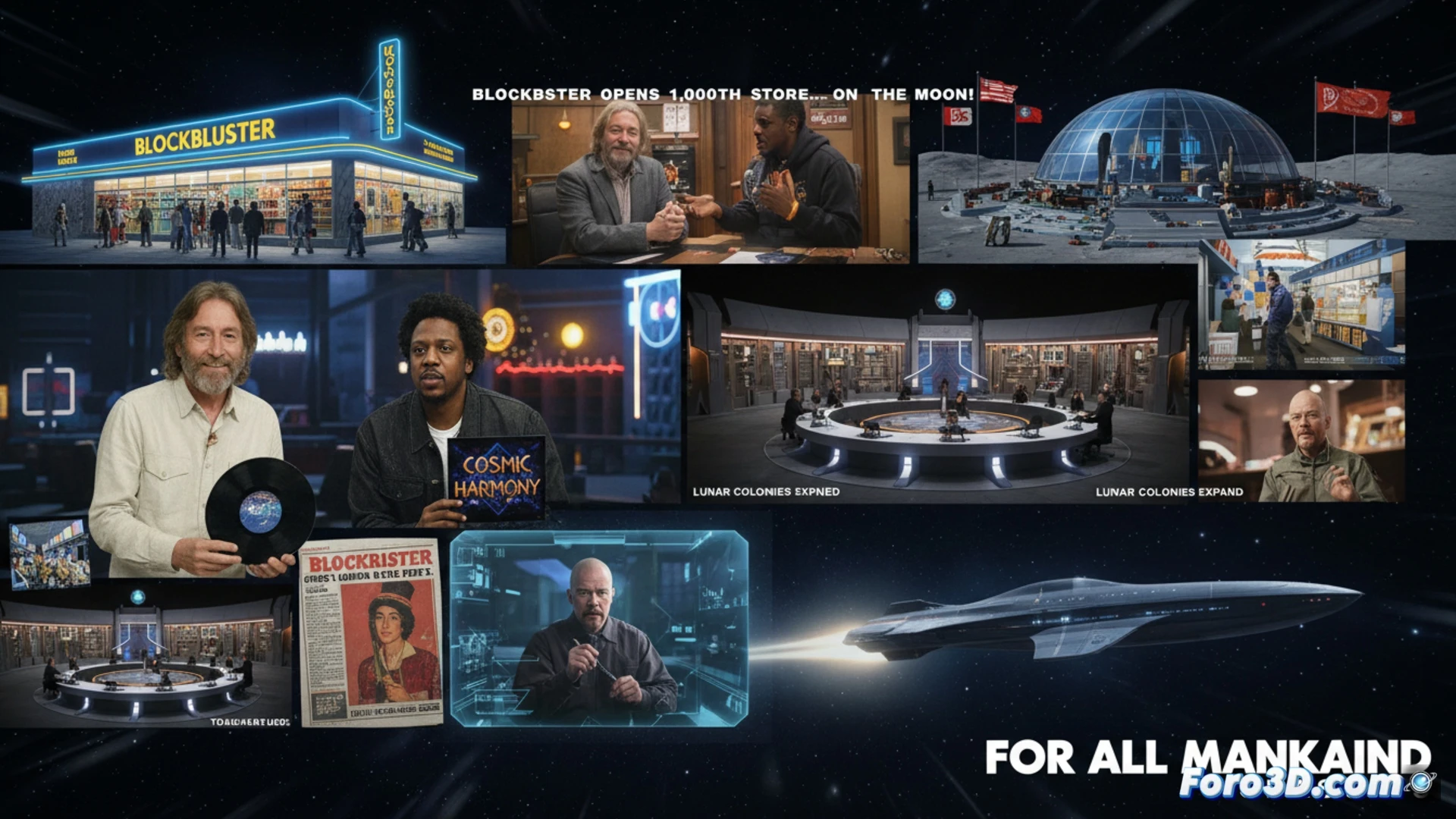
The fifth season of For All Mankind makes a nine-year leap, a complex narrative device that redefines its alternate universe. The opening montage synthesizes decades of divergent political and cultural changes, from the survival of John Lennon to a lunar Blockbuster. This sequence is not casual; it is the result of meticulous visual planning where tools like 3D storyboard and previsualization are essential for mapping the coherence of an evolving world.
Previs and 3D Storyboard: The Pillars of Narrative Coherence 🧱
For such information-dense time jump sequences, previsualization (previs) and 3D storyboard are fundamental. These techniques allow creators to lock the sequence, defining rhythm, composition, and transitions between multiple story fragments. Visualizing the alternate timeline in 3D, with its anachronistic and divergent elements, ensures that every image, whether a political poster or a store on the Moon, integrates logically and visually impactfully. It is the process where it is planned how to blend crucial data with cultural nods without losing the series' tone.
Visualizing the Divergent: Beyond Effects 🔍
The true power of these tools is not only in creating effects, but in building credibility. By visually planning from the script, the viability of complex ideas, like an alternate pop culture, can be tested, and ensured that they serve the main plot. This methodological approach is key for long-running series, where every visual detail in a time jump montage lays the narrative foundations for entire seasons, maintaining an expansive but coherent universe for the audience.
How do art directors and production designers plan time jumps to maintain visual and narrative coherence in a historical science fiction series like For All Mankind?
(P.S.: Previs in cinema is like the storyboard, but with more chances for the director to change their mind.)