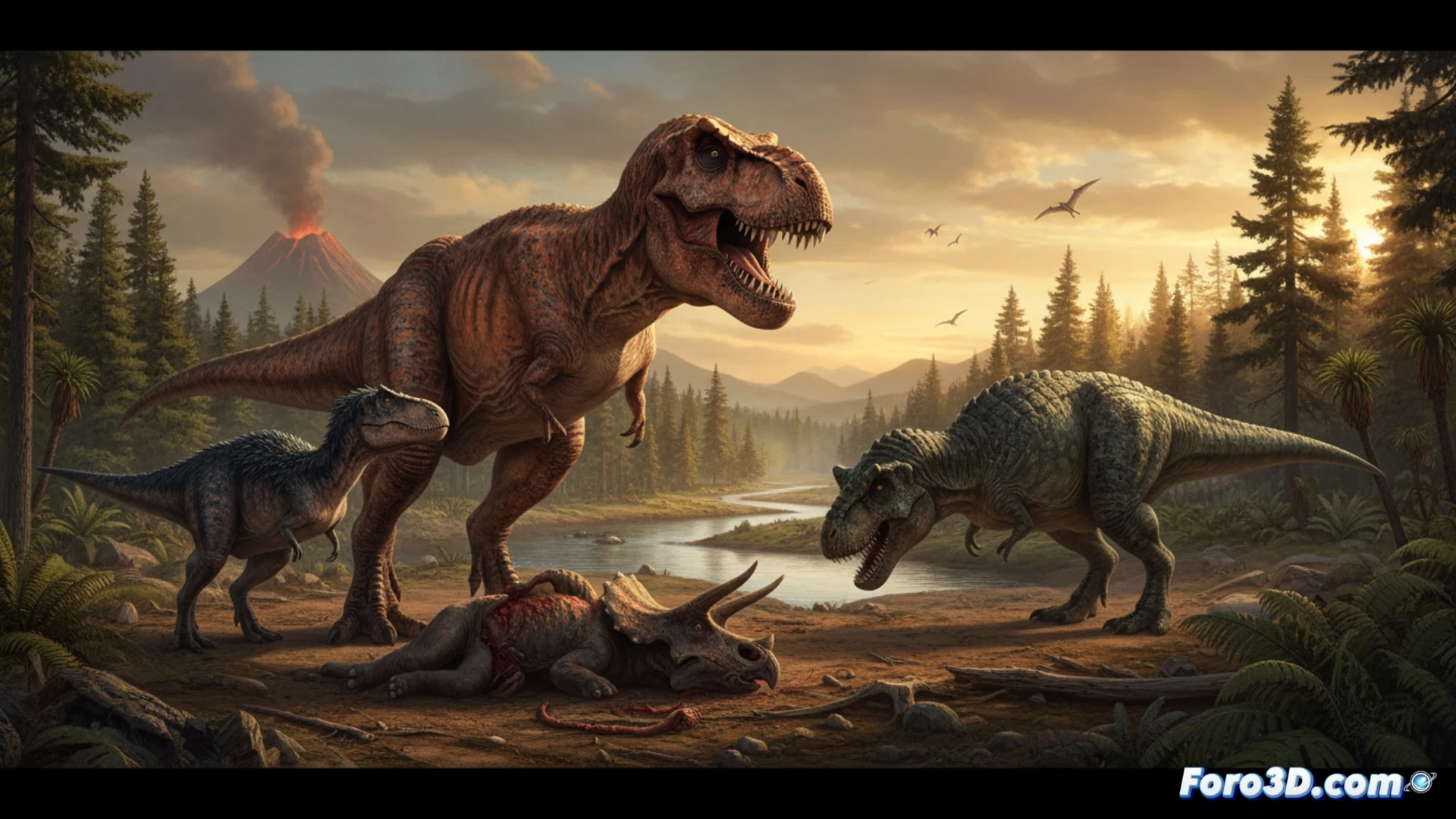
The image of the Tyrannosaurus rex as the supreme and undisputed predator of its time has been toppled. New fossils reveal that it coexisted with at least two other tyrannosaur species in North America. This discovery forces a complete rethinking of the structure of Late Cretaceous ecosystems. In our Scientific Visualization niche, this opens a fascinating field: how to represent in 3D this complex community of superpredators and their interactions?
3D Modeling to Deconstruct a Paleontological Paradigm 🦴
3D visualization becomes the essential tool for interpreting this new scenario. It is no longer enough to model isolated dinosaurs; now we need comprehensive digital reconstructions of the habitat that show possible niche partitioning. Through comparative 3D anatomical models, we can analyze differences in skulls and skeletons that suggest distinct diets or hunting strategies. Simulations of movements and territories in reconstructed environments help test hypotheses about how three large carnivores could coexist without eliminating each other, transforming bone data into a visual and comprehensible ecological narrative.
Revisualize to Understand: The Future of Paleontological Outreach 🧩
This case demonstrates that scientific visualization is not just illustration, but a research methodology. A 3D modeled ecosystem with multiple tyrannosaurs forces us to question established dynamics and enriches outreach. By visually showing this complexity, we bring the public to a deeper and less simplistic understanding of prehistory, where competition and coexistence shaped a much more intriguing world.
How can we use modern scientific visualization techniques to reconstruct and analyze the complex trophic interactions and biodiversity of the Late Cretaceous ecosystem, beyond the iconic figure of T. rex?
(P.S.: at Foro3D we know that even manta rays have better social bonds than our polygons)