The Strasbourg Oath, pronounced in the year 842, is a historical milestone. It not only sealed the alliance between Charles the Bald and Louis the German, but it is also one of the first written testimonies of a Romance language, Old French. This document marks the decline of Latin as the sole language and the birth of European vernacular languages. Its preservation and study are crucial for understanding our cultural identity.
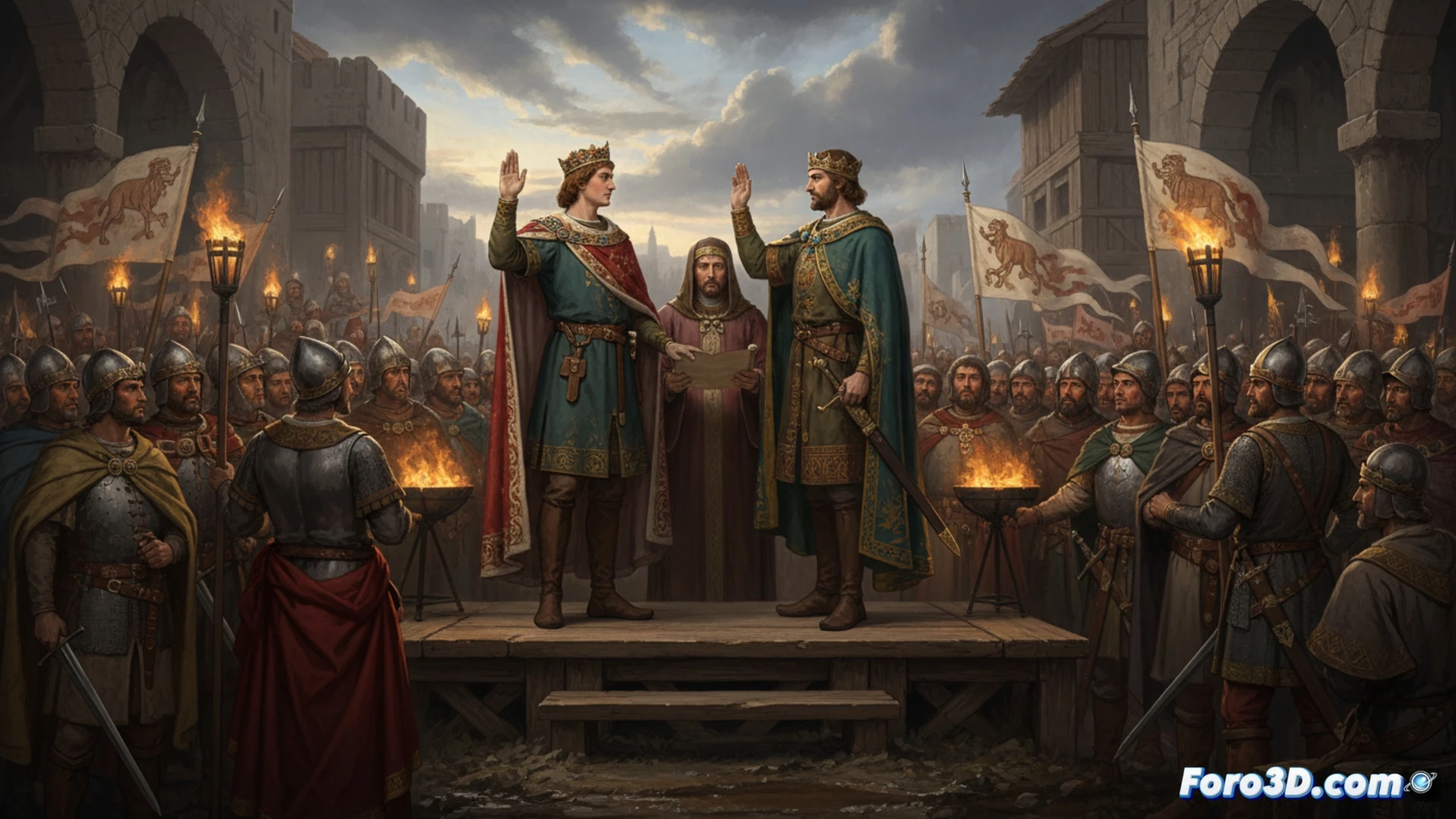
Digital reconstruction: from parchment to immersive experience 🖥️
Digital Archaeology allows us to go beyond plain text. We can 3D scan the scarce fragments of the manuscript, recreating its texture and degradation for non-invasive analysis. But the potential is greater: imagine an interactive model of the parchment with layers of information on linguistics and historical context. Or a virtual environment that reconstructs the oath ceremony, showing the characters and the landscape of the time. Even an animated map that visualizes the evolution of Romance languages from this turning point.
Documentary heritage and technological outreach 📜
This approach transforms the way we access heritage. An interactive 3D model not only digitally preserves a fragile artifact, but turns it into a powerful and accessible educational tool. It allows researchers and the general public to explore, question, and understand intuitively a foundational moment of Europe. 3D technology, thus, is not an end, but an essential bridge between our documentary past and future generations.
How can 3D modeling and digital archaeology help us understand the physical context and performativity of the Strasbourg Oath beyond the traditional analysis of its text?
(P.S.: If you excavate a site and find a USB, don't plug it in: it could be Roman malware.)