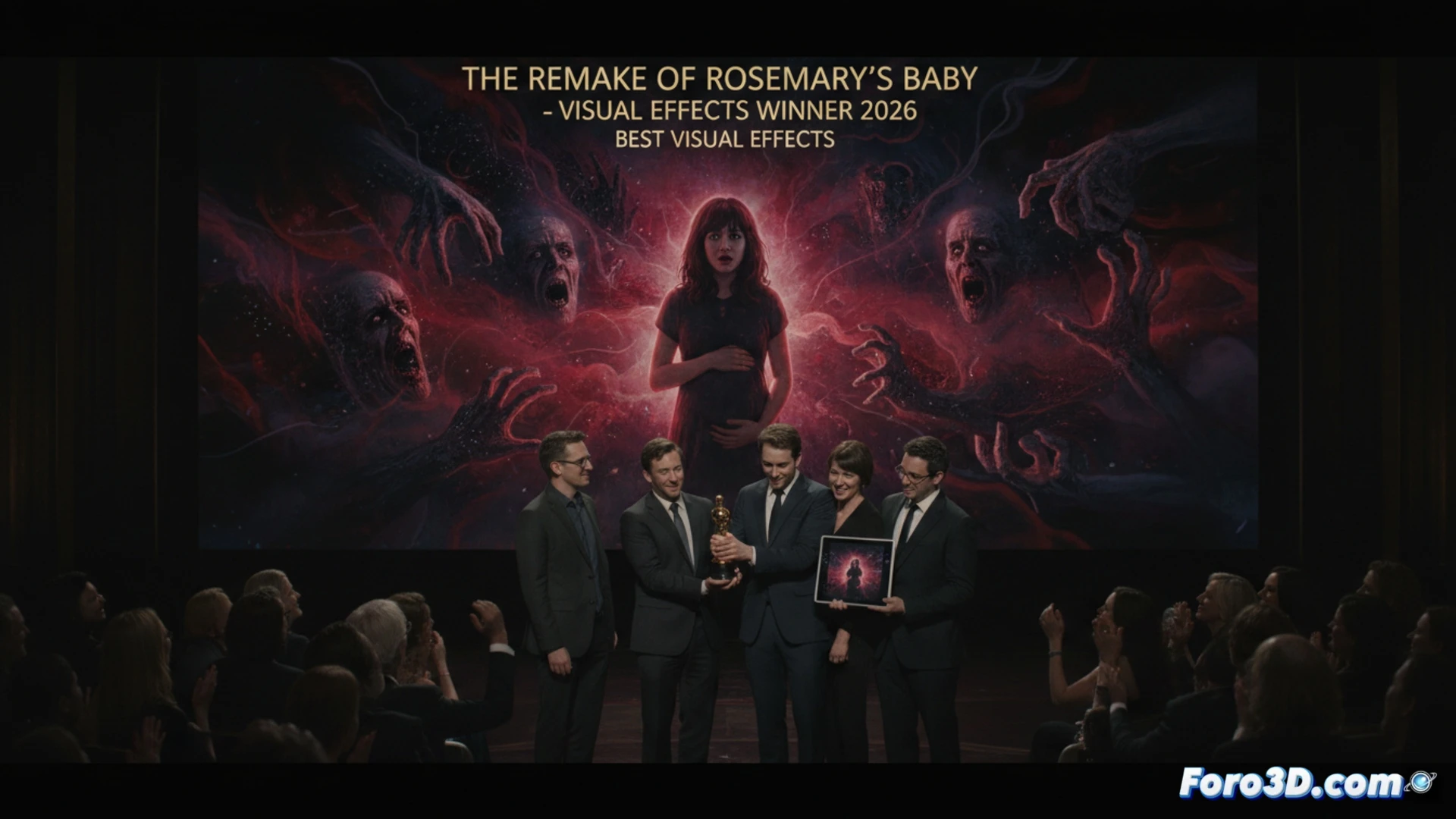
The remake of Rosemary's Baby, winner of the Oscar for Best Visual Effects in 2026, marks a milestone by creating palpable horror without physical elements. Abandoning miniatures and prosthetics, its artists built a nightmarish atmosphere entirely digitally. The achievement is not only technical, but narrative: each effect serves the psychological tension, demonstrating that modern CGI can evoke the original's primal fear with unprecedented and disturbing visual intensity.
Techniques behind the unease: from virtual scenography to real-time simulation 🎬
The film is built on a backbone of virtual scenography, allowing absolute manipulation of lights and shadows to distort familiar spaces. Facial and environmental deformations were achieved with procedural animation, while simulations of smoke, fog, and dark energy interacted dynamically with the actors. The key was advanced compositing, integrating hyperrealistic CGI—like the unsettling baby—with the performances in the same luminous and textured space. This generated believable interaction with invisible entities, where real-time color changes and deformations intensified the sensation of supernatural presence.
Beyond realism: the illusion of the real in the fantastic 👁️
The success of these VFX does not lie in their isolated photorealism, but in how they manufacture a coherent reality within the film's perturbing logic. The technological leap from the original is not just one of fidelity, but of immersion: the viewer does not question the veracity of the effects because they are organically linked to the drama and psychology of the characters. Thus, the movie positions itself as a benchmark: it proves that cutting-edge digital effects are the definitive tool for materializing the intangible and making the most abstract fear feel tangible and real.
How can digital visual effects manipulate the viewer's perception and psychology to generate deep and visceral terror, beyond conventional scares?
(P.S.: VFX are like magic: when they work, no one asks how; when they fail, everyone sees it.)