Recent attacks on Iran have tested the strategic alliance with Russia, revealing its true nature. Moscow, despite its rhetoric, has not intervened militarily. This relationship is not based on ideology, but on a cold calculation of interests. For the Kremlin, Iran is a crucial node in the North-South transport corridor and a vital supplier of drones for its war in Ukraine. However, its absolute priority remains the Ukrainian front, which limits its response to diplomacy.
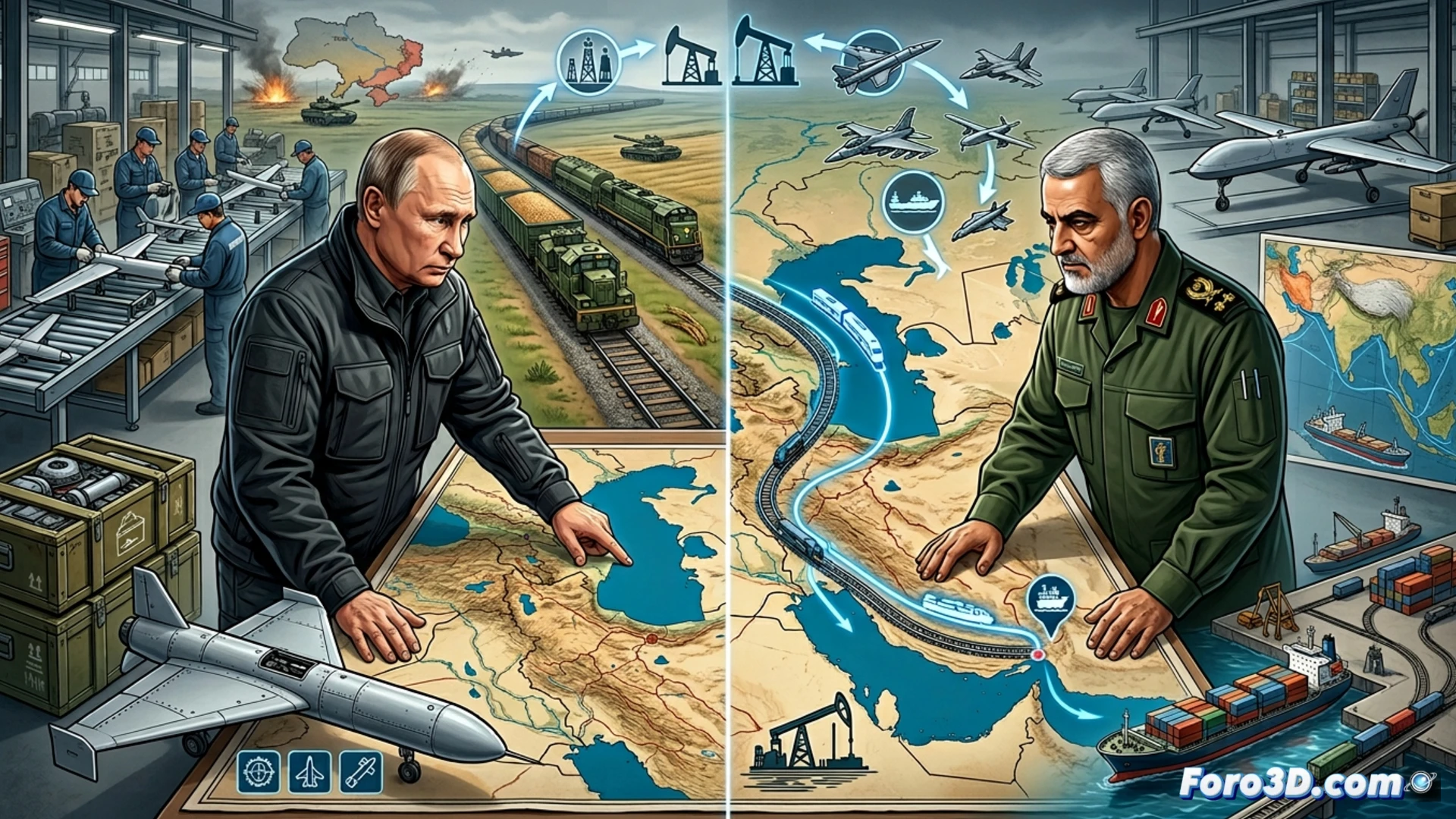
Visualizing Interdependence: Corridors and Critical Supplies 🗺️
To understand this dynamic, we must visualize two intertwined systems. First, the International North-South Transport Corridor, a multimodal route connecting Russia with India through Iran, bypassing traditional routes controlled by the West. Its disruption would strangle a strategic trade route for Moscow. Second, the reverse flow of military material, where Iran provides Shahed drones and advice to evade sanctions. A diagram of these interdependencies shows an alliance of convenience, not a monolithic bloc. A simulation of an Iranian collapse reveals immediate cracks in Russian logistics and its military capacity in Ukraine.
The Geopolitical Calculation: Risk versus Reward ⚖️
The final map is the Kremlin's risk calculation. Intervening for Iran would mean direct conflict with the West and probably with Israel, breaking a key tacit understanding. This scenario would divert massive resources from Ukraine, its main objective. Therefore, Russia assumes the risk of a weakened Iran rather than compromising its priority war. The alliance is strong economically and logistically, but deliberately weak defensively. It is a piece on its global chessboard, not an unbreakable commitment.
How would you model in 3D the global supply routes for electronic components?