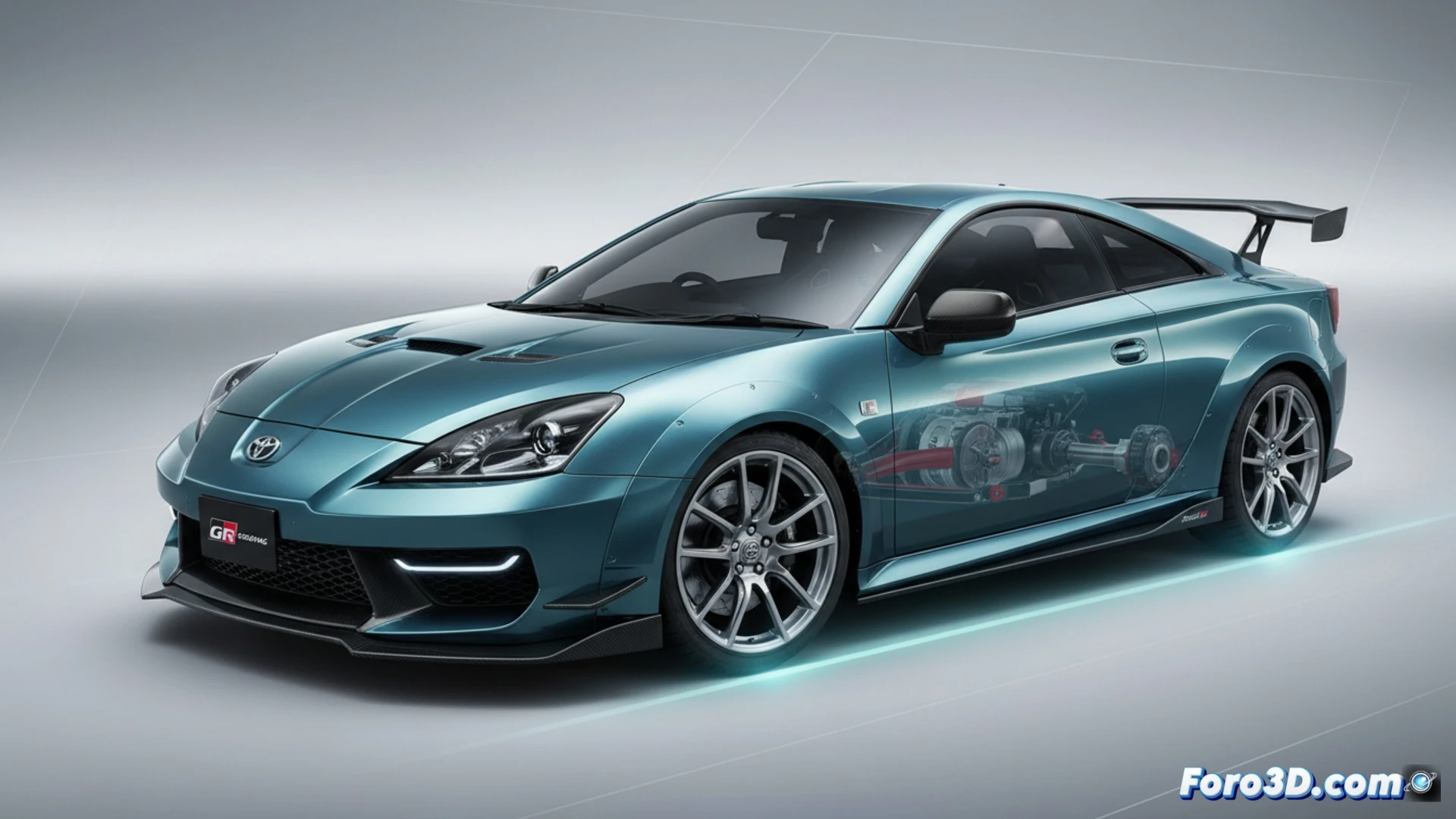
After twenty years, Toyota announces the return of the legendary Celica, now as Celica Sport. The eighth generation will recover all-wheel drive and, according to rumors, will bet on a 2.0-liter turbo hybrid engine from Gazoo Racing. This development, aligned with current regulations, cannot be understood without the advanced 3D modeling and simulation tools, which have been fundamental for integrating complex systems into an accessible sports car.
3D Simulation: from the hybrid chassis to virtual dynamics 🚀
The development of the new Celica Sport relies on 3D software suites for multiple phases. In the design of the body and chassis, space is optimized for the battery and electrical components without compromising rigidity. Computational fluid dynamics simulation (CFD) cools the thermal and electric engines. Additionally, the new all-wheel drive dynamics are modeled and tested virtually, adjusting torque distribution between axles to achieve sporty and safe behavior, all before manufacturing the first physical prototype.
Virtual prototyping: the efficiency that drives the sports renaissance ⚙️
This process, based on digital prototypes, is the key that allows Toyota to reactivate icons like the Celica or the Supra in a viable way. The reduction in engineering costs and time is enormous, allowing designs and technical solutions to be iterated with agility. Thus, 3D modeling is not just a design tool, but the pillar that makes the renaissance of gasoline sports cars economically sustainable in the era of electrification.
How has 3D modeling and simulation influenced the redesign of the all-wheel drive in the new Toyota Celica Sport to balance performance and efficiency?
(PS: simulating an ECU is like programming a toaster: it seems easy until you order a croissant)