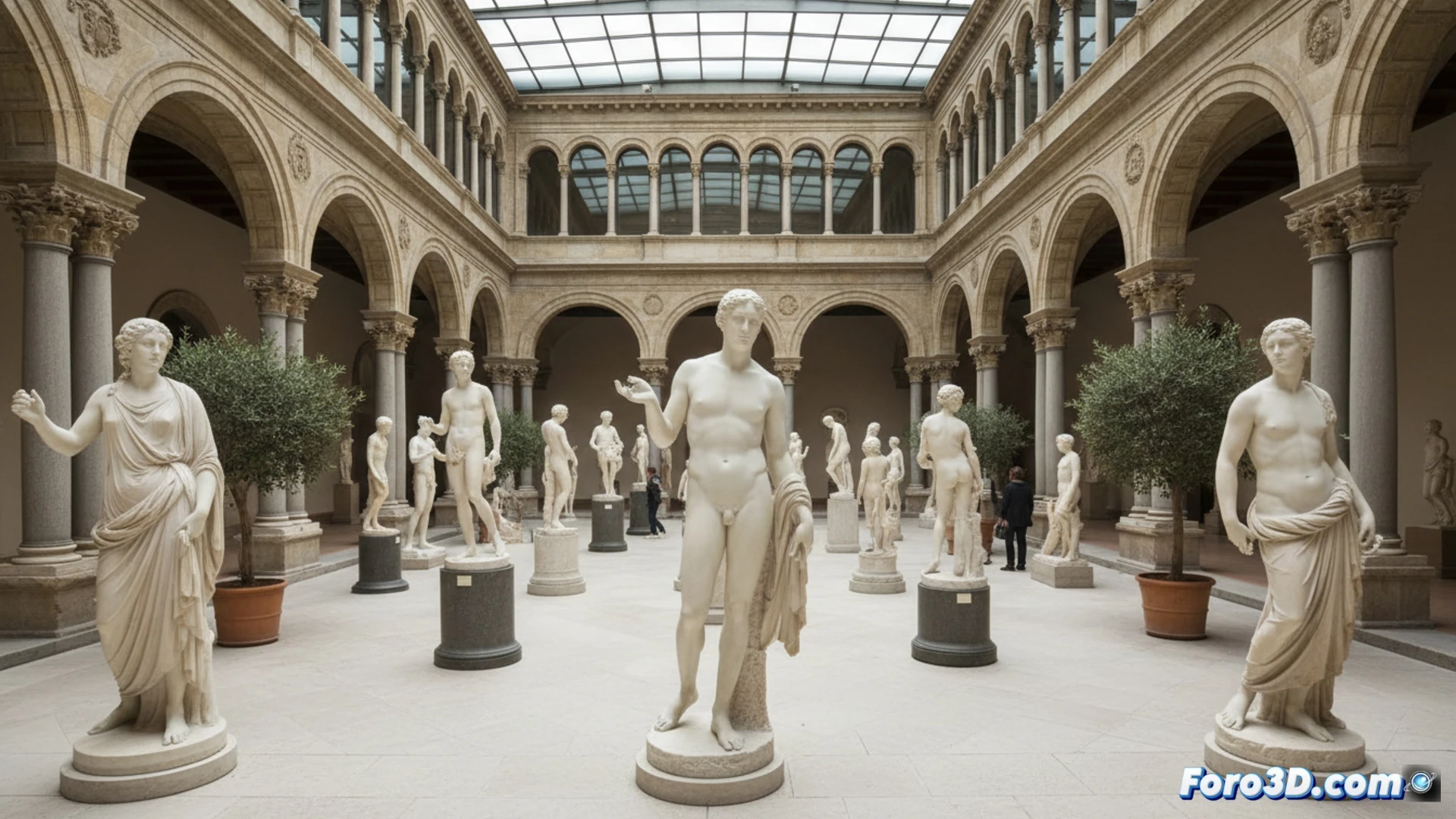
The Prado Museum has reconfigured its Cloister space to present a collection of 19th-century sculpture. The new arrangement follows a chronological and stylistic order, tracing the evolution of the nude during that period. Works by Ginés, Álvarez Cubero, or Solá show the transition from neoclassicism. The reorganization seeks to offer a clear narrative about this chapter in art history.
Museography as the engine of historical rendering 🖥️
This reorganization acts as a software update for the exhibition space. The chronological criterion is the main algorithm that orders the data (the sculptures). Lighting and spatial arrangement function as the user interface, guiding the visitor without interruptions. The result is a coherent rendering of a complex period, where each piece finds its context in the whole, avoiding visual information saturation.
The canon of the nude: the 19th-century benchmark ⚙️
One reviews the evolution of the nude and thinks that 19th-century sculptors were in a perpetual benchmark. Canova was the reference processor that everyone tried to emulate or overclock. Each Venus or Mercury was a new performance test in marble, competing for the greatest anatomical realism without going overboard with decorum. Now, their works pass the ultimate test: surviving the room change without a direct ray of sunlight falling on them.