In the desolate plains of Fuerteventura, the legend speaks of a wandering and pursuing light, the soul of a condemned shepherd. Beyond the tale, this documented phenomenon represents a perfect challenge for scientific visualization. Recreating this spectral light in 3D within its desert environment is not only an artistic exercise, but a tool to dissect the boundary between human perception, optical phenomena, and the intangible cultural heritage of the Canary Islands.
Breaking Down the Phenomenon: Hypotheses and Geometry 🔍
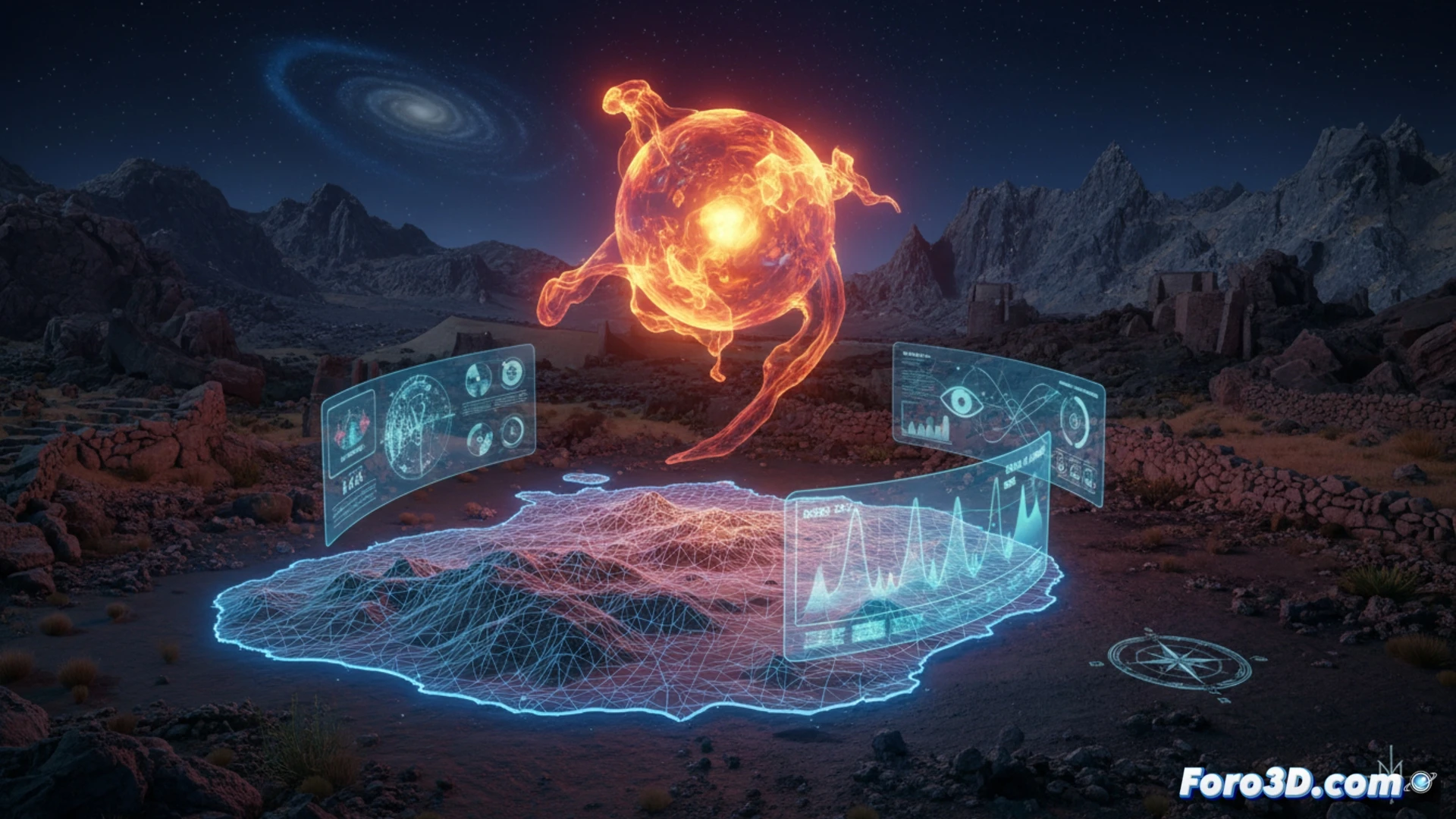
A rigorous 3D model starts from plausible scientific hypotheses. The visualization could simulate the spontaneous combustion of organic decomposition gases, such as methane, creating a will-o'-the-wisp whose wandering trajectory would be modeled with particle systems influenced by the wind. Alternatively, extreme atmospheric refraction effects could be recreated, such as superior mirages or flashes from distant sources, using shaders and air density maps. The environment, scanned or modeled from real geographic data, provides the essential scale and context to validate these simulations against testimonies.
Visualization as a Tool for Dialogue 🌉
The final model does not seek to debunk the legend, but to enrich it. A photorealistic visualization, or a stylized one with editable parameters, allows researchers and the public to explore how small physical variations generate the intelligent behavior described. Thus, 3D acts as a bridge: the modeled light is both an igniting gas and a restless soul, demonstrating that science and tradition are two languages to describe the same mystery in the darkness of the Majorero desert.
What technique would you use to represent years of social bonds in an animation?