A bill proposal in the U.S., H.R. 3385, threatens to create a legal vacuum for three-wheeled vehicles like the Polaris Slingshot. By redefining motorcycle to require handlebars, it excludes these autocycles with steering wheels, without offering an alternative category. This is not just a legal debate, but an engineering and design issue that directly impacts manufacturers, dealerships, and crucially, the 3D modeling and simulation processes behind these vehicles.
Hybrid engineering and the crucial role of 3D design 🔧
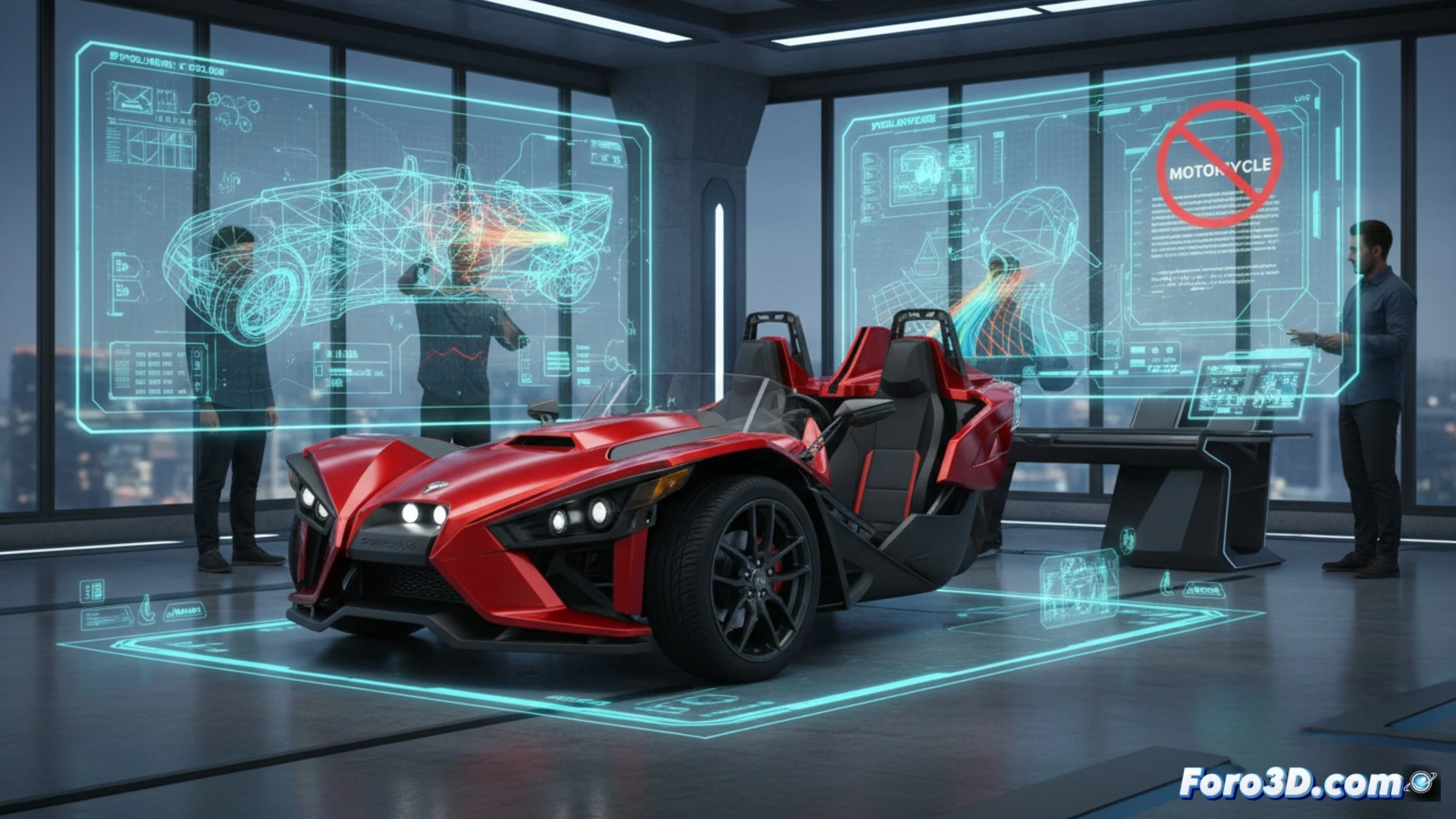
The core of the conflict is technical. An autocycle like the Slingshot is a hybrid: chassis and stability close to a car, but three-wheel configuration and lightweight of a motorcycle. Its development relied on years of R&D in 3D design software and simulation of dynamics, structural stress, and aerodynamics. An abrupt legal change invalidates this specialized work. Through 3D infographics, key technical differences can be visualized: steering geometry (steering wheel vs. handlebars), mass distribution and anchor points, demonstrating that they are a distinct category requiring their own regulation.
When the law ignores technical innovation ⚖️
This situation reflects how legislation can lag behind engineering innovation. Industry opposition warns of manufacturer closures and loss of specialized jobs in design and manufacturing. For the Foro3D community, it is a reminder that our work in modeling and simulation can be cut short by decisions unrelated to technical development. Protecting innovation requires legal frameworks that understand the complexity of modern design, not nullify it with obsolete definitions.
How does the legal definition of a vehicle affect the creation of 3D models and simulations for the automotive industry, especially in the case of three-wheeled vehicles like the Polaris Slingshot?
(P.S.: modeling a car is easy, the hard part is that it doesn't turn into a cube with wheels)